Too easily lured by food with 釣られる
Kanji Explanation: Fishing and baiting with 釣
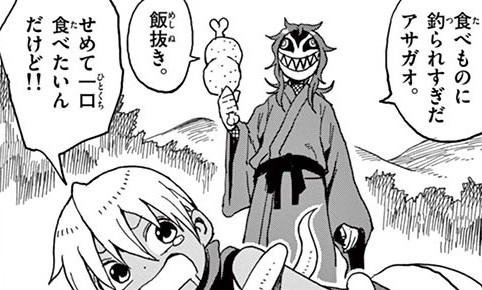
Ms. Hana has canceled lessons for a game of tag. She plays a man chasing the students, to teach them to run from men, and anyone she catches goes without dinner. While the girls hide, a drumstick of meat lies out in the open. Asagao leaps for it, ignoring a warning that it’s an obvious trap, and snakes wrap around her.
- ハナ先生:
- 「食べものに釣られすぎだアサガオ。」
- “You're way too easy to lure with food, Asagao.”
- 「飯抜き。」
- “No dinner for you.”
- アサガオ:
- 「せめて一口食べたいんだけど!!」
- “At least let me have one bite!”
Key Points
- 釣る means “to fish”, and by extension “to lure someone with bait”. Its passive 釣られる means being drawn in by something tempting, the way a fish goes for bait.
- に marks what does the luring: 食べものに釣られる, “to be lured by food”.
- The teacher’s trap really was bait, a drumstick left out in the open.
- すぎ after a verb stem means “too much”. 釣られすぎだ is “you get lured way too easily”. The noun form すぎ with だ makes it a flat verdict.
- 飯抜き is “going without a meal”. It’s the penalty the teacher set for anyone caught: no dinner.
- せめて means “at least”. Asagao has lost dinner, so she pleads for the smallest consolation, one bite of the bait.
- んだけど softens the complaint and leaves it hanging, as if waiting for the teacher to give in.
Vocabulary
| Word | English | Meaning |
|---|---|---|
| 食べもの | Food | 食べもの is anything people eat. It is a mixed spelling of 食べ物. |
| 釣られる | To be lured | 釣られる is to be drawn in by something tempting, such as food, money, or someone else’s mood. It is the passive of 釣る used for people. |
| すぎる | Too much | すぎる follows a verb stem or adjective to mean “too much” or “overly”. On its own, it means to pass by or for time to pass. It is also written 過ぎる. |
| 飯 | Meal | 飯 is a meal or cooked rice. It sounds casual and a little rough compared with ご飯. |
| 抜く | To pull out | 抜く means taking something out of where it was. It also means leaving something out or going without it, as in 飯を抜く, “to skip a meal”. |
| せめて | At least | せめて describes the minimum the speaker hopes for, even if more is not possible. |
| 一口 | One bite | 一口 is one bite or one mouthful of food, or one sip of a drink. It’s the usual amount to ask for when you want a taste of someone else’s food. |
| 食べる | To eat | 食べる is to put food in your mouth, chew, and swallow it. |
See Also
- Kanji: Fishing and baiting with 釣
- Grammar: Too much with 〜すぎる
- Grammar: Receptive verbs with 〜れる
- Grammar: Reasoning with 〜のだ
- Grammar: But with 〜けど and 〜けれど
- Kanji: Eating and food with 食