Too light-weight to overcome friction with 摩擦
Kanji Explanation: Friction and scraping with 擦
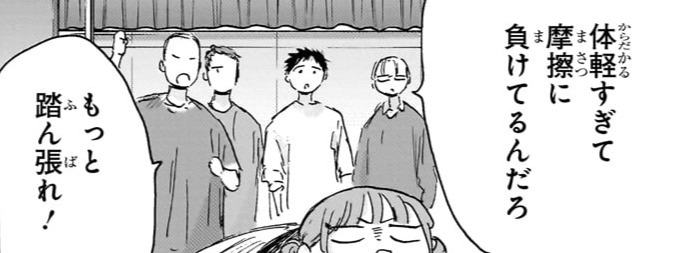
With the end of the school year, the sports clubs turn their attention to cleaning the gym. The boys from the make a race out of wiping the floor. When the girls decide to give it a go, Hina joins in, but she finds herself unable to move forward like the others do. Her attempts to advance only cause her socks to slip, keeping her in place.
- 匡:
- 「体軽すぎて摩擦に負けてるんだろ」
- “I guess she's too light to overcome the friction.”
- 西田:
- 「もっと踏ん張れ!」
- “Dig your feet in harder!”
Key Points
- 摩擦 is physical friction here. Hina tries to push forward, but her socks slip and she stays in place.
- With 負ける, に marks what someone loses to. Kyou describes friction as the opponent she cannot overcome.
- The fuller phrase is 体が軽すぎて. Casual speech leaves out が after 体.
- Drop the final い of 軽い and add すぎる to get 軽すぎる, meaning “too light”. Its て-form connects that excessive lightness to the result, losing to friction.
- 負けてる contracts 負けている by dropping い. It describes her current struggle against the friction.
- んだろ expands to のだろう. The explanatory の connects his comment to Hina’s difficulty, while だろう presents it as his guess.
- 踏ん張る means to plant your feet firmly and exert strength. Nishida tells her to dig in harder so she can move forward.
- 踏ん張れ is the plain imperative of 踏ん張る, with final る changing to れ. It is a forceful shout of encouragement here.
Vocabulary
体 (Body)
体 means the body or physique of a person or animal. It can also refer to physical health or condition.
軽い (Light)
軽い means light in weight. It can also describe something minor, mild, or easy to do.
摩擦 (Friction)
摩擦 means rubbing or friction, the resistance to movement between surfaces in contact. It also describes conflict or strained relations between people or groups.
負ける (To lose)
負ける means to lose or be defeated.
もっと (More)
もっと means more or to a greater degree.
踏ん張る (To brace one's feet)
踏ん張る means to plant one’s feet firmly and exert strength. It also means to stand firm or persist through difficulty.
See Also
- Kanji: Friction and scraping with 擦
- Grammar: Too much with 〜すぎる
- Grammar: Reasoning with 〜のだ
- Grammar: Presuming with 〜だろう and 〜でしょう
- Grammar: Ongoing actions and resulting states with 〜ている
- Grammar: The plain imperative