Too many clothing options with 選択肢
Kanji Explanation: Choosing and selection with 選
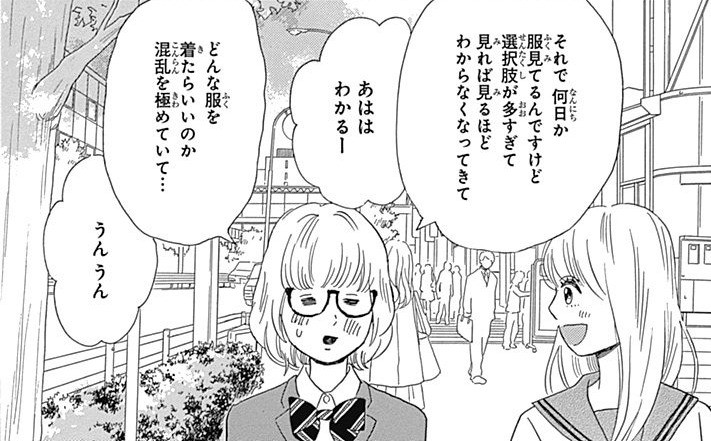
Yukika has invited Sunakawa to go out with her, and he has agreed. She texted Yamato that she was in town shopping for clothes but couldn’t decide, and Yamato came to meet her. Yamato tells her it makes sense to put in the effort when she’s going out with the person she likes.
- ゆきか:
- 「それで何日か服見てるんですけど選択肢が多すぎて見れば見るほどわからなくなってきて」
- “So I've been looking at clothes for a few days, but there are too many options. The more I look, the less sure I am.”
- 大和:
- 「あはは わかるー」
- “Ha ha, I know the feeling.”
- ゆきか:
- 「どんな服を着たらいいのか混乱を極めていて…」
- “I'm completely lost on what I should wear...”
- 大和:
- 「うんうん」
- “Uh-huh.”
Key Points
- 選択肢 is an option, one of the things you can choose. 選択 is choosing, and 肢 means a limb, so each option is like one branch of the decision.
- Yukika uses it for every outfit she might buy. The same word appears on multiple-choice tests for the answer choices.
- 多すぎて is 多い with 〜すぎる, “too many”, in its て-form. The て-form gives the reason for what follows.
- 見れば見るほど is 〜ば〜ほど: “the more I look, the more…”. The result is わからなくなってきて, “I’ve stopped being able to tell”.
- わからない + なる is “come to not know”. Adding 〜てくる shows the change building up over the days she has been shopping.
- The sentence ends on the て-form, trailing off before Yukika finishes her thought.
- どんな服を着たらいいのか is “what kind of clothes I should wear”. 〜たらいい asks what would be best, and のか makes it an embedded question.
- 混乱を極める means confusion has reached its peak. It’s a formal, bookish phrase, and Yukika’s serious delivery about shopping is part of the joke.
Vocabulary
| Word | English | Meaning |
|---|---|---|
| 何日 | How many days | 何日 asks how many days, or which day of the month. 何日か means “a few days” or “several days”. |
| 服 | Clothes | 服 is clothes, especially Western-style clothing. |
| 見る | To see | 見る is to see, look at, or watch something. It also means to check or judge something, or to look after someone, as in 面倒を見る. |
| 多い | Many | 多い describes a large number or amount. |
| すぎる | Too much | すぎる follows a verb stem or adjective to mean “too much” or “overly”. On its own, it means to pass by or for time to pass. It is also written 過ぎる. |
| わかる | To understand | わかる is to understand something, or for something to become known or clear. It is also written 分かる. |
| なる | To become | なる is to change into a different state or become something. It also means something turns out a certain way. It is also written 成る. |
| くる | To come | くる is to move toward the speaker or the place being talked about. After a て-form verb, it shows a change coming about, or going and coming back. It is the kana spelling of 来る. |
| どんな | What kind of | どんな asks what kind of person or thing something is. |
| 着る | To wear | 着る is to put on or wear clothes on the upper body or whole body. |
| いい | Good | いい describes something good, nice, or fine. It can also mean “okay” or “that’s enough”. Its other forms come from よい, as in よくない and よかった. |
| 混乱 | Confusion | 混乱 is things or thoughts being thrown into a mess so that nobody can tell what is what. A person’s head and a whole city can both be in it. |
| 極める | To reach the extreme | 極める is to go as far as something can go, or to master a skill completely. 〜を極める says a state has reached its peak, as in 混乱を極める, “to be in utter confusion”. |
See Also
- Kanji: Choosing and selection with 選
- Grammar: Too much with 〜すぎる
- Grammar: Proportional to with 〜ば〜ほど
- Grammar: Becoming with 〜くなる and 〜になる
- Grammar: Coming and going with 〜てくる and 〜ていく
- Grammar: But with 〜けど and 〜けれど
- Grammar: Ongoing actions and resulting states with 〜ている
- Kanji: Clothing and submission with 服
- Kanji: Seeing and viewpoints with 見