Too many traps with 仕掛ける
Vocabulary Explanation: Words ending in 掛ける
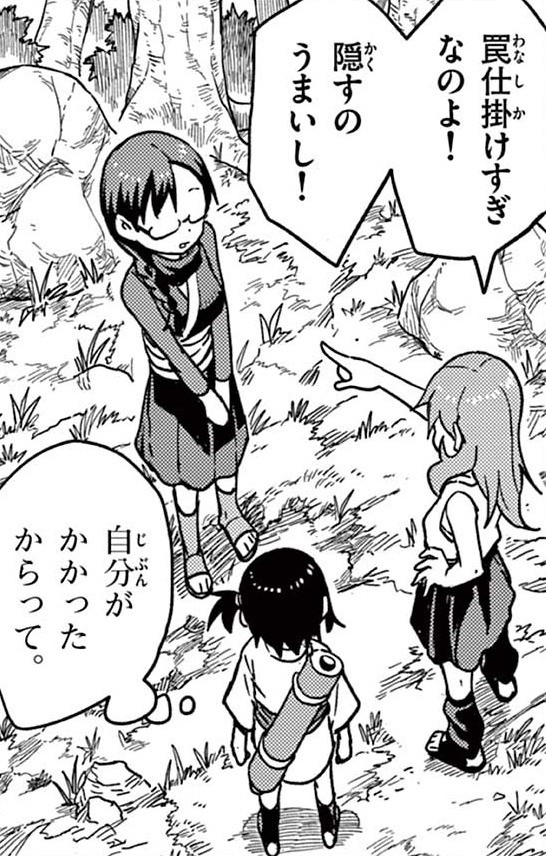
Touwata gets caught in yet another of Mizubashou’s traps and complains that she sets too many. Mizubashou says making traps calms her down. Benisumomo scolds Touwata for not paying attention, but steps into a trap herself in the middle of her lecture. Afterward, she points at Mizubashou and declares traps banned.
- ベニスモモ:
- 「罠仕掛けすぎなのよ!」
- “You set way too many traps!”
- 「隠すのうまいし!」
- “And you're good at hiding them!”
- トウワタ:
- 「自分がかかったからって。」
- “Just because she got caught herself.”
Key Points
- 仕掛ける means to set something up, like a trap or a hidden device. It is a fixed compound, so learn it as its own word.
- Benisumomo drops を in casual speech: 罠仕掛けすぎ comes from 罠を仕掛けすぎる.
- Attaching すぎ to the stem 仕掛け gives “setting too many”. The noun form 仕掛けすぎ takes な before のよ.
- なのよ explains a situation with feeling. It is common in feminine speech.
- の turns 隠す, to hide, into “hiding”. 隠すのがうまい means “good at hiding”, with が dropped.
- し adds one more reason to her complaint.
- からって is a casual form of からといって, “just because”. Touwata’s thought trails off, leaving out something like “she doesn’t need to ban them”.
Vocabulary
罠 (Trap)
罠 is a trap for catching animals or people. It is also used for a trick meant to catch someone out. 罠を仕掛ける means to set a trap.
仕掛ける (To set up)
仕掛ける is to set something up in advance, such as a trap or a hidden device. It can also mean to start something against someone, such as a fight or a tease.
すぎる (Too much)
すぎる follows a verb stem or adjective to mean “too much” or “overly”. On its own, it means to pass by or for time to pass. It is also written 過ぎる.
隠す (To hide)
隠す means to put something where others can’t see or find it, or to keep a fact or feeling secret.
うまい (Good)
うまい describes something done with skill, or food that tastes good. For taste, it is more casual than おいしい.
自分 (Oneself)
自分 is oneself. It refers back to the person doing the action, and some speakers use it to mean “I”.
かかる (To take)
かかる is to require time, money, or effort. It also means to hang on something, or to be caught or covered by something. It is also written 掛かる.
See Also
- Vocabulary: Words ending in 掛ける
- Grammar: Too much with 〜すぎる
- Grammar: Reasoning with 〜のだ
- Grammar: Marking the direct object with を
- Kanji: Dividing and portions with 分