Too much to carry alone with 〜きれない
Grammar Explanation: Unable to finish with 〜きれない (Future entry)
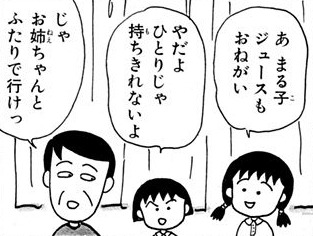
The family is watching a TV drama together. When the commercials come on, Dad tells Maruko to go get him a beer before the show starts again.
- お姉ちゃん:
- 「あ まる子 ジュースもおねがい」
- “Oh, Maruko, get me a juice too.”
- まる子:
- 「やだよ ひとりじゃ持ちきれないよ」
- “No way. I can't carry it all by myself.”
- お父さん:
- 「じゃ お姉ちゃんとふたりで行けっ」
- “Then go together with your sister!”
Key Points
1ひとりじゃ持ちきれない, “I can’t carry it all by myself”
- 持ちきれない is the stem of 持つ, “to carry”, plus 〜きれない. Maruko can carry something. She can’t carry the beer and the juice together.
- ひとりじゃ says why. じゃ is the casual contraction of では, so ひとりでは is “if it’s just me”.
2ジュースも, “juice too”
- も adds the juice to the beer that Dad already asked for. That second drink is what tips the load over Maruko’s limit.
3やだよ, “no way”
- やだ is a casual, childish form of いやだ, “I don’t want to.” よ pushes the refusal at her sister.
4行けっ, a gruff order
- 行け is the plain imperative of 行く. The small っ cuts it off sharply. ふたりで means “the two of you together”.
Vocabulary
ジュース (Juice)
ジュース is juice, or more loosely, any sweet soft drink.
おねがい (Please)
おねがい is a request or a favor you ask of someone. Said on its own, it means “please”. It is also written お願い.
ひとり (One person)
ひとり means one person, or being alone. It is also written 一人.
持つ (To hold)
持つ is to hold or carry something, or to have it.
お姉ちゃん (Big sister)
お姉ちゃん is a familiar word for one’s older sister. People also use it to address a girl or young woman.
ふたり (Two people)
ふたり means two people, or a pair of people together. It is also written 二人.
行く (To go)
行く means to go or move toward a place away from the speaker.
See Also
- Grammar: The plain imperative
- Grammar: How casual contractions work
- Grammar: Marking the topic with は and も
- Grammar: Informing with よ
- Kanji: Going and carrying out with 行
ちびまる子ちゃん © its respective creators. It is used here for educational commentary.