Too scared of raw fish to fillet it with さばく
Vocabulary Explanation: Collocations for cooking
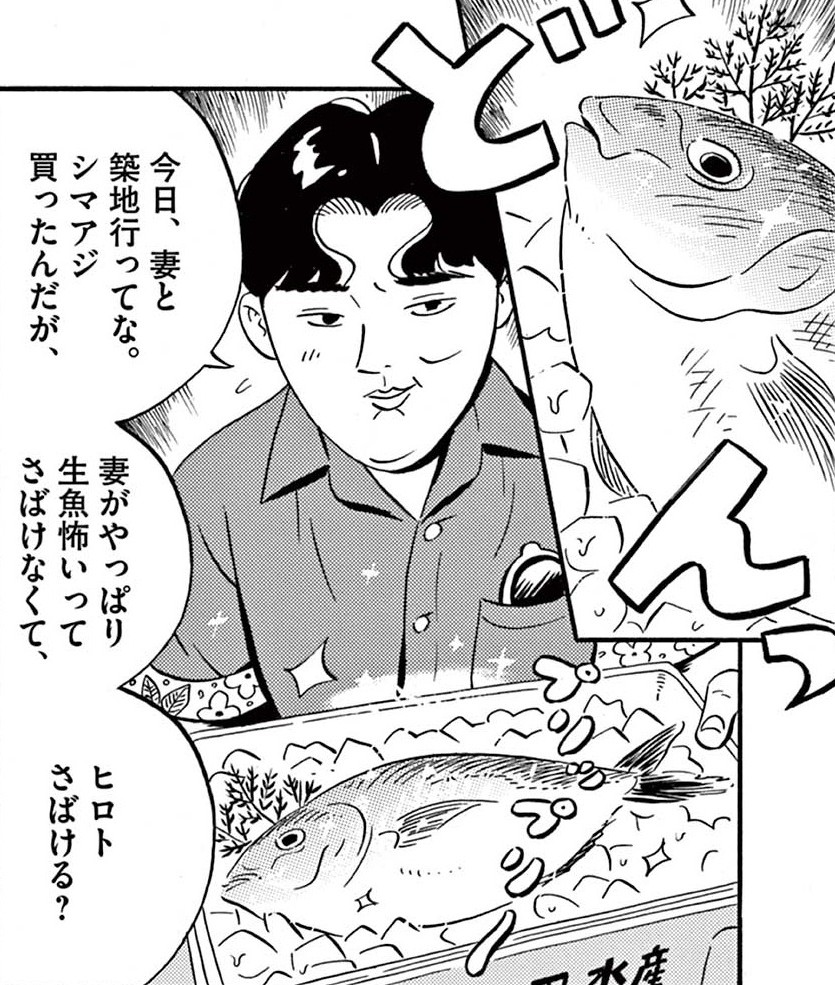
Hiroto and his cousin Natsumi have nothing but rice in the house and can’t decide what to do about lunch. Just then, Hiroto’s friend Hideki pulls up in his car.
- ヒデキ:
- 「今日、妻と築地行ってな。シマアジ買ったんだが、」
- “My wife and I went to Tsukiji today. We bought a striped jack, but...”
- 「妻がやっぱり生魚怖いってさばけなくて、」
- “...my wife says raw fish scares her after all, so she couldn't fillet it.”
- 「ヒロトさばける?」
- “Hiroto, can you fillet it?”
Key Points
- さばく (捌く) means to take a whole fish and clean it: scale it, gut it, and cut it into fillets or sashimi. Hideki’s fish needs all of that before anyone can eat it raw.
- The same verb also means to handle a crowd or a pile of work, but with a fish on ice in front of him, Hideki means the cooking sense.
- さばける is the potential form of さばく: change the final く to け and add る.
- さばけなくて is its negative て-form. It gives the reason Hideki is here, and the request follows in his next line: ヒロトさばける?, “can you do it?”
- って is a casual quotation marker, like と言って. It reports what his wife said: 生魚怖い, “raw fish is scary”.
- やっぱり means “after all”. She went along with buying the fish, but when it came time to prepare it, she backed out.
- んだ gives background, and が means “but”. Hideki explains the situation first and saves the favor for later.
- が does the same job as けど here. It sounds a little blunter and more old-fashioned, which suits Hideki’s clipped speech, as in 築地行ってな.
Vocabulary
今日 (Today)
今日 means today. In formal writing, it can also mean the present day or current era.
築地 (Tsukiji)
築地 is a district in central Tokyo, famous for decades as home to the city’s main fish market. The wholesale market moved to Toyosu in 2018, but Tsukiji’s outer market still sells fresh seafood.
行く (To go)
行く means to go or move toward a place away from the speaker.
シマアジ (Striped jack)
シマアジ is the striped jack, a silvery saltwater fish prized for sashimi. It can also be written 縞鯵.
買う (To buy)
買う is to buy something.
やっぱり (As expected)
やっぱり shows that something turned out as the speaker thought, or that the speaker is coming back to an earlier choice: “after all”.
生魚 (Raw fish)
生魚 is fish that hasn’t been cooked, as in sashimi and sushi. It also covers fresh fish bought whole before anyone prepares it.
怖い (Scary)
怖い describes something that makes you afraid.
さばく (To gut and fillet)
さばく means to clean a whole fish and cut it up for cooking, or to cut up meat the same way. It also means to handle people or work deftly, as when a clerk handles a long line of customers. The kanji spelling is 捌く.
See Also
- Vocabulary: Collocations for cooking
- Grammar: Able to do with 〜れる・〜られる
- Grammar: Quoting and reporting with と and って
- Grammar: Reasoning with 〜のだ
- Grammar: Contrasting with 〜が〜
- Grammar: Connecting actions with 〜て・〜で
- Kanji: Earth and places with 地
- Kanji: Going and carrying out with 行
- Kanji: Now and the present with 今