Too suspicious with 〜すぎる
Grammar Explanation: Too much with 〜すぎる
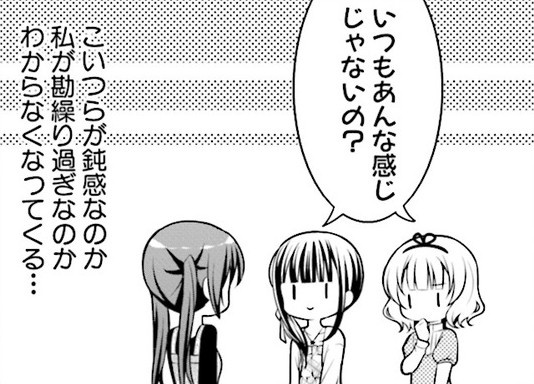
Rize comments on how Chino and Cocoa seems to have gotten over their fight.
- シャロ・千夜:
- 「いつもあんな感じじゃないの?」
- “Aren't they always like that?”
- リゼ:
- 「こいつらが鈍感なのか私が勘繰り過ぎなのかわからなくなってくる…」
- “I can't tell whether these two are oblivious, or if I'm reading into it too much...”
- Literal: “I start not knowing whether these people are insensitive, or whether I am suspecting too much...”
Key Points
- 勘繰る means suspecting hidden motives, and the noun-like stem joins 過ぎ to mark excess.
- Rize cannot tell whether the others are oblivious or she is overthinking things; わからなくなってくる shows her growing uncertainty.
- じゃない is the casual negative of ではない, and final の? asks whether the pair are not always like that.
Vocabulary
| Word | English | Meaning |
|---|---|---|
| いつも | Always | いつも describes what happens all the time, or what is normal for someone. |
| あんな | That kind of | あんな describes something like that thing over there, or like a thing both people know about, often with surprise or disapproval. |
| 感じ | Feeling | 感じ is a feeling or impression. 〜って感じ means “it has a feel of”. |
| こいつら | These guys | こいつら is a casual, rough way to refer to a group of people close to the speaker. |
| 鈍感 | Insensitivity | 鈍感 means insensitive or slow to notice feelings, hints, or subtle changes. |
| 私 | I | 私 means “I” or “me”. It is the standard first-person pronoun in polite speech and is also common in casual speech among women. |
| 勘繰る | To read into | 勘繰る is to suspect a hidden motive behind what someone says or does, often when there is none. |
| 過ぎる | Too much | 過ぎる follows a verb stem or adjective to mean “too much”. On its own, it means to pass by or for time to pass. |
| わかる | To understand | わかる is to understand something, or for something to become known or clear. It is also written 分かる. |
See Also
- Grammar: Too much with 〜すぎる
- Grammar: Negation with 〜ない
- Grammar: How casual contractions work
- Grammar: Coming and going with 〜てくる and 〜ていく
- Kanji: Privacy and self with 私