Trading a vote for help with 選挙
Kanji Explanation: Choosing and selection with 選
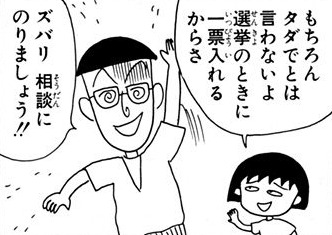
A rumor that Maruko and Hamaji are a couple has spread through the class, and their classmates won’t stop teasing them. They have even passed around a mock newspaper about it. Maruko asks Maruo, the class representative, to save her from the rumor, and he is delighted that she came to him for a favor.
- まる子:
- 「もちろん タダでとは言わないよ 選挙のときに一票入れるからさ」
- “Of course, I'm not asking you to do it for free. I'll give you my vote at election time.”
- 丸尾くん:
- 「ズバリ 相談にのりましょう!!」
- “Precisely! I shall take up your case!!”
Key Points
- 選挙 is an election, here the class vote for class representative. Maruo holds the post, so the next election matters to him.
- 選挙のときに means “at election time”. のとき turns the noun into a point in time, and に places her vote there.
- 票 is a ballot, so 一票 is one vote. 票を入れる, “put in a ballot”, is the everyday way to say you vote for someone.
- タダで is “for free”. とは言わない, “I won’t say”, sets up an offer. Maruko is saying she won’t ask for his help without paying for it.
- The は after the quoting と adds a contrast. She won’t ask for nothing, and the next clause says what she will give.
- から gives the reason he should help, her vote. さ adds a casual, persuasive push, like “so, you know”.
- ズバリ means “precisely” or “right on the mark”. It is Maruo’s catchphrase, and he opens many lines with it.
- 相談にのる is a set phrase for hearing out someone’s problem and helping. Maruo uses the polite volitional のりましょう, “I shall”, which makes him sound like an official accepting a petition.
Vocabulary
| Word | English | Meaning |
|---|---|---|
| もちろん | Of course | もちろん describes something so natural that it goes without saying. |
| タダ | Free | タダ describes something that costs nothing. It is a katakana spelling of ただ. |
| 言う | To say | 言う means to say or tell. It can also mean to call something by a particular name. |
| 選挙 | Election | 選挙 is a vote to fill an office, from the national Diet down to a school’s student council. |
| とき | Time | とき is a point or stretch of time. After a clause, it means “when” or “at a time when”. It is also written 時. |
| 入れる | To put in | 入れる is to put something inside something else. It also means to let someone in, or to make tea or coffee. |
| ズバリ | Precisely | ズバリ means hitting the point exactly. It often opens a blunt statement, like “to put it plainly”, and is also written ずばり. |
| 相談にのる | To give advice | 相談にのる means to hear out someone’s problem and offer advice or help. It is also written 相談に乗る. |
See Also
- Kanji: Choosing and selection with 選
- Grammar: Because with 〜から
- Grammar: Casual emphasis with さ
- Grammar: Quoting and reporting with と and って
- Grammar: Polite style with です and ます
- Kanji: Entering and putting in with 入
- Kanji: Mutuality and appearance with 相