Training for a judo match with 稽古
Vocabulary Explanation: Training with 稽古
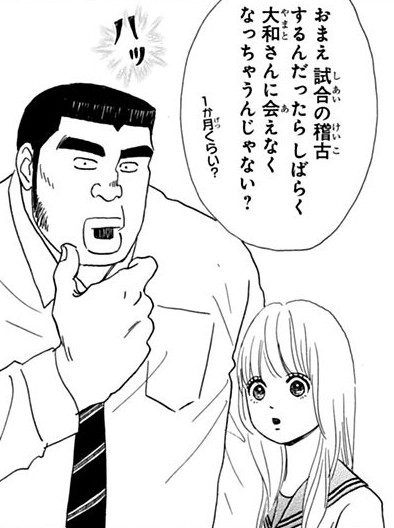
Members of the judo team plea for Takeo to help them in their upcoming match against a rival high school. Takeo quickly accepts their request, but Sunakawa considers how this will impact Takeo’s new relationship with Yamato.
- 砂川:
- 「おまえ試合の稽古するんだったら しばらく大和さんに会えなくなっちゃうんじゃない? 1か月くらい?」
- “When you're training for the match, won't you be unable to see Yamato for a while? For about a month.”
Here, 稽古 is used to describe training for a judo match.
Key Points
1稽古 = “training” (specifically for martial arts / traditional arts)
- 稽古 refers to disciplined, structured training in martial arts and traditional arts.
- Unlike 練習 as general practice, 稽古 emphasizes learning from past techniques and traditional methods.
- Pattern: 試合の稽古をする “to train for a match”.
2Conditional form: ~するんだったら
- ~んだったら is a casual conditional meaning “if you’re going to~” or “when you~”.
- Here: 試合の稽古するんだったら “if you’re going to train for the match”.
3Negative potential + contraction: 会えなくなっちゃう
- 会えなくなっちゃう is a casual contraction of 会えなくなってしまう.
- Pattern: [potential negative form] + なる “to become unable to~”.
- The ちゃう (from てしまう) adds a sense of regret or unfortunate outcome.
4Seeking confirmation: じゃない?
- じゃない? at the end of a sentence seeks confirmation or agreement.
- It’s casual and can be translated as “won’t you?” “don’t you think?” or “right?”
- The speaker (Sunakawa) is prompting Takeo to consider the situation.
- さん is an honorific suffix attached to a person’s name to show respect and social distance, roughly equivalent to “Mr.”, “Ms.”, or “Mrs.” in English, though it’s used far more broadly and doesn’t specify gender or marital status.
Vocabulary
試合 (Match)
試合 means a match or contest in sports, martial arts, or games.
稽古 (Practice)
稽古 means practice or training, especially in martial arts, performing arts, and other traditional disciplines. It can also mean a lesson or training session in one of those arts.
会う (To meet)
会う means to meet or see someone in person.
See Also
- Vocabulary: Training with 稽古
- Grammar: Doing completely or ending up doing with 〜てしまう and 〜ちゃう
- Grammar: If that's the case with なら
- Kanji: Joining and fitting with 合
- Kanji: Oldness and antiquity with 古
- Kanji: Testing and trying with 試
俺物語!! © its respective creators. It is used here for educational commentary.