Trying to draw latte art with 〜てみる
Grammar Explanation: Trying it out with 〜てみる
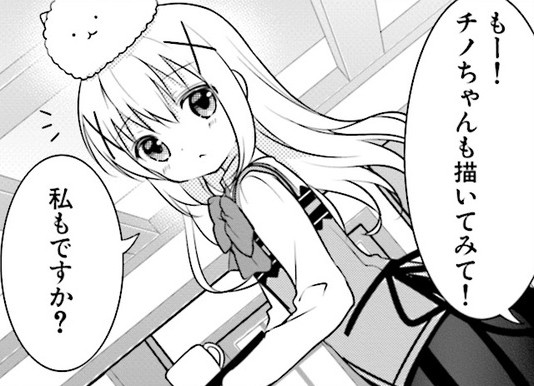
After learning about latte art, Cocoa wants to see what Chino can do.
- ココア:
- 「チノちゃんも描いてみて!」
- “Chino-chan, try drawing one too!”
- Literal: “Chino-chan, you too, try drawing!”
- チノ:
- 「私もですか?」
- “Me too?”
Key Points
1描いてみて asks Chino to try drawing latte art
- 描く takes the て-form before みる, so Cocoa invites Chino to attempt it and see how it goes.
2て makes a request
- 描いてみて ends on the て-form of みる. Cocoa leaves ください unsaid, so the line works as the casual request “try drawing one”.
- ちゃん is an affectionate, informal suffix attached to names, used mainly for children, close friends, and family members.
Vocabulary
| Word | English | Meaning |
|---|---|---|
| 描く | To draw | 描く is to draw or paint a picture. Read えがく, it also means to picture something in the mind. |
| みる | To see | みる is the kana spelling of 見る, “to see”. After a て-form verb, it means to try doing something to see how it goes. |
| 私 | I | 私 means “I” or “me”. It is the standard first-person pronoun in polite speech and is also common in casual speech among women. |
See Also
- Grammar: Trying it out with 〜てみる
- Grammar: Marking the topic with は and も
- Grammar: Connecting actions with 〜て・〜で
- Kanji: Privacy and self with 私
ご注文はうさぎですか? © its respective creators. It is used here for educational commentary.