Understanding my resolve as a man with 理解
Kanji Explanation: Separating and understanding with 解
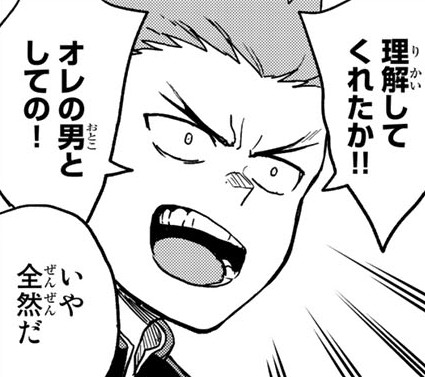
Sakurako tells Takeru not to go to the shogi club as he’ll get in the way of Ayumu being with Urushi. However, as a new member of shogi club, and as a man, Takeru feels it’s his duty to show up. On his way to the shogi club room, he encounters Ayumu who implores him to come to the shogi club room.
- タケル:
- 「理解してくれたか!!」
- “You understood me, huh?”
- Literal: “You understood for me, huh!!”
- 「オレの男としての!」
- “As a man, my (duty)!”
- Literal: “My, as a man...!”
- 歩:
- 「いや全然だ」
- “No, not at all.”
Key Points
- 理解する means to understand something by grasping its meaning or reasoning.
- Takeru thinks Ayumu has understood his motivation for going to the shogi club.
- 〜てくれる presents someone else’s action as beneficial to the speaker.
- Takeru hears Ayumu’s invitation as support for his self-important resolve.
- The phrase means “my … as a man”, with something like duty, resolve, or pride left unsaid.
- The fragmentary follow-up makes Takeru sound dramatic.
- Ayumu’s reply means “no, not at all”.
Vocabulary
| Word | English | Meaning |
|---|---|---|
| 理解 | Understanding | 理解 means understanding the meaning or logic of something. It can also mean appreciating another person’s feelings or circumstances. |
| オレ | I | オレ is a katakana spelling of おれ, a casual, masculine word for “I”. It is also written 俺. |
| 男 | Man | 男 is a man or boy. |
| とする | As | とする appears in として, “as” or “in the role of”. It also appears in 〜とする, “to assume” or “to decide on”. |
| いや | false | いや is used to deny something or to hesitate, like “no” or “well…”. It also describes something unpleasant or unwanted, often written 嫌. |
| 全然 | Not at all | 全然 means not at all when used with a negative expression. In casual modern speech, it can also strengthen an affirmative statement to mean completely or entirely. |
See Also
- Kanji: Separating and understanding with 解
- Grammar: Past tense with 〜た・〜だ
- Grammar: Receiving kindness with 〜てくれる
- Grammar: The copula だ
- Grammar: Not at all with 全然〜ない
- Kanji: Wholeness and completion with 全