Unluckily winning a tour with 当選
Kanji Explanation: Choosing and selection with 選
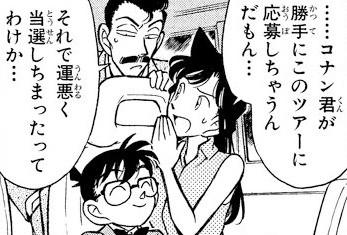
Kogoro, Ran, and Conan are riding to a pension with a group of Sherlock Holmes fans on a tour for Holmes enthusiasts. Kogoro, who has no interest in Holmes, grumbles that he can’t see why he has to take part. Ran starts to explain, but Conan cuts in to tell the other fans that his favorite story is “The Sign of the Four”.
- 蘭:
- 「…コナン君が勝手にこのツアーに応募しちゃうんだもん…」
- “...Conan went and entered us in this tour without asking...”
- 小五郎:
- 「それで運悪く当選しちまったってわけか…」
- “And then we had the bad luck to win, huh...”
Key Points
- 当選 combines 当, to hit the mark, with 選, selection. The selection lands on your entry.
- After an 応募, or entry, 当選 means winning a prize draw or being picked from the applicants.
- The same word also means winning an election. Context tells you which. Here the word 応募 points to a prize draw.
- 運悪く is the adverb form of 運が悪い, “unlucky”. It colors the whole sentence.
- Most people call a win lucky. Pairing 運悪く with 当選 shows how little Kogoro wanted to come.
- しちゃう and しちまった are both contractions of してしまう, which marks something regrettable or done without thinking.
- Ran’s ちゃう is the usual casual form. Kogoro’s ちまう is rougher and more masculine.
- Ran’s んだもん gives a reason with a complaining tone, “it’s because Conan went and did it”.
- Kogoro’s ってわけか is a casual というわけか, “so that’s how it is”. He sums up how they ended up here.
Vocabulary
| Word | English | Meaning |
|---|---|---|
| 君 | You | 君 is a word for “you” used toward equals or people younger or of lower standing. It sounds gentle or poetic. Read くん, it is a suffix on names. |
| 勝手に | Without permission | 勝手に describes doing something on one’s own, without asking or being asked. |
| この | This | この means “this” or “these” and comes directly before a noun. It points to something near the speaker or something the speaker is referring to in the conversation. |
| ツアー | Tour | ツアー is a tour, such as a planned trip for a group of travelers or a series of concerts in different cities. |
| 応募 | Application | 応募 is sending in an entry in answer to a call, for a job, a contest, or a prize draw. Aspiring manga artists do it for newcomer awards. |
| もん | Because | もん ends a sentence to give a reason, often in a childish or pouting tone. It is a casual form of もの. |
| 運悪く | Unluckily | 運悪く means unluckily or as bad luck would have it. It is the adverb form of 運が悪い. |
| 当選 | Election victory | 当選 is winning an election, or being picked as a winner in a lottery or prize drawing. |
| わけ | Reason | わけ is a reason or meaning. It also appears in grammar patterns such as わけがない, “there’s no way”, and わけにはいかない, “can’t very well”. |
See Also
- Kanji: Choosing and selection with 選
- Grammar: Doing completely or ending up doing with 〜てしまう and 〜ちゃう
- Grammar: Casual reasons with 〜もん
- Grammar: Logical conclusion with 〜わけだ
- Kanji: Hands and skill with 手
- Kanji: Matching and appropriateness with 当