Visiting at every break with 〜ごとに
Grammar Explanation: Every 〜 with 〜ごとに
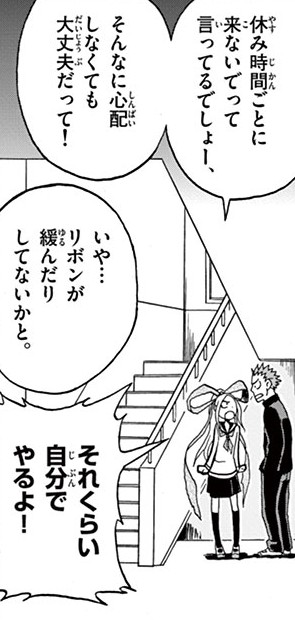
Due to concern about his sister’s ribbon, which seals away her need to attack people for their blood, Kenji takes every opportunity he can to check up on her at school.
- キョーコ:
- 「休み時間ごとに来ないでって言ってるでしょー、そんなに心配しなくても大丈夫だって!」
- “I'm telling you, you don't need to check up on me every break period. I'll be fine even without you worrying about me!”
- Literal: “I told you not to come every break period, right? I'm saying I'll be okay even if you don't worry that much!”
- ケンジ:
- 「いや… リボンが緩んだりしてないかと。」
- “No, I'm just checking whether your ribbon's come loose.”
- キョーコ:
- 「それくらい自分でやるよ!」
- “I can handle that much on my own!”
Key Points
- Noun + ごとに means “every [noun interval]”, so 休み時間ごとに means “every break period”.
- 「来ないで」 means “don’t come”, and って言ってる means “(I) keep saying”.
- The stretched でしょー sounds conversational and annoyed, which fits Kyoko’s exasperated “I keep telling you…”
- 「そんなに心配しなくても大丈夫だって!」 pushes back against his overprotectiveness: “I’ll be fine even if you don’t worry that much.”
- 「リボンが緩んだりしてないかと」 means “whether the ribbon has come loose or something like that”.
- The たり in 緩んだりしてない treats a loose ribbon as one example of what could go wrong.
Vocabulary
| Word | English | Meaning |
|---|---|---|
| 休み時間 | Break time | 休み時間 is a short break in the day’s schedule, most often the recess between classes at school. |
| 来る | To come | 来る means to come or move toward the speaker or the place being discussed. |
| 言う | To say | 言う means to say or tell. It can also mean to call something by a particular name. |
| そんなに | That much | そんなに describes a degree like the one just mentioned. With a negative, it means “not that much”. |
| 心配 | Worry | 心配 means worry, concern, or anxiety about what might go wrong. With する, it means “to worry”. |
| 大丈夫 | All right | 大丈夫 describes being all right, with nothing to worry about. People use it to reassure others, or to politely say “no thanks”. |
| いや | false | いや is used to deny something or to hesitate, like “no” or “well…”. It also describes something unpleasant or unwanted, often written 嫌. |
| リボン | Ribbon | リボン is a ribbon, often worn as a bow. |
| 緩む | To loosen | 緩む is for something tight to become loose. |
| する | To do | する is to do or perform something. It also turns many nouns into verbs, as in 勉強する. |
| それ | That | それ points to something near the listener, or to something just mentioned. |
| やる | To do | やる is a casual word for “to do”. It also means to give something to someone of lower standing, or to animals and plants. |
See Also
- Grammar: Every 〜 with 〜ごとに
- Grammar: Marking the subject with が
- Grammar: Ongoing actions and resulting states with 〜ている
- Grammar: Permission to do with 〜てもいい
- Grammar: Quoting and reporting with と and って
- Grammar: Negation with 〜ない
- Grammar: Presuming with 〜だろう and 〜でしょう
- Grammar: Listing example actions with 〜たり〜たりする
- Grammar: Without doing and please don't with 〜ないで
- Kanji: Distribution and arrangement with 配
- Kanji: Spaces and intervals with 間
- Kanji: Time and occasions with 時