Visiting on the last day of summer with 押しかける
Vocabulary Explanation: Words ending in 掛ける
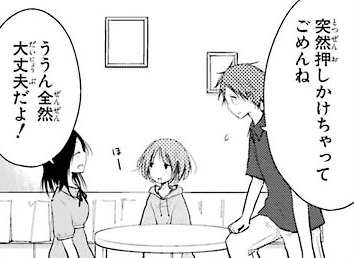
On the last day of summer vacation, Hase, Kiryu, and Saki visit Fujimiya’s house. Fujimiya greets them at the door with a smile and invites them inside.
- 長谷:
- 「突然押しかけちゃってごめんね」
- “Sorry for barging in on you out of the blue.”
- 藤宮:
- 「ううん 全然大丈夫だよ!」
- “No, it's totally fine!”
Key Points
- 押す means to push. 押しかける means to push your way into someone’s place: to show up uninvited, or for a crowd to flock somewhere.
- Fujimiya greeted them with お待ちしてました, so she was expecting them. 突然押しかけてごめん works here as a polite apology for imposing on her.
- 押しかけちゃって is the casual form of 押しかけてしまって. 〜てしまう adds a feeling of regret.
- The て-form before ごめんね gives the reason for the apology: “sorry for barging in”.
- 全然 usually comes with a negative, but in casual speech it also strengthens positive words. 全然大丈夫 means “totally fine”.
- ううん is a casual “no”, here waving off the apology.
Vocabulary
押しかける (To barge in)
押しかける is to show up at someone’s place uninvited or without warning. It can also mean for a crowd to flock to a place. 突然押しかけてすみません is a common apology for an unexpected visit.
ごめん (Sorry)
ごめん is a casual “sorry”, used with friends and family. ごめんね sounds softer, and ごめんなさい is a little more polite.
全然 (Not at all)
全然 means not at all when used with a negative expression. In casual modern speech, it can also strengthen an affirmative statement to mean completely or entirely.
大丈夫 (All right)
大丈夫 describes being all right, with nothing to worry about. People use it to reassure others, or to politely say “no thanks”.
See Also
- Vocabulary: Words ending in 掛ける
- Grammar: Doing completely or ending up doing with 〜てしまう and 〜ちゃう
- Grammar: Connecting actions with 〜て・〜で
- Kanji: Wholeness and completion with 全