Visiting teahouses with お茶屋さん
Kanji Explanation: Tea and tea culture with 茶
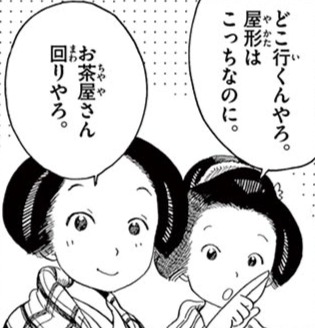
A couple of maiko see Momohana leave a shop and head in the other direction.
- まいこ1:
- 「どこ行くんやろ。屋形はこっちなのに。」
- “I wonder where she's going. The lodge is this way, though.”
- まいこ2:
- 「お茶屋さん回りやろ。」
- “She's probably doing the teahouse rounds.”
Key Points
1お茶屋さん means “teahouse” in Kyoto’s geisha districts
- Here an お茶屋 is an establishment that arranges banquets with maiko and geiko, not an ordinary tea shop or café.
- The honorific さん refers politely to the establishment. It does not mean that the speaker is talking about the shopkeeper.
2お茶屋さん回り means “making the teahouse rounds”
- Adding 回り to a place or group can describe going around to several of them.
- This is a compact noun version of お茶屋さんを回る.
3行くんやろ expresses a wondering guess
- Casual どこ行く leaves out the destination particle に or へ. The fuller wording would be どこに行く.
- 行くんやろ corresponds to standard 行くんだろう. The contracted explanatory ん frames her destination as the question, and Kyoto-area やろ marks it as a guess: “I wonder where she’s going.”
4お茶屋さん回りやろ gives a likely explanation
- Here やろ corresponds to だろう after a noun. The second maiko is not asking where Momohana is going. She is offering her best guess, “She’s probably doing the teahouse rounds.”
5屋形はこっちなのに marks a mismatch
- こっちなのに is こっちだ plus のに: “even though the lodge is this way.” Momohana is walking away from where the first maiko expected her to go.
Vocabulary
行く (To go)
行く means to go or move toward a place away from the speaker.
茶屋 (Teahouse)
茶屋 means a teahouse, tea shop, or tea dealer. In Kyoto’s geisha districts, it refers to an establishment that arranges banquets with maiko and geiko.
See Also
- Kanji: Tea and tea culture with 茶
- Grammar: Grammar in the Kansai dialect
- Grammar: Presuming with 〜だろう and 〜でしょう
- Grammar: Reasoning with 〜のだ
- Future entry: Even though with 〜のに
- Kanji: Shelter and shops with 屋
舞妓さんちのまかないさん © its respective creators. It is used here for educational commentary.