Waiting in a safe town with というわけで
Grammar Explanation: Logical conclusion with 〜わけだ
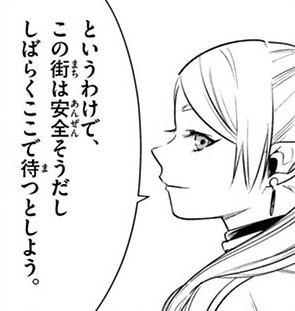
Frieren, Fern, and Stark reach the fortress city of Vaar on their way north. The guard captain tells them the northern checkpoint is closed because monsters are active, and since he took his post, he hasn’t let a single monster or person through. He warns them not to cause trouble in town. Fern finds him unfriendly, but Frieren calls him an excellent guard, since a guard who protects a town should be strict with outsiders.
- フリーレン:
- 「というわけで、この街は安全そうだし、しばらくここで待つとしよう。」
- “So, this town seems safe, so let's wait here for a while.”
Key Points
- というわけで starts a sentence by pointing back to what was just said: “that being the case”. The sentence after it states what follows.
- わけ is a reason or the sense of things, and で is the て-form of だ. Literally it’s “with things being as described”.
- Here it gathers up the whole scene, the closed checkpoint and the strict guard, and turns it into a plan.
- 安全そう is the な-adjective 安全 plus そう: “looks safe”. Frieren hasn’t tested the town. She’s judging from how its guard behaves.
- し gives a reason while implying there are others. The town being safe is one reason to wait. The closed checkpoint, which leaves them nowhere to go, is another.
- Dictionary form + とする means to settle on doing something. The volitional としよう announces the decision: “let’s go with waiting” or “I guess we’ll wait”.
- It sounds more matter-of-fact than plain 待とう. Frieren isn’t eager to wait. She’s accepting what the situation allows.
- しばらく is “for a while”. The wait has no set end, since no one knows when the checkpoint will open.
Vocabulary
わけ (Reason)
わけ is a reason or meaning. It also appears in grammar patterns such as わけがない, “there’s no way”, and わけにはいかない, “can’t very well”.
この (This)
この means “this” or “these” and comes directly before a noun. It points to something near the speaker or something the speaker is referring to in the conversation.
街 (Town)
街 is a town or city, especially the streets of a busy area.
安全 (Safety)
安全 means safety or freedom from danger, harm, or loss.
そう (So)
そう means “like that” or “that way”. Said alone, it agrees: “right”. After a verb stem or adjective, it means something looks or seems a certain way.
しばらく (For a while)
しばらく describes a stretch of time, short or long. It also greets someone you have not seen in a long time.
ここ (Here)
ここ is the place where the speaker is.
待つ (To wait)
待つ is to stay until someone comes or something happens.
する (To do)
する is to do or perform something. It also turns many nouns into verbs, as in 勉強する.
See Also
- Grammar: Logical conclusion with 〜わけだ
- Grammar: Looking like with 〜そうだ
- Grammar: Volitional with 〜う・〜よう
- Kanji: Peace and ease with 安
- Kanji: Wholeness and completion with 全