Walking Kiyo to the bus stop with バス停
Kanji Explanation: Stopping and halting with 停 (Future entry)
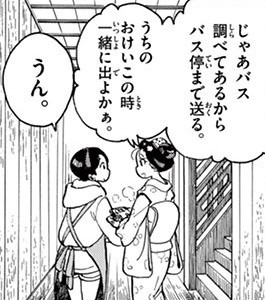
Sumire has heard of a Kyoto shrine that brings luck in ball sports, and their friend Kenta has a big baseball tournament coming up. The game is before Sumire’s day off, so Kiyo offers to go and pray today, and Sumire asks her to bring back a good-luck charm too.
- すみれ:
- 「じゃあバス調べてあるからバス停まで送る。」
- “Then I've already looked up the bus, so I'll walk you to the bus stop.”
- 「うちのおけいこの時一緒に出よかぁ。」
- “Let's head out together when I go to my lesson.”
- キヨ:
- 「うん。」
- “Okay.”
Key Points
- バス停 is short for バス停留所, a bus stop. 停留所 is a place where buses or streetcars stop to let passengers on and off. The short form keeps just 停, the “stop” part.
- 停 means “stop” or “bring to a halt”, and てい is its only official reading. You’ll see it in 停車, “a vehicle stopping”, 停止, “a halt”, and 停電, “a power outage”. Each one names what stops: the vehicle, the motion, or the electricity.
- Manga sometimes borrow 停 for the verb とまる too, writing バスが停まる for “the bus stops”. That spelling is unofficial, and formal writing uses 止まる.
- 〜てある after a verb like 調べる says something was done ahead of time and is still ready to use. Sumire looked up the bus earlier, so she already knows which one Kiyo should take.
- Standard Japanese would usually say バスを調べてある, or バスが調べてある. In casual speech the particle drops out.
- 送る is “send”, but with a person it means going along with them to see them off. 〜まで marks how far: バス停まで送る is “walk you to the bus stop”.
- 出よか is the volitional 出よう, “let’s go out”, shortened to 出よ, plus the question marker か. It works like standard 出ようか, “shall we head out?” The long かぁ makes it a soft suggestion.
- うち is “I” or “my” in Kyoto speech, so うちのおけいこの時 is “when I have my lesson”. おけいこ is lessons in an art, here Sumire’s maiko training in dance and music.
Vocabulary
| Word | English | Meaning |
|---|---|---|
| バス | Bus | バス is a bus. |
| 調べる | To look up | 調べる is to look into something to find out about it, such as looking up a word, checking a bus timetable, or investigating a case. |
| ある | To exist | ある is to exist or be in a place, for things and plants rather than people or animals. It also means to have something, or for an event to take place. |
| バス停 | Bus stop | バス停 is a bus stop, the place on a route where buses stop to let passengers on and off. It’s short for バス停留所. |
| 送る | To send | 送る is to send something, such as a letter or a message. With a person, it means going along to see them off, as in 駅まで送る, “walk someone to the station”. It also means spending time, as in 毎日を送る. |
| うち | I | うち can mean “I” or “me”, especially in Kansai speech and in casual speech among women. It also has other meanings, including “home” and “inside”. |
| おけいこ | Lesson | おけいこ is a lesson or practice in an art or skill, such as dance, music, or tea ceremony. It’s お稽古 written in kana, and the お makes it sound softer. |
| 時 | Time | 時 is a point or stretch of time. 〜時 means “when” or “at the time of”. |
| 一緒に | Together | 一緒に describes doing something with someone else, at the same time or in the same place. |
| 出る | To go out | 出る means to go out or leave. It is also used when something appears or is produced. |
See Also
- Grammar: Volitional with 〜う・〜よう
- Grammar: Doing in advance with 〜ておく
- Kanji: Going out and emerging with 出
- Kanji: Sending and escorting with 送
- Kanji: Time and occasions with 時