Want you always by my side with 〜てほしい
Grammar Explanation: Want you to do something with 〜てほしい
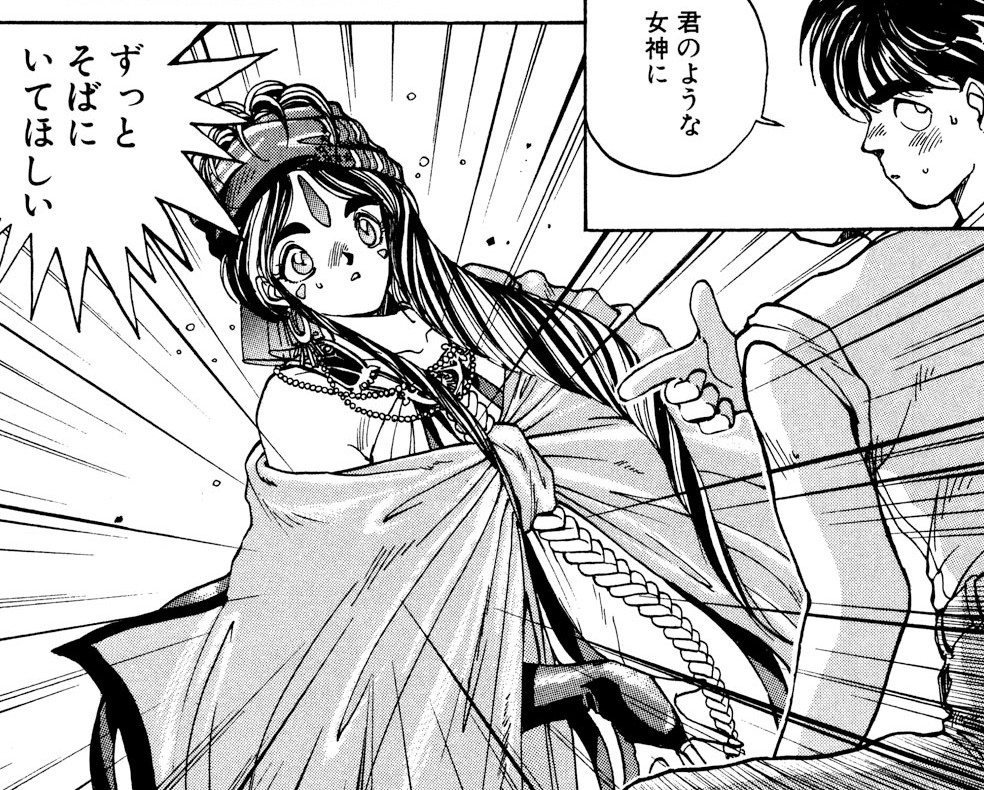
After accidentally dialing the Goddess Technical Help Line, Kei’ichi finds himself face-to-face with a Goddess offering him a wish. After a brief conversation, Kei-ichi flippantly makes a wish.
- 螢一:
- 「君のような女神にずっとそばにいてほしい」
- “I want a Goddess like you to always be by my side.”
- Literal: “I want a goddess like you to be by my side forever.”
Key Points
- いてほしい comes from いる and means “I want you to be”.
- 君のような女神 means “a goddess like you”.
- The に marks the person he wants to be with him.
Vocabulary
| Word | English | Meaning |
|---|---|---|
| 君 | You | 君 is a word for “you” used toward equals or people younger or of lower standing. It sounds gentle or poetic. Read くん, it is a suffix on names. |
| ような | Like | ような follows a word to compare something to it: “like” or “such as”. At the end of a sentence, it shows the speaker’s impression. |
| 女神 | Goddess | 女神 means a goddess. Figuratively, it can describe an admired or exceptionally beautiful woman. |
| ずっと | All along | ずっと describes something continuing the whole time, or lasting a long time. Before a comparison, it means “by far”. |
| そば | Beside | そば is the space near someone or something. It is also written 側. A different word, also そば, is buckwheat noodles. |
| いる | To be | いる is to exist or be somewhere, for people and animals. After a て-form verb, it shows an ongoing action or a continuing state. |
| ほしい | Want | ほしい describes wanting something. After a て-form verb, it means wanting someone else to do something. It is also written 欲しい. |
See Also
- Grammar: Want you to do something with 〜てほしい
- Grammar: Compound voicing with 連濁
- Grammar: Giving an example with 〜ようだ
- Kanji: Women and femininity with 女