Wanting an alluring older woman with 〜っぽい
Grammar Explanation: Kind of like with 〜っぽい
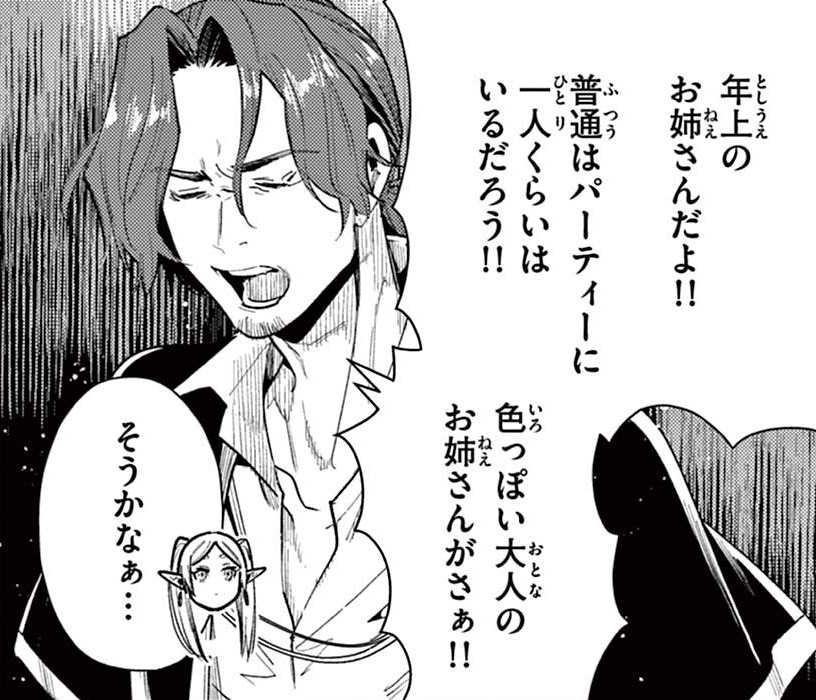
While the party walks through the hills of the northern lands, Sein says the party is missing something and asks the others what it is. Fern suggests a thief, since Frieren keeps falling for mimics, but Sein says what they lack is far more important.
- ザイン:
- 「年上のお姉さんだよ!!」
- “An older woman, that's what!!”
- 「普通はパーティーに一人くらいはいるだろう!!」
- “Normally every party's got at least one!!”
- 「色っぽい大人のお姉さんがさぁ!!」
- “A sexy grown-up woman, y'know!!”
- フリーレン:
- 「そうかなぁ…」
- “I wonder about that...”
Key Points
- 色 usually means “color”, but it can also mean romance or sex appeal. 色っぽい is “sexy” or “alluring”. It’s mostly said of women.
- It’s a fixed word, not “colorful” or “kind of like a color”. For a color tint, Japanese uses a color name plus っぽい, as in 青っぽい, “bluish”.
- Like any い-adjective, it goes straight before the noun: 色っぽい大人のお姉さん.
- お姉さん is “older sister”, but it’s also used for any young woman a little older than the speaker. Sein means an older-sister type, not a relative.
- 年上 is “older”, and 大人の is “grown-up”. Sein stacks both on お姉さん so nobody misses his point.
- だよ gives the answer to his own question with force: “it’s an older woman!”
- だろう with a rising tone presses for agreement: “there’s normally at least one, right?” 一人くらいは is “at least one”.
- The last line names who should be in the party. It’s the subject of いる, tacked on after the sentence has ended. さぁ, a stretched-out さ, gives it a whiny, pleading emphasis.
- そうかなぁ is “I wonder about that.” かな wonders aloud, and the stretched-out ぁ makes Frieren sound unconvinced.
Vocabulary
年上 (Older)
年上 describes someone older than another person. As a noun, it means an older person or senior.
お姉さん (Big sister)
お姉さん is a polite word for one’s older sister. People also use it to address or refer to a young woman.
パーティー (Party)
パーティー is a party, a social gathering.
一人 (One person)
一人 means one person or being alone. It can function as a counter expression or describe doing something by oneself.
くらい (About)
くらい after a number or amount means “about” or “around”. With は, as in 一人くらいは, it means “at least”. It is also pronounced ぐらい.
いる (To be)
いる is to exist or be somewhere, for people and animals. After a て-form verb, it shows an ongoing action or a continuing state.
色っぽい (Sexy)
色っぽい describes someone, usually a woman, who is sexy or alluring.
色 (Color)
色 is color. It can also mean a look or expression, as in a face’s color, or romance and sex appeal.
っぽい (-ish)
っぽい follows a word to say something seems like it or tends toward it.
そう (So)
そう means “like that” or “that way”. Said alone, it agrees: “right”. After a verb stem or adjective, it means something looks or seems a certain way.
See Also
- Grammar: Kind of like with 〜っぽい
- Grammar: Casual emphasis with さ
- Grammar: Presuming with 〜だろう and 〜でしょう
- Grammar: Informing with よ
- Grammar: Wondering with かな
- Kanji: People and persons with 人