Wanting to try eating bread with 〜たい
Grammar Explanation: Wanting to do with 〜たい
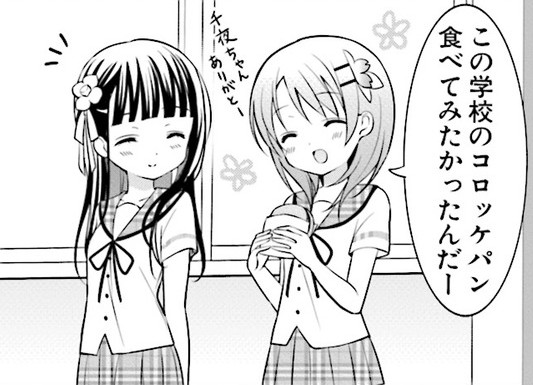
At lunch, Cocoa was showing Chiya the boxed lunch she’d made herself when Chiya’s rabbit Anko, dropped by a crow, landed in it. Now Cocoa has a croquette bun from the school instead.
- ココア:
- 「この学校のコロッケパン食べてみたかったんだー」
- “I've wanted to try this school's croquette bun!”
- 「千夜ちゃんありがとー」
- “Thanks, Chiya!”
Key Points
- 食べてみる means trying the bread, and たい makes that attempt desired. たかった places the desire before this moment.
- コロッケパン is a bread roll with a croquette inside, a common item at Japanese school stores. Cocoa had wanted to taste this school’s version for herself, so “try eating” points to first-hand experience.
- Cocoa presents the earlier desire as the reason she’s happy with the croquette bun, even though she lost her own lunch.
- ありがとー is a casual ありがとう, with the final sound stretched. Cocoa calls Chiya by name with ちゃん and thanks her directly.
Vocabulary
| Word | English | Meaning |
|---|---|---|
| この | This | この means “this” or “these” and comes directly before a noun. It points to something near the speaker or something the speaker is referring to in the conversation. |
| 学校 | School | 学校 means a school, where teachers provide organized instruction to students. |
| コロッケ | Croquette | コロッケ is a croquette, a deep-fried patty of mashed potato or meat coated in breadcrumbs. |
| パン | Bread | パン is bread, including rolls and pastries. |
| 食べる | To eat | 食べる is to put food in your mouth, chew, and swallow it. |
| みる | To see | みる is the kana spelling of 見る, “to see”. After a て-form verb, it means to try doing something to see how it goes. |
See Also
- Grammar: Wanting to do with 〜たい
- Grammar: Past tense with 〜た・〜だ
- Kanji: Eating and food with 食
- Kanji: Learning and schooling with 学
- Kanji: Schools and checking with 校