Warming a stuck jar lid with お湯がわく
Vocabulary Explanation: Collocations for cooking
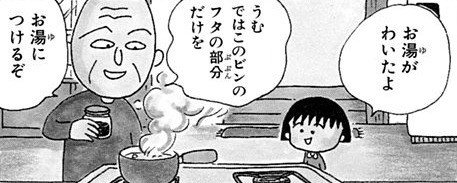
Mrs. Takamaru brings the family a jar of black beans, and Maruko and Grandpa want to eat some right away. Mom, Maruko, and Grandpa can’t budge the lid, and Grandma fails even with rubber gloves. When Mom tells Maruko to wait for Dad to get home, Grandpa gets the idea of warming the lid, and the two of them head to the kitchen and put a pot of water on the stove.
- まる子:
- 「お湯がわいたよ」
- “The water's boiling!”
- Literal: “The hot water has boiled.”
- おじいちゃん:
- 「うむ、ではこのビンのフタの部分だけをお湯につけるぞ」
- “Right. Now, I'll dip just the lid of this jar in the hot water.”
Key Points
- わく (沸く) means a liquid comes to a boil. Japanese names the result, so the thing that boils is お湯, “hot water”, not 水.
- わく is intransitive. The water is the subject and takes が. Its transitive partner is わかす (沸かす): お湯をわかす, “to boil water”, with someone doing the heating.
- The past tense わいた reports a change that has just happened. English says “the water’s boiling” or “the water’s boiled” for the same moment. This is the usual thing to call out when the kettle or pot is ready.
- The series writes 沸く in kana, as children’s manga often do with less common kanji.
- つける (漬ける) means to dip or soak something in a liquid. に marks the liquid it goes into.
- Grandpa’s plan is to warm the metal lid so it loosens, so he only wants the lid in the water.
- だけ limits the action to one thing. Only the lid goes in the water, not the whole jar of beans.
- 部分 means part or section. フタの部分 is “the lid part” of the jar.
- うむ is an older man’s “yes” or “right”. It acknowledges what Maruko said.
- では means “well then” or “now”, moving on to the next step.
- ぞ at the end announces his action with a firm, masculine tone, as if starting a demonstration.
Vocabulary
お湯 (Hot water)
お湯 is heated water. At a hot spring or bath, it also means the bath water itself.
わく (To boil)
わく means a liquid heats up until it boils, as in お湯がわいた, “the water’s boiling”. It also describes a bath getting hot, and a crowd or feeling stirring up. It is also written 沸く.
この (This)
この means “this” or “these” and comes directly before a noun. It points to something near the speaker or something the speaker is referring to in the conversation.
ビン (Bottle)
ビン is a glass bottle or jar, such as a jar of jam or a milk bottle. It is also written 瓶.
フタ (Lid)
フタ is a lid or cap that closes the top of a container, such as a pot, jar, or box. It is also written 蓋.
部分 (Part)
部分 is one piece or section of a larger whole. Its opposite is 全体, the whole.
つける (To attach)
つける is to put something on or attach it to something else, such as accessories or a name. It is also written 付ける.
See Also
- Vocabulary: Collocations for cooking
- Future entry: Transitivity in Japanese
- Grammar: Past tense with 〜た・〜だ
- Grammar: Limiting with 〜だけ
- Grammar: Rough declarations with ぞ and ぜ
- Kanji: Dividing and portions with 分
- Kanji: Sections and departments with 部