Washing rice for the new cooker with 米を洗う
Vocabulary Explanation: Collocations for cooking
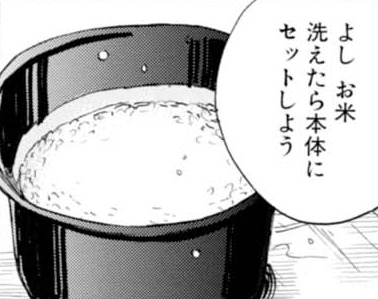
Machi has always cooked rice over a wood fire, so Natsu brings her a new pressure IH rice cooker. Wary of electrical appliances, Machi has taken the inner pot out of the cooker.
- ナツ:
- 「よし お米洗えたら本体にセットしよう」
- “Okay, once the rice is washed, let's put it in the cooker.”
- Literal: “Okay, if you've managed to wash the rice, let's set it in the main unit.”
Key Points
1お米を洗う = to wash rice
- Before cooking, Japanese rice is rinsed in water to remove the starch on the grains. The everyday way to say this is 米を洗う.
- Cookbooks and rice cooker manuals often use 米を研ぐ instead. 研ぐ means to polish, and it describes rubbing the grains together in the water. Both mean the same step in the kitchen.
- 米 is uncooked rice. Once it’s cooked, it becomes ご飯. Natsu adds the polite prefix お, as most speakers do for 米.
2洗えたら = once (you) have managed to wash
- 洗える is the potential form of 洗う. 〜たら after its past form means “once this happens”. Natsu uses them to mark the end of a step Machi has been slow and nervous about.
- The particle after お米 is dropped, as often happens in casual speech. With a potential verb it would be が or を.
3本体にセットしよう = let’s set it in the main unit
- A rice cooker has a removable inner pot (内釜) and the 本体, the main unit that heats it. Machi took the pot out to wash the rice in it.
- セットする means to put something in its place in a machine. しよう is the volitional form of する. Natsu uses it to walk Machi through the next step, as a suggestion rather than an order.
Vocabulary
お米 (Rice)
お米 is uncooked rice, the grains before they are cooked. The お makes it sound polite and gentle, and most speakers use it in everyday talk. Once cooked, rice is called ご飯.
本体 (Main body)
本体 is the main unit of something, apart from its accessories or packaging. It also means the real thing behind a decoy or a disguise.
する (To do)
する is to do or perform something. It also turns many nouns into verbs, as in 勉強する.
See Also
- Vocabulary: Collocations for cooking
- Grammar: Able to do with 〜れる・〜られる
- Grammar: If and when with 〜たら
- Grammar: Volitional with 〜う・〜よう
- Kanji: Body and substance with 体
- Kanji: Origins and main things with 本
くまみこ © its respective creators. It is used here for educational commentary.