Watching the pot for Mom with 鍋がふく
Vocabulary Explanation: Collocations for cooking
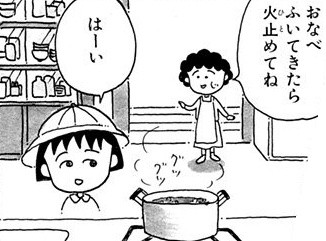
Maruko comes home after school. Her mother asks her to keep an eye on the pot on the stove while she brings in the laundry.
- お母さん:
- 「おなべふいてきたら火止めてね」
- “If the pot starts to boil over, turn off the heat, okay?”
- まる子:
- 「はーい」
- “Okay!”
Key Points
- ふく (吹く) means to blow. When a pot comes to a hard boil, the foam rises and spills over the rim, and Japanese says the pot ふく. The longer verb 吹きこぼれる says the same thing.
- おなべ is 鍋 with the polite お, which mothers often use for kitchen words. The が after it is dropped, as it often is in casual speech.
- 〜てくる here marks a change that starts happening on its own. ふいてくる is the pot beginning to boil over while Maruko watches.
- 〜たら sets a condition that may or may not happen. If it does, the request that follows applies.
- 火を止める means to turn off the burner. 火 is the stove’s flame, and 止める is to stop. 火を消す also works. Mom drops the を.
- 止めて is a bare て-form request, the everyday way a parent asks a child to do something. ね softens it into “okay?”
Vocabulary
おなべ (Pot)
おなべ is 鍋, a cooking pot, with the polite prefix お. It sounds softer and is common in home kitchens and when talking to children.
ふく (To blow)
ふく (吹く) is to blow, as wind or breath does. It also means to spout or spew out, as when a pot boils over and foam spills over the rim.
くる (To come)
くる is to move toward the speaker or the place being talked about. After a て-form verb, it shows a change coming about, or going and coming back. It is the kana spelling of 来る.
火 (Fire)
火 is fire or flame. In cooking, it also means the heat of a stove, as in 火を通す, “to cook something through”.
止める (To stop)
止める is to stop something moving or happening. Read やめる, it means to quit doing something.
See Also
- Vocabulary: Collocations for cooking
- Grammar: If and when with 〜たら
- Grammar: Requests with 〜てください and 〜てくれ
- Grammar: Coming and going with 〜てくる and 〜ていく