Watery daikon syrup with 〜っぽい
Grammar Explanation: Kind of like with 〜っぽい
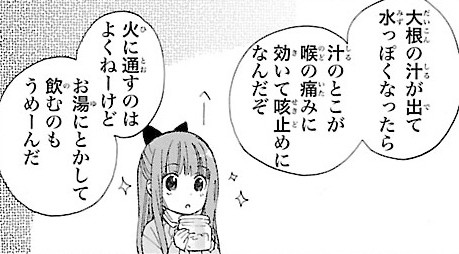
Moka has a sore throat. Hinata brings her chopped daikon that was left to steep in honey in a sealed jar. Moka tastes it and is surprised that it’s sweet.
- 日向:
- 「大根の汁が出て水っぽくなったら 汁のとこが喉の痛みに効いて咳止めになんだぞ」
- “Once the daikon juice comes out and it gets watery, the juice is good for a sore throat and works as cough medicine.”
- 「火に通すのはよくねーけど お湯にとかして飲むのもうめーんだ」
- “Heating it's no good, but it's tasty stirred into hot water, too.”
Key Points
- 水っぽい means “watery”, full of water. っぽい conjugates like an い-adjective, so before なる it becomes 水っぽく.
- Watery food is usually a complaint, but here it’s what Hinata is waiting for. It means the daikon’s juice has mixed into the honey.
- なったら is the たら form of なる. It sets a point in time: once the syrup is watery, it works on a sore throat.
- なんだぞ is なるんだぞ. The る turns into ん before だ. ぞ makes it a firm heads-up for Moka.
- よくねー is よくない, and うめー is うまい, “tasty”. Rough speech turns “ai” into “ee”.
- 汁のとこ is 汁のところ, “the juice part”.
- The usual phrase is 火を通す, “to cook” or “to heat through”. Hinata says heating the syrup isn’t good, though stirring it into hot water is fine.
Vocabulary
汁 (Juice)
汁 is the liquid that comes out of fruit, vegetables, or meat. It also means a soup or broth, as in 味噌汁.
出る (To go out)
出る means to go out or leave. It is also used when something appears or is produced.
水っぽい (Watery)
水っぽい describes food or drink that has too much water in it, such as a thin soup or a bland, watery fruit.
っぽい (-ish)
っぽい follows a word to say something seems like it or tends toward it.
なる (To become)
なる is to change into a different state or become something. It also means something turns out a certain way. It is also written 成る.
とこ (Place)
とこ is a casual, shortened form of ところ, “place”.
喉 (Throat)
喉 is the throat. 喉が渇く means to be thirsty, and 喉 can also refer to someone’s singing voice.
痛み (Pain)
痛み is pain or an ache in the body, such as 喉の痛み, “a sore throat”. It can also mean emotional pain or damage to an object.
効く (To work)
効く is for a medicine, method, or the like to have an effect.
咳止め (Cough medicine)
咳止め is a medicine that stops or soothes a cough, such as a cough syrup or lozenge.
火 (Fire)
火 is fire or flame. In cooking, it also means the heat of a stove, as in 火を通す, “to cook something through”.
通す (To pass through)
通す is to let something or someone pass through, or to run something through from one side to the other. It also means to see a plan or opinion through to the end.
よい (Good)
よい describes something good, nice, or proper. It is the more formal form of いい, and its other forms, like よく and よかった, are used in everyday speech. It is also written 良い.
お湯 (Hot water)
お湯 is heated water. At a hot spring or bath, it also means the bath water itself.
とかす (To dissolve)
とかす is to dissolve something in a liquid or to melt it with heat. Written 溶かす. A different とかす, written 梳かす, means to comb hair.
飲む (To drink)
飲む is to drink something, or to take medicine.
うまい (Good)
うまい describes something done with skill, or food that tastes good. For taste, it is more casual than おいしい.
See Also
- Grammar: Kind of like with 〜っぽい
- Grammar: Becoming with 〜くなる and 〜になる
- Grammar: If and when with 〜たら
- Grammar: How casual contractions work
- Grammar: Rough declarations with ぞ and ぜ
- Kanji: Going out and emerging with 出