Went to see a kindergarten sports day with 運動会
Kanji Explanation: Meeting and joining with 会
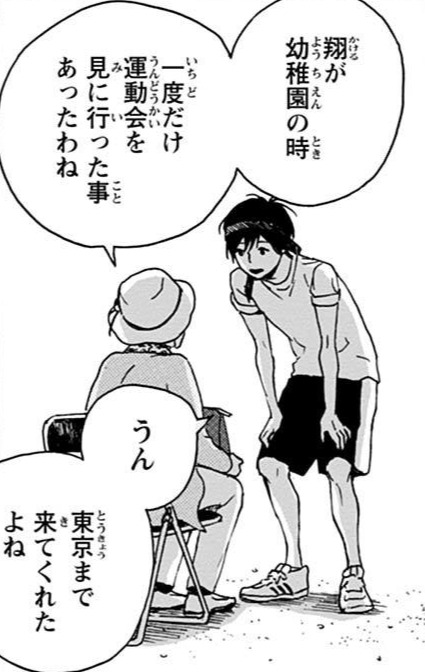
Kakeru’s grandmother unexpectedly shows up at the school sports day event.
- おばあさん:
- 「翔が幼稚園の時一度だけ運動会を見に行った事あったわね」
- “I went to see your sports day just once when you were in kindergarten, didn't I?”
- 翔:
- 「うん 東京まで来てくれたよね」
- “Yeah, you came all the way to Tokyo for me.”
Key Points
- 運動 is exercise or athletics, and 会 is a gathering or organized event.
- Here the compound names the school’s sports day, with races and other athletic events.
- 見に行く puts the verb stem 見 before に行く to state the purpose of going.
- 運動会を marks what Kakeru’s grandmother went to watch.
- 一度だけ means “only once”. だけ limits the number of visits.
- The fuller form of 行った事あった is 行った事があった. Casual speech drops が.
- The past あった recalls an occasion from an earlier period.
- まで marks Tokyo as the far endpoint of the trip, giving the sense of “all the way to Tokyo” here.
- 来てくれた presents the trip as something Kakeru received and appreciated.
- The grandmother’s わね sounds as though she is recalling the occasion and inviting Kakeru to agree.
- Kakeru begins with うん and ends with よね, affirming her memory while asking her to confirm his added detail.
Vocabulary
| Word | English | Meaning |
|---|---|---|
| 幼稚園 | Kindergarten | 幼稚園 is a school for young children from age three until they enter elementary school. |
| 時 | Time | 時 is a point or stretch of time. 〜時 means “when” or “at the time of”. |
| 運動会 | Sports day | 運動会 means a school sports day or community athletic meet with races and team events. |
| 見る | To see | 見る is to see, look at, or watch something. It also means to check or judge something, or to look after someone, as in 面倒を見る. |
| 行く | To go | 行く means to go or move toward a place away from the speaker. |
| 事 | Thing | 事 is an abstract thing, matter, or fact. It also turns a verb phrase into a noun, as in 見た事がある. It is often written こと. |
| ある | To exist | ある is to exist or be in a place, for things and plants rather than people or animals. It also means to have something, or for an event to take place. |
| 東京 | Tokyo | 東京 is Tokyo, the capital of Japan. The name means “eastern capital”, in contrast to the old capital, Kyoto. |
| 来る | To come | 来る means to come or move toward the speaker or the place being discussed. |
See Also
- Kanji: Meeting and joining with 会
- Grammar: Previous experience with 〜た+ことがある
- Grammar: Going to for a purpose with 〜に行く
- Grammar: Receiving kindness with 〜てくれる
- Grammar: Limiting with 〜だけ
- Grammar: Seeking agreement with ね
- Grammar: Until an action occurs with 〜まで
- Kanji: Enclosed grounds and gardens with 園
- Kanji: Going and carrying out with 行
- Kanji: Matters and events with 事
- Kanji: Motion and activation with 動
- Kanji: Seeing and viewpoints with 見
- Kanji: Time and occasions with 時