What score did you get with 〜の
Grammar Explanation: Reasoning with 〜のだ
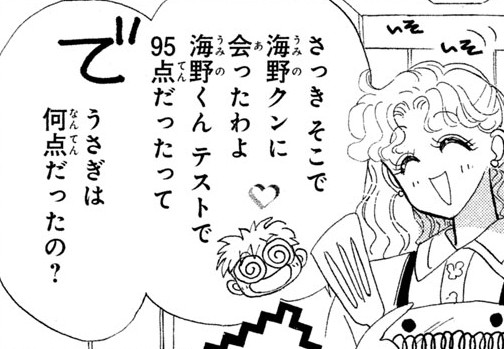
After failing a test at school, Usagi drowns her sorrows at the arcade. She returns home late and finds her mother expecting her.
- お母さん:
- 「さっき そこで海野クンに会ったわよ。海野くんテストで95点だったって」
- “I saw Umino a while ago. He said he scored 95 points on a test.”
- 「で、うさぎは何店だったの? 」
- “So, what was your score, Usagi?”
- Literal: “So, it is that your score is how many points, Usagi?”
Key Points
1だったの? asks for the missing explanation
- The mother already knows Usagi had a test, so の asks her to fill in the unknown result.
2何点 asks for a score
- 何点 asks how many points or what score.
- 君 is an honorific suffix used after names, typically for boys or men. It’s commonly used by teachers addressing male students, by friends among young people, or by superiors addressing junior colleagues, and can also be used for girls in childhood or casual contexts.
Vocabulary
会う (To meet)
会う means to meet or see someone in person.
See Also
- Grammar: Reasoning with 〜のだ
- Future entry: Past tense with 〜た・〜だ
- Grammar: Quoting and reporting with と and って
美少女戦士セーラームーン © its respective creators. It is used here for educational commentary.