When the smelt stop biting with 釣れる
Kanji Explanation: Fishing and baiting with 釣
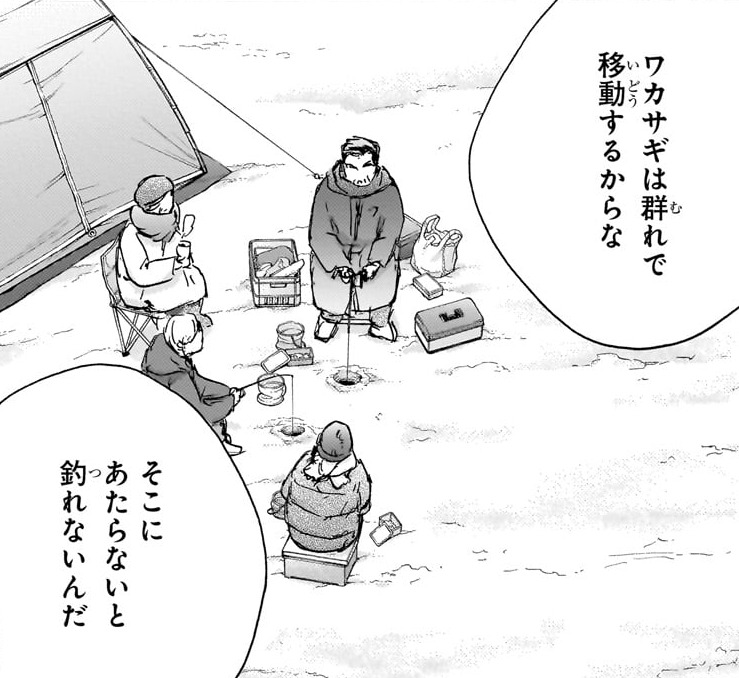
Chinatsu is spending New Year’s at her grandparents’ home in Nagano. Her grandfather has taken the family ice fishing for pond smelt on a frozen lake. After a while the fish stop biting, and Chinatsu remarks on it.
- おじいちゃん:
- 「ワカサギは群れで移動するからな」
- “Smelt move around in schools.”
- 「そこにあたらないと釣れないんだ」
- “Unless you hit the spot where they are, nothing's biting.”
Key Points
- 釣れる is what happens to the fish: it gets caught, or it bites. In the negative, 釣れない is the angler’s way of saying “no luck” or “they’re not biting”.
- Chinatsu used the same verb just before this: 釣れなくなっちゃったね, “they’ve stopped biting, huh”.
- Compare 釣る, “to catch”, which has the angler as its subject: ワカサギを釣る.
- あたらないと釣れない is “if you don’t hit it, it won’t bite”. A negative verb plus と sets a condition that has to be met, and the result after it follows every time.
- あたる (当たる) means to hit or land on something. そこ is the spot where the school is right now.
- 群れ is a group of animals, here a school of fish. で marks how they do something: they move around as a school.
- ワカサギ is the pond smelt, a small fish people catch in winter through holes cut in lake ice.
- Her grandfather gives the reason with からな and the result with んだ. Both make it sound like an explanation from someone who knows how smelt behave.
Vocabulary
| Word | English | Meaning |
|---|---|---|
| ワカサギ | Pond smelt | ワカサギ is the Japanese pond smelt, a small, slender lake fish. In winter, people catch it through holes cut in lake ice. |
| 群れ | Group | 群れ is a group of animals or people gathered together, such as a flock of birds, a herd of cattle, or a school of fish. |
| 移動 | Movement | 移動 is going or being moved from one place to another, as when a class changes rooms or a file is moved. |
| そこ | There | そこ points to a place near the listener or one just mentioned. It can also point to a matter just raised, as in そこは “on that point”. |
| あたる | To hit | あたる is the kana spelling of 当たる, for something to hit or land on its target. In fishing, it can mean getting a bite or finding the spot where the fish are. |
| 釣れる | To be caught | 釣れる says that a fish bites and gets caught. よく釣れる describes a good place or day for fishing, and 釣れない means nothing is biting. |
See Also
- Kanji: Fishing and baiting with 釣
- Grammar: Natural result with 〜と
- Grammar: Because with 〜から
- Grammar: Reasoning with 〜のだ
- Kanji: Motion and activation with 動