When you're small with 〜うちは
Grammar Explanation: While with 〜うちは
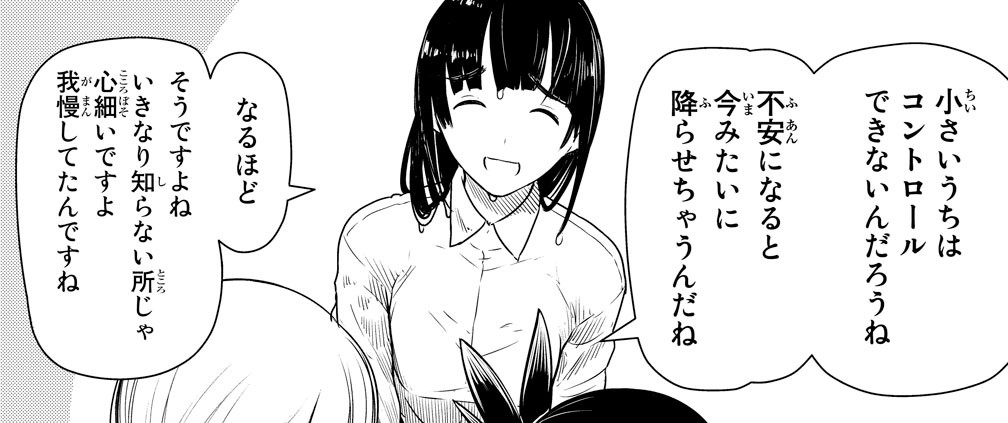
During a visit with Anzu’s family, Makoto receives a request to babysit for another witch. Things are fine at first, but after a while, rain begins to pour inside. Anzu’s mother realizes that the child they’re watching over has rain magic.
- 杏子の母:
- 「小さいうちはコントロールできないんだろうね。不安になると今みたいに降らせちゃうんだね」
- “You don't have control while you're small, right? When he gets uneasy, he makes it rain like just now.”
- Literal: “While he is small, he probably can't control it. When he gets uneasy, he makes it fall like now.”
- 真琴:
- 「なるほど。そうですよね。いきなり知らない所じゃ心細いですよ。我慢してたんですね」
- “I see. So that's it. It's a little scary suddenly being in a place you don't know. You've been patient, haven't you?”
Key Points
- 小さいうち frames childhood as the period when control is difficult.
- The focus is on a temporary stage that will eventually change.
- んだろうね means the mother is reasoning it out gently.
- She is explaining the rain magic rather than blaming the child.
- 不安になると means “when he gets uneasy”.
- 今みたいに降らせちゃう says he ends up making it rain like now, with ちゃう adding the sense of an unintended result.
Vocabulary
| Word | English | Meaning |
|---|---|---|
| 小さい | Small | 小さい describes something small in size. 小さいころ means “when one was little”. |
| うち | I | うち can mean “I” or “me”, especially in Kansai speech and in casual speech among women. It also has other meanings, including “home” and “inside”. |
| コントロール | Control | コントロール is control over something, such as power, emotions, or a ball. |
| 不安 | Anxiety | 不安 means anxiety or unease, often a vague fear that something may go wrong. |
| 今 | Now | 今 is the present moment, or these days. |
| 降らせる | To make fall | 降らせる is to cause rain or snow to fall. |
| なるほど | I see | なるほど shows the speaker now understands or agrees with what was said. |
| そう | So | そう means “like that” or “that way”. Said alone, it agrees: “right”. After a verb stem or adjective, it means something looks or seems a certain way. |
| いきなり | Suddenly | いきなり describes something happening without warning or preparation. |
| 知る | To know | 知る means to learn or come to know a fact or person. In the form 知っている, it describes already knowing. |
| 所 | Place | 所 is a place or spot. It also refers to a point in time or an aspect of something. |
| 心細い | Uneasy | 心細い describes feeling helpless, lonely, or anxious, without anyone to rely on. |
| 我慢 | Patience | 我慢 means patience, endurance, or self-restraint when bearing something difficult. |
See Also
- Grammar: While with 〜うちは
- Grammar: Past tense with 〜た・〜だ
- Grammar: Likening things with 〜みたい
- Grammar: Presuming with 〜だろう and 〜でしょう
- Grammar: Doing completely or ending up doing with 〜てしまう and 〜ちゃう
- Grammar: Natural result with 〜と
- Grammar: Marking the topic with は and も
- Grammar: Able to do with 〜れる・〜られる
- Grammar: Making and letting with 〜せる・〜させる
- Grammar: Compound voicing with 連濁
- Grammar: Informing with よ
- Grammar: Seeking agreement with ね
- Grammar: Becoming with 〜くなる and 〜になる
- Kanji: Negation and lack with 不
- Kanji: Now and the present with 今
- Kanji: Peace and ease with 安