Where are you at with いんの
Grammar Explanation: How casual contractions work
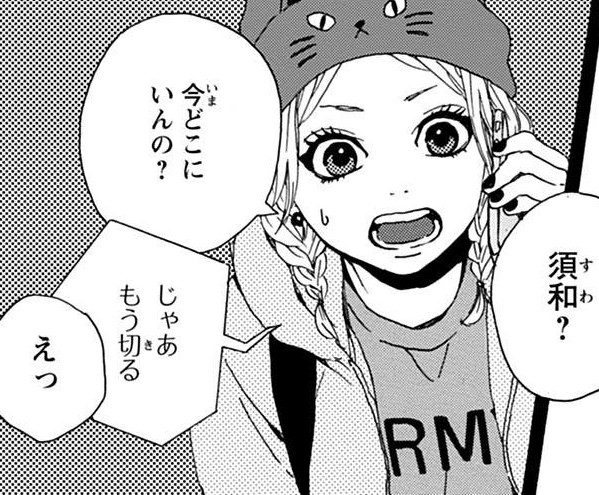
Azu is with her friends, waiting for Suwa. They call him to find what’s keeping him, and while Azu talks with Suwa by phone, she hears an echo of his voice in the distance.
- あずさ:
- 「須和? 今どこにいんの?」
- “Suwa? Where is it you're at right now?”
- Literal: “Suwa? Where are you now?”
- 須和:
- 「じゃあ もう切る」
- “Well, I'm hanging up now.”
- あずさ:
- 「えっ」
- “Eh?”
Key Points
1いんの = casual contraction of いるの
- 「どこにいんの」 is a spoken shortening of どこにいるの.
- This kind of contraction is common in casual conversation and can sound softer and more natural than the full form.
2Particle choice: どこに
- に marks the place where someone exists or is located.
- So どこにいる means “to be at what place”.
Vocabulary
| Word | English | Meaning |
|---|---|---|
| 今 | Now | 今 is the present moment, or these days. |
| どこ | Where | どこ asks what place something is in. |
| いる | To be | いる is to exist or be somewhere, for people and animals. After a て-form verb, it shows an ongoing action or a continuing state. |
| もう | Already | もう means something has already happened, or with a negative, “no longer”. Before a number, it means “more”. Said alone, it shows frustration. |
| 切る | To cut | 切る is to cut something. It also means to end a phone call or turn something off. |
See Also
- Grammar: How casual contractions work
- Grammar: Reasoning with 〜のだ
- Grammar: Consonant doubling with 促音
- Kanji: Now and the present with 今
orange © its respective creators. It is used here for educational commentary.