While I didn't see you with 〜うちに
Grammar Explanation: During with 〜うちに
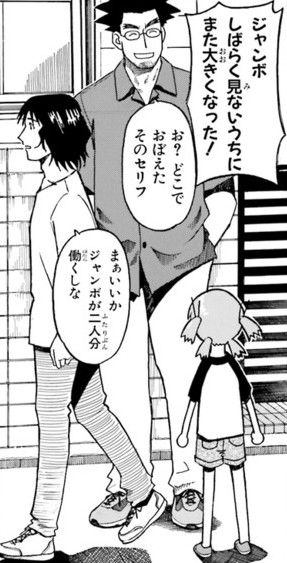
Jumbo arrives to help Yotsuba and her father move into their new home.
- よつば:
- 「しばらく見ないうちにまた大きくなった!」
- “You've grown bigger since I last saw you!”
- Literal: “During the time I didn't see you, you've gotten bigger!”
- ジャンボ:
- 「お?どこでおぼえたそのセリフ」
- “Oh? Where'd you pick up that line?”
Key Points
- The phrase marks the unseen interval as the time when Jumbo supposedly grew.
- It does not mean Yotsuba watched him grow.
- また means “again”, as if this has happened before.
- 「どこでおぼえたそのセリフ」 asks where she learned that line.
- セリフ treats her comment like a borrowed scripted phrase.
Vocabulary
| Word | English | Meaning |
|---|---|---|
| しばらく | For a while | しばらく describes a stretch of time, short or long. It also greets someone you have not seen in a long time. |
| 見る | To see | 見る is to see, look at, or watch something. It also means to check or judge something, or to look after someone, as in 面倒を見る. |
| うち | I | うち can mean “I” or “me”, especially in Kansai speech and in casual speech among women. It also has other meanings, including “home” and “inside”. |
| また | Again | また means “again” or “once more”. It also means “also”. As a goodbye, またね means “see you”. |
| 大きい | Big | 大きい describes something large in size or amount. 大きくなる means to grow bigger or grow up. |
| なる | To become | なる is to change into a different state or become something. It also means something turns out a certain way. It is also written 成る. |
| どこ | Where | どこ asks what place something is in. |
| おぼえる | To remember | おぼえる is to keep something in memory, or to learn it. It is the kana spelling of 覚える. |
| その | That | その points to something near the listener or to something just mentioned. Said alone, it fills a pause, like “um”. |
| セリフ | Line | セリフ is a line of dialogue, such as from a play or show, or something someone says. It is also written 台詞. |
See Also
- Grammar: During with 〜うちに
- Grammar: Past tense with 〜た・〜だ
- Grammar: Negation with 〜ない
- Grammar: Becoming with 〜くなる and 〜になる
- Kanji: Seeing and viewpoints with 見