Whisking eggs and honey for waffles with 泡立てる
Vocabulary Explanation: Collocations for cooking
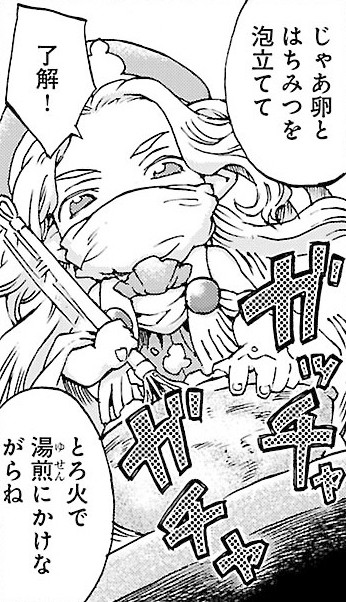
Konju drops by Hakumei and Mikochi’s new house and finds Mikochi testing a new product, honey waffles. Konju has just learned that Mikochi makes the cookies and tea she loves. She doesn’t want to be in Mikochi’s debt, so she begs to help, and Mikochi gives in.
- ミコチ:
- 「じゃあ卵とはちみつを泡立てて」
- “Okay, then whisk the eggs and honey.”
- コンジュ:
- 「了解!」
- “Got it!”
- ミコチ:
- 「とろ火で湯煎にかけながらね」
- “Over a double boiler on a low flame, okay?”
- Literal: “While putting it in a hot-water bath on a low flame, okay?”
Key Points
- 泡立てる is 泡, foam, plus 立てる, to raise. It means whipping air into something until it turns foamy, and it takes を: 卵を泡立てる, 生クリームを泡立てる. The tool is a 泡立て器, the whisk in Konju’s hand.
- Its intransitive partner 泡立つ means something foams up on its own, like soap or a wave. Mikochi uses the transitive verb because Konju does the whipping.
- 卵を溶く only mixes the yolk and white. 泡立てる keeps going until the mixture is light and full of air, which is what a waffle batter needs.
- 湯煎 is warming food in a bowl that sits in hot water, so the heat stays gentle. にかける puts the food over that heat, the same pattern as 火にかける, “put on the stove”.
- とろ火 is the lowest flame. で marks it as the condition the cooking happens under.
- Whole eggs whip up faster when they’re warm, so bakers often whisk them over hot water.
- 〜ながら joins two actions by one person. Here both are Konju’s: she whisks, and at the same time she keeps the bowl in the hot water.
- Mikochi adds the condition after Konju has already said 了解, so 湯煎にかけながら trails after the request it belongs to. In full it would be とろ火で湯煎にかけながら泡立てて.
- ね softens the add-on instruction, like “okay?” in English.
- 泡立てて is a bare て-form, 〜てください with ください dropped. Friends use it to give each other instructions.
- じゃあ is the casual form of では, “well then”. Mikochi has just agreed to let Konju help, and じゃあ moves straight to her first job.
- 了解 means “understood” or “roger”. On its own it’s a quick, eager “got it!”
Vocabulary
卵 (Egg)
卵 is an egg, especially a chicken egg used as food. It also means a person still in training, as in 医者の卵, a future doctor.
はちみつ (Honey)
はちみつ is honey, the sweet syrup bees make from flower nectar. It is also written 蜂蜜.
泡立てる (To whip)
泡立てる is to beat air into something, such as eggs or cream, until it turns foamy. It also means to work soap into a lather.
了解 (Understanding)
了解 means understanding and accepting what someone has said or requested.
とろ火 (Low flame)
とろ火 is a very low flame on a stove, used to simmer or warm food slowly.
かける (To hang)
かける is to hang something up or put it over something else. It also means to spend time or money, to cause someone trouble, to make a phone call, and more. It is also written 掛ける.
See Also
- Vocabulary: Collocations for cooking
- Grammar: Requests with 〜てください and 〜てくれ
- Grammar: Concurrent events with 〜ながら
- Grammar: Seeking agreement with ね
- Grammar: Marking the direct object with を
- Grammar: How casual contractions work
- Kanji: Separating and understanding with 解