You trusted me with 〜のこと信じる
Grammar Explanation: Referring to a person with 〜のこと
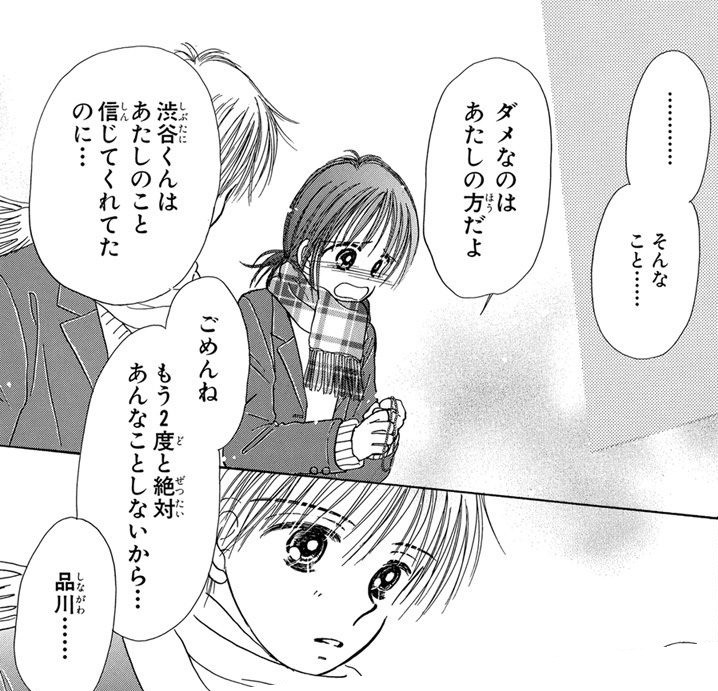
Miku secretly opened a text message on Shibuya’s phone and came to suspect him of seeing their senior, Yoyogi. Shibuya has just cleared up the rumors about him and Yoyogi, given Miku her White Day present early, and apologized for being such a hopeless boyfriend.
- みく:
- 「………そんなこと……」
- “...That's not...”
- 「ダメなのはあたしの方だよ」
- “I'm the hopeless one.”
- 「渋谷くんはあたしのこと信じてくれてたのに…」
- “You trusted me the whole time, and I...”
- 「ごめんね もう2度と絶対あんなことしないから…」
- “I'm sorry. I'll never, ever do anything like that again...”
- 渋谷:
- 「品川……」
- “Shinagawa...”
Key Points
- のこと after あたし makes Miku the person Shibuya trusted. 信じる works with or without のこと: あたしを信じてくれてた means the same thing.
- The full form is あたしのことを信じてくれていた, with the を and the い of ていた dropped.
- 〜てくれる shows that Shibuya’s trust was a kindness to her.
- のに means “even though”. Miku stops before the second half, that she went behind his back anyway.
- Shibuya just called himself ダメダメな彼氏. 〜の方 means “the side”, so Miku turns it around: “the hopeless one is me”.
- もう2度と with a negative means “never again”. 絶対 makes the promise stronger.
Vocabulary
そんな (Like that)
そんな describes something like the thing just mentioned. Said alone, it shows shock or denial: “no way!”
ダメ (No good)
ダメ is a katakana spelling of だめ, describing something that is useless or not allowed.
あたし (I)
あたし means “I” or “me”. It is a casual, feminine form of 私.
方 (Side)
方 is a direction or side. In comparisons, 〜方がいい means “it’s better to”. Read かた, it is a polite word for a person.
くん (-kun)
くん is a suffix added to a name, usually for boys or for someone younger or of lower standing. It is also written 君.
こと (Thing)
こと is an abstract thing, matter, or fact, as opposed to a physical object. It also turns a verb phrase into a noun, as in 見たことがある. It is also written 事.
信じる (To believe)
信じる is to accept that something is true, or to trust someone.
くれる (To give)
くれる is for someone to give something to the speaker or the speaker’s side. After a て-form verb, it means someone does something for the speaker.
ごめん (Sorry)
ごめん is a casual “sorry”, used with friends and family. ごめんね sounds softer, and ごめんなさい is a little more polite.
もう (Already)
もう means something has already happened, or with a negative, “no longer”. Before a number, it means “more”. Said alone, it shows frustration.
絶対 (Absolute)
絶対 means absolute or unconditional. As an adverb, it means definitely or under no circumstances, depending on the sentence.
あんな (That kind of)
あんな describes something like that thing over there, or like a thing both people know about, often with surprise or disapproval.
する (To do)
する is to do or perform something. It also turns many nouns into verbs, as in 勉強する.
See Also
- Grammar: Referring to a person with 〜のこと
- Grammar: Receiving kindness with 〜てくれる
- Grammar: Even though with 〜のに
- Kanji: Measures and degrees with 度