You're already awake with 起きてもた
Grammar Explanation: Doing completely or ending up doing with 〜てしまう and 〜ちゃう
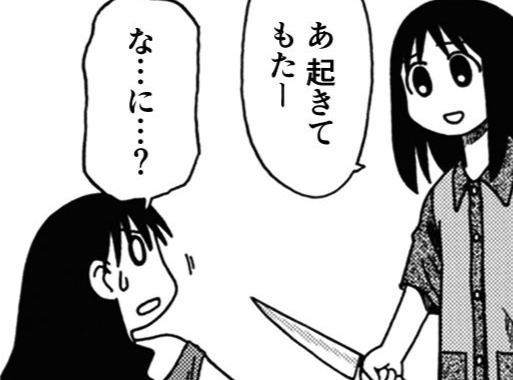
During a vacation trip with her teacher and friends from class, Ayumu plans to wake the teacher by banging a ladle against a frying pan. Since Ayumu is still half asleep herself, she doesn’t realize all she’s grabbed is a kitchen knife. She enters the teacher’s room only to find her sitting up already.
- 歩:
- 「あ 起きてもたー」
- “Oh, you're already awake!”
- Literal: “Oh, you've already woken up!”
- ゆかり:
- 「な…に…?」
- “What...?”
Key Points
1起きてもた = “you are already awake”
- 〜てもた is a Kansai past form corresponding to standard 〜てしまった. Here, 起きてもた corresponds to 起きてしまった.
- Ayumu had planned to wake Yukari herself, so finding her awake is an unexpected result.
2Yukari’s な…に…? is a broken-up 何?
- The pauses make her “What…?” sound slow and confused because she has just woken up.
See Also
- Grammar: Doing completely or ending up doing with 〜てしまう and 〜ちゃう
- Grammar: Grammar in the Kansai dialect
- Grammar: Doing completely or ending up doing with 〜てしまう and 〜ちゃう
- Future entry: Past tense with 〜た・〜だ
あずまんが大王 © its respective creators. It is used here for educational commentary.