Yui's grandmother's place with 〜んち
Grammar Explanation: One's house with 〜んち
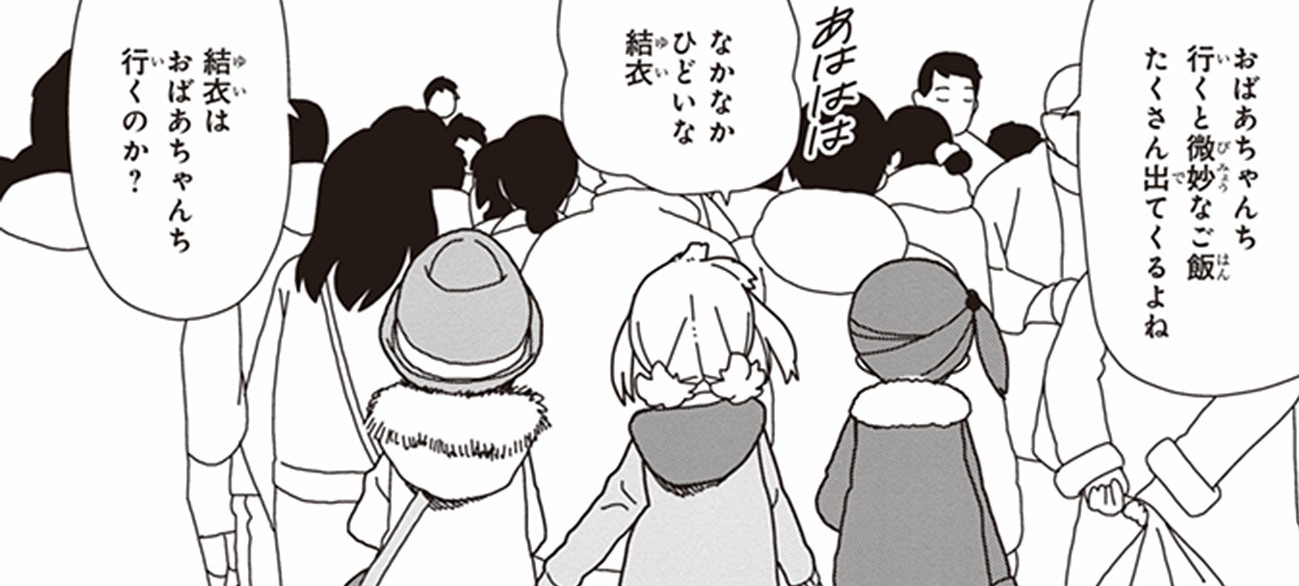
As the end of the year approaches, Yui and her friends discuss which New Year foods they like and dislike.
- 結衣:
- 「おばあちゃんち行くと微妙なご飯たくさん出てくるよね」
- “When I go to my grandma's house, a lot of not-so-good food is served.”
- Literal: “When you go to grandma's place, a lot of iffy food comes out, doesn't it?”
- さっちゃん:
- 「なかなかひどいな結衣」
- “That's pretty bad, Yui.”
- 琴葉:
- 「結衣はおばあちゃんち行くのか?」
- “Are you going to your grandma's house, Yui?”
「おばあちゃんのうち」 is contracted into 「おばあちゃんち」.
Key Points
1おばあちゃんち means “grandma’s house”
- The んち attaches to おばあちゃん, making the place belong to or be associated with Grandma.
2The first line describes what happens there
- 行くと means “when I go”, setting up the usual result at Grandma’s house.
- 微妙なご飯 is food that is iffy or not very appealing.
3Omitted particle に
- The particle に is omitted before 行く, which is common in casual speech.
- ご飯 means “cooked rice”, but it also broadly means “meal”.
Vocabulary
行く (To go)
行く means to go or move toward a place away from the speaker.
微妙 (Subtle)
微妙 means subtle, delicate, or hard to judge. In casual speech, it often means awkward or not quite good.
出る (To go out)
出る means to go out or leave. It is also used when something appears or is produced.
See Also
- Grammar: One's house with 〜んち
- Grammar: Natural result with 〜と
- Grammar: Marking the topic with は and も
三ツ星カラーズ © its respective creators. It is used here for educational commentary.