A strong denial with 〜っこない
Grammar: Assertion and Declaration » 〜っこない
~っこない is a forceful, colloquial way to say that something is impossible or has no chance of happening.
It translates as “no way”, “definitely impossible”, or “absolutely cannot”. The speaker treats the denial as certain.
Usage Notes
Attach it to a verb stem, as in 食べられっこない, “there is no way I can eat it”. It often follows potential verbs and appears with conditionals.
It also pairs with emphatic expressions such as なんて: なんてありっこない, “there is no way that is possible”. It resembles ~わけがない but sounds less formal and more conversational.
Further Reading
- 【JLPT N2】文法・例文:~っこない (nihongokyoshi-net.com)
- 【N2文法】〜っこない (nihongobu.net)
- 〜っこない|日本語能力試験 JLPT N2 (www.edewakaru.com)
Examples
Can't be found with 〜っこない
Grammar Explanation: A strong denial with 〜っこない
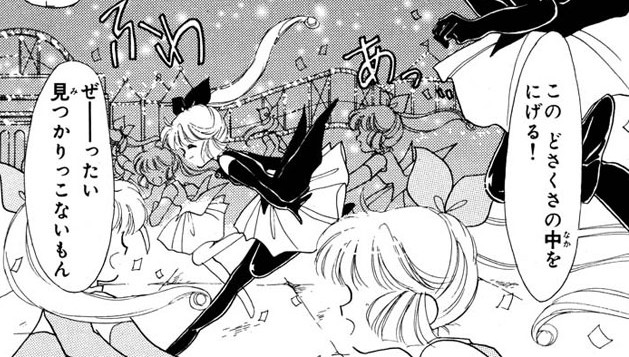
Saint Tail sends out a parade of copies of herself to confuse Asuka Jr. and the police.
- セイント・テール:
- 「この どさくさの中をにげる!」
- “I'll escape in the midst of all this confusion!”
- 「ぜーーったい見つかりっこないもん」
- “There's absolutely no way that I can be found.”
No way he can win with 〜っこない
Grammar Explanation: A strong denial with 〜っこない
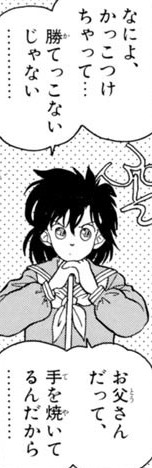
As he performs one trick after another, Kaito says he’s unbeatable at magic. Aoko says he can’t win against Kaitou Kid, the magic-using thief her police father has yet to apprehend. Kaito disregards the claim and continues disrupting class with his tricks.
- 青子:
- 「なによ、かっこつけちゃって… 勝てっこないじゃない……」
- “What's with all that showing off? There's no way he can win.”
- 「お父さんだって、手を焼いてるんだから」
- “Even Dad is having a hard time of it.”
No way you can catch with 〜っこない
Grammar Explanation: A strong denial with 〜っこない
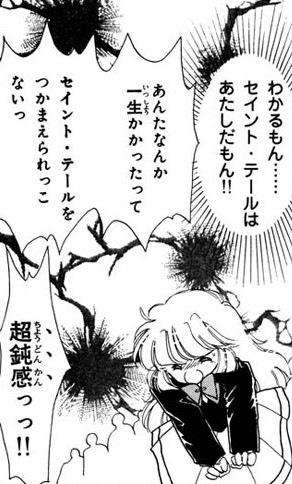
Asuka Jr. is feeling down after Saint Tail committed a theft without giving him advance notice. When Meimi tries to console him, he tells her she doesn’t understand Saint Tail.
- 芽美 (thinking):
- 「わかるもん…… セイント・テールはあたしだもん!!」
- “I do understand... Because I'm Saint Tail!!”
- 芽美:
- 「あんたなんか一生かかったってセイント・テールをつかまえられっこないっ」
- “Someone like you can take a lifetime and there's no way you can catch Saint Tail!”