Being made to do with 〜させられる
Grammar: Unsorted » 〜させられる
〜させられる is the causative-receptive, which textbooks call the causative-passive 使役受身. It puts the receptive on top of the causative. 食べる, “eat”, becomes 食べさせる, “make someone eat”, and then 食べさせられる, “be made to eat”. The subject is the one who does the action, but someone or something else brought it about.
It has two main uses. In the basic one, the subject is made to do something they didn’t want to do: 母に野菜を食べさせられた, “my mom made me eat my vegetables”. With verbs of feeling and thinking, it says something stirred a reaction in the subject: 叔父には驚かされた, “my uncle surprised me”.
Usage Notes
The person who caused the action takes に, but it’s often left out when the context makes it clear. The subject is often left out too, especially when it’s the speaker.
Godan verbs, except those ending in す, have a short form that’s more common than the long one: 待たせられる becomes 待たされる. Either way, the result conjugates like an ichidan verb: 待たされた, 待たされて, and in casual speech 待たされてる or 食べさせられちゃった.
Being made to do something usually sounds like a complaint. When the speaker was glad to be allowed to do something, Japanese uses 〜させてもらう instead.
Formation
Start from the causative and make it receptive. For godan verbs, the short form, with される, is used more often than the long one.
View formation details
- Godan verb not ending in す (あ-row) + される
- 一時間も待たされた
- "I was kept waiting a whole hour."
- Note: The long form, 待たせられた, means the same thing. Verbs ending in う use わ, so 買う becomes 買わされる.
- Godan verb ending in す (drop す) + させられる
- みんなの前で話させられた
- "I was made to speak in front of everyone."
- Note: す-verbs have no short form. 話さされる isn't used.
- Ichidan verb (drop る) + させられる
- 母に野菜を食べさせられた
- "My mom made me eat my vegetables."
- する → させられる
- 先輩に部室の掃除をさせられた
- "My senpai made me clean the club room."
- 来る → 来させられる
- 日曜なのに学校に来させられた
- "I was made to come to school even though it's Sunday."
Being Made to Do Something
The basic use of 〜させられる is being made to do something you didn’t want to do. The person behind it takes に: 先輩に部室の掃除をさせられた, “my senpai made me clean the club room”.
Compare the plain causative. In 先輩が私に掃除をさせた, the senpai is the subject and makes me clean. In 私は先輩に掃除をさせられた, the subject is the one who cleaned. Either way, 掃除 keeps its を.
The person behind it often goes unnamed. 毎日10キロも走らされた is “they made us run ten kilometers every day”, and who “they” are is left to context. Nobody has to give an order out loud, either. A job or a club’s rules can do it: 残業させられる会社 is “a company where they make you work overtime”.
待たされる, “be kept waiting”, belongs here too, and it’s very common: 一時間も待たされた, “I was kept waiting a whole hour”.
Example 1 of 3: Kept waiting countless times with 〜される
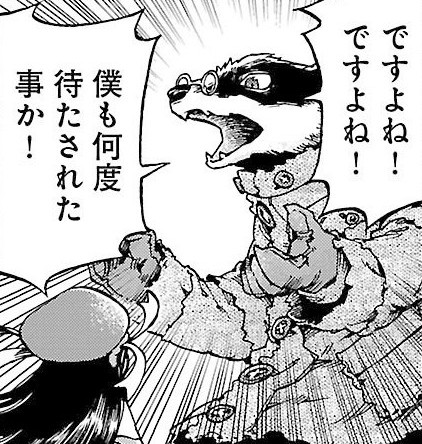
Hakumei and Mikochi visit Kate, a badger who makes canelés deep in the forest, hoping to sell them at the shop where Mikochi works. Kate turns them down when he learns the shop belongs to Suzumi, but offers to show them how he makes canelés. He warns that the work is hard for anyone who’s bad at waiting, and Mikochi says she’s good at it, since her manager often keeps her waiting.
- ケイト:
- 「ですよね! ですよね! 僕も何度待たされた事か!」
- “Right?! Right?! I can't tell you how many times I've been kept waiting too!”
Mikochi says her manager, Suzumi, often keeps her waiting, and Kate, who knows Suzumi too, jumps in to agree. 待たされた, “was kept waiting”, makes Kate the one left waiting. Suzumi goes unnamed, since Mikochi has just mentioned the manager.
Example 2 of 3: Made to wear a panda costume with 〜させられる
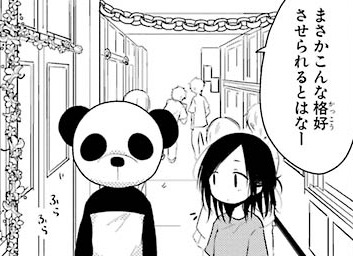
At the school festival, Hase, Kiryuu, and Fujimiya are put in charge of drawing customers to their class’s café. The class wants one of them in costume. Kiryuu gets a sharp waiter’s outfit, and Hase ends up inside a panda suit.
- 長谷:
- 「まさかこんな格好させられるとはなー」
- “Never thought they'd make me wear something like this.”
At the school festival, Hase’s class has put him in a panda suit to draw in customers. 格好をする is “dress like”, so 格好させられる is “be made to dress like this”. Nobody is named as the one who made him. It’s his class.
Example 3 of 3: Made to quit smoking with 〜させられる
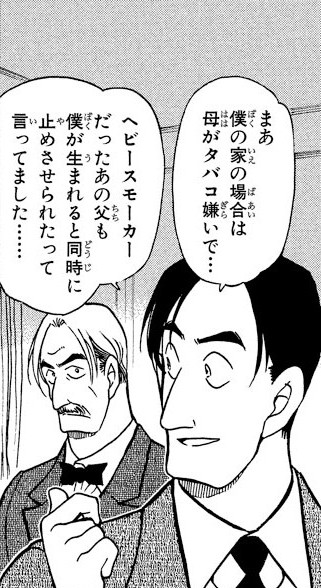
Four actors filming a mystery drama at a mansion are suspects in a real murder. While they wait with Kogoro, he lights a cigarette, and the actress Ruri says her father’s dislike of smoking rubbed off on her. Nobuharu, who acts alongside his father, Akatsuki, says it’s the same in his family.
- 伸晴:
- 「まあ 僕の家の場合は母がタバコ嫌いで…」
- “Well, in my family's case, it's my mother who hates cigarettes...”
- 「ヘビースモーカーだったあの父も僕が生まれると同時に止めさせられたって言ってました……」
- “Even my dad there, who used to be a heavy smoker, told me she made him quit the moment I was born...”
Kogoro lights a cigarette, and the actor Nobuharu explains that his mother hates smoking. 止めさせられた says his father, a heavy smoker, was made to quit. The mother from the previous sentence is the one who made him, though she isn’t marked with に here.
The Short Form 〜される
Godan verbs have two causative-receptive forms. The long one adds せられる to the あ-row stem, as in 飲ませられる. The short one adds される, as in 飲まされる. Both mean “be made to drink”, and the short one is more common. The long form can also be the causative plus the potential, “can make someone drink”, as covered below.
Verbs ending in す don’t shorten. 話す becomes 話させられる, never 話さされる.
In standard Japanese, ichidan verbs, する, and 来る take only the long form: 食べさせられる, させられる, and 来させられる. A short form like 食べさされる is very rare.
The short form ends in される, so it can look like a plain receptive. Check the dictionary form. If it ends in す or する, される is the plain receptive: 出す becomes 出される, “be taken out”, and 注意する becomes 注意される, “be warned”. Otherwise, される after an あ-row kana is the causative-receptive. The receptive of 待つ is 待たれる, while 待たされる is “be kept waiting”. Likewise, the receptive 飲まれる means someone else drinks it, and 飲まされる is “be made to drink”.
Watch for 〜す verbs with an あ-row kana before す that pair with a godan verb. Examples are 動かす, “move (something)”, which pairs with 動く, “move”, 減らす, “reduce”, which pairs with 減る, “decrease”, and 悩ます, “trouble”, which pairs with 悩む, “worry”. 動かされる, 減らされる, and 悩まされる can be read either as plain receptives of the 〜す verb or as short causative-receptives of its partner, and the meaning comes out much the same either way. 甘やかされる, “be spoiled”, and 冷やされる, “be cooled”, also have an あ-row kana before される, but they are only plain receptives.
Example 1 of 2: Made to run around with 〜される
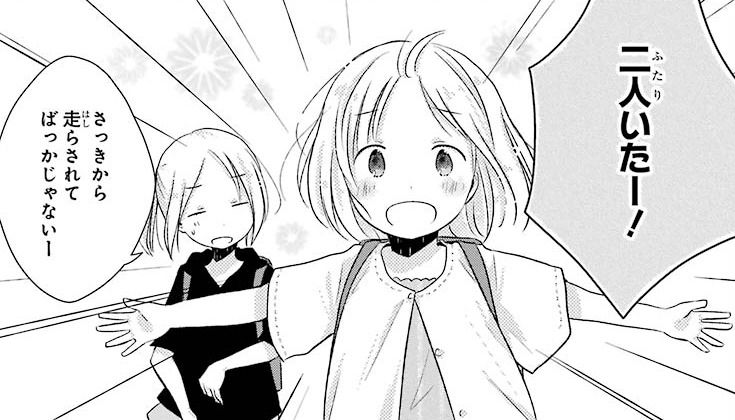
Kakihara remembers a day from her childhood. She stopped to look at some hydrangeas, and while she wasn’t paying attention, Sana challenged everyone to a race to the park and the others ran off. Only Shun stayed behind to wait for her.
- 紗奈:
- 「二人いたー!」
- “There you two are!”
- 千尋:
- 「さっきから走らされてばっかじゃないー」
- “All we've done is get dragged into running!”
Sana challenged everyone to a race, and Chihiro has been chasing after her ever since. 走る is a godan verb, so its causative-receptive is usually the short 走らされる rather than 走らせられる. With 〜てばっか, it’s “all we’ve done is get made to run”.
Example 2 of 2: Sent with a gift from mom with 〜される
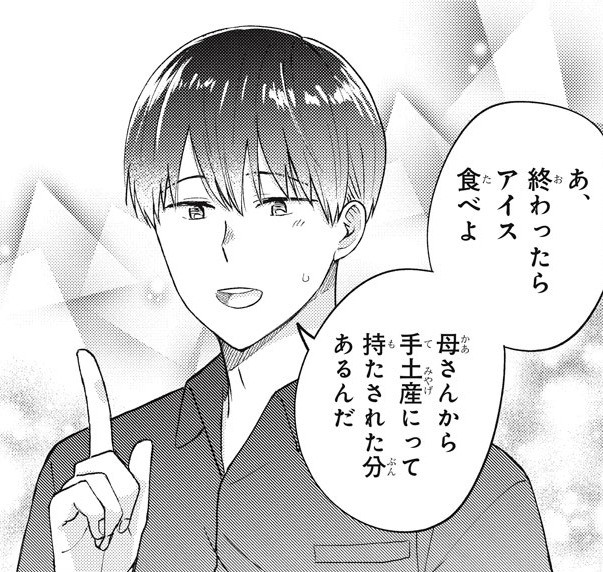
With summer vacation almost over, Makoto still hasn’t finished her homework. Tsukasa comes over to cheer her on through her last assignment, but she soon slumps over the table, worn out.
- 司:
- 「あ、終わったらアイス食べよ」
- “Oh, let's have ice cream when you're done.”
- 「母さんから手土産にって持たされた分あるんだ」
- “My mom sent me over with some as a gift.”
Tsukasa is helping Makoto finish her summer homework, and offers her ice cream as a reward. 持たされた is the short form of 持たせられた, from 持つ: his mom sent him over with it as a gift. Here there’s little sense of being forced.
Feelings and Thoughts Brought On
With verbs of feeling or thinking, 〜させられる says that someone or something brought on a reaction. The cause takes に: 叔父には本当に驚かされた, “my uncle really surprised me”. The cause can also be a て-form clause: 友人の話を聞いて泣かされた, “hearing my friend’s story made me cry”.
Nobody is giving orders here, and the feeling isn’t always unwelcome. It’s most often a negative one, such as 心配させられる, “be made to worry”, or イライラさせられる, “be irritated”. So is 悩まされる, “be troubled”: 頭痛に悩まされている, “I’ve been suffering from headaches”. But 感心させられる, “be impressed”, and 感動させられる, “be moved”, are positive.
Verbs of thinking work the same way. 考えさせられる says something “made me think”: 改めて考えさせられた, “it made me think about it all over again”. 思い知らされる is “be made painfully aware”, and 気づかされる is “be made to realize”.
驚かされる can also be read as the plain receptive of 驚かす, “startle”. 泣かされる and 悩まされる are the same, since 泣かす and 悩ます are verbs of their own. Either reading gives the same meaning.
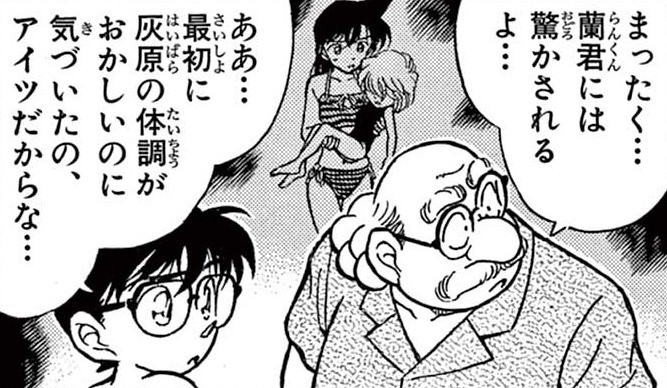
Professor Agasa takes Conan and the other kids to a beach in Izu, where they run into Ran and Sonoko. When Haibara says she’s tired, Ran comes ashore with her and Conan, and Haibara turns out to have sunstroke. Once Haibara starts to recover, Ran tells her to speak up the next time she feels sick, and heads back to join the others.
- 阿笠:
- 「まったく…蘭君には驚かされるよ…」
- “Honestly... Ran never stops amazing me...”
- コナン:
- 「ああ…最初に灰原の体調がおかしいのに気づいたの、アイツだからな…」
- “Yeah... She's the one who noticed something was wrong with Haibara first.”
Ran was the first to notice that Haibara had sunstroke, and Professor Agasa is impressed. 蘭君には marks Ran as the cause of his surprise, and the nonpast 驚かされる says she does this all the time. The feeling is admiration, not annoyance.
Telling It Apart from Similar Forms
Four forms built on 食べる are easy to mix up. The difference is who eats and who makes it happen.
| Form | Meaning | Who eats |
|---|---|---|
| 食べられた | was eaten | someone else |
| 食べさせた | made someone eat | someone else, because the subject made them |
| 食べさせられた | was made to eat | the subject, because someone made them |
| 食べさせてもらった | was allowed to eat | the subject, because someone let them |
〜させてもらう is the grateful counterpart. It presents being allowed to do something as a favor, while 〜させられる presents it as a burden.
The same spelling, 〜させられる, can also be the causative plus the potential, “can make (someone or something) do”. So can the long godan form, as in 驚かせられる, “can surprise (someone)”. 完成させられる can mean “can finish it”, and 無理なんてさせられない is “I can’t make you overdo it”. Context decides which one is meant. If the subject would be the one making something happen, it’s the potential.
聞かされる and 知らされる can also be read as the plain receptives of 聞かす, “tell”, and 知らす, “inform”, which mean the same as 聞かせる and 知らせる. Both are very common, and they often just mean “be told” or “be informed”, with no sense of being forced: 手紙で知らされた is “I was informed by letter”, and 何も聞かされていない is “nobody told me anything”. When the news is unwelcome, 聞かされる can still sound like “had to hear it”.
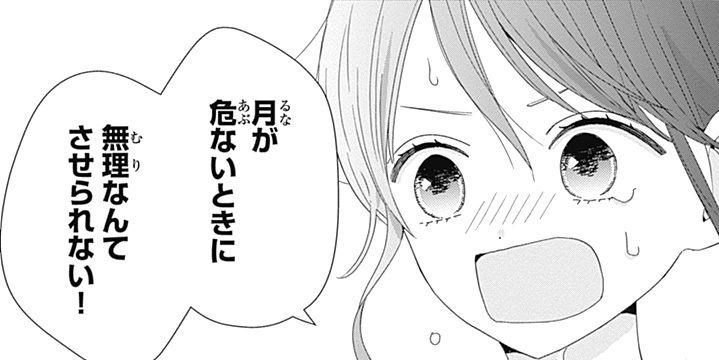
Ayumu and Luna end up hiding in a hot spring bath while two other boys soak nearby, and Luna overheats waiting for them to leave. When the boys finally go, Luna is too dizzy to walk, but he won’t let Ayumu go out first to get help, because then someone would see her. Seeing him suffer for her sake, Ayumu stands up.
- 歩:
- 「月が危ないときに無理なんてさせられない!」
- “You're in trouble, Luna! I can't let you push yourself like this!”
Luna has overheated in the bath keeping Ayumu from being seen, and he’s too dizzy to walk. 無理をさせる is “make someone push themselves”, and Ayumu is the one who’d be doing it, so させられない is the potential: “I can’t let you push yourself”.
Further Reading
- 〜される・〜せられる・〜させられる, 日本語文型バンク (NINJAL) (ninjal.ac.jp)
- 使役受身形, 教科書を作ろう (Japan Foundation) (kyozai.jpf.go.jp)
Related Grammar
- Making and letting with 〜せる・〜させる
- The causative that 〜させられる is built on. There, the subject is the one who makes or lets someone act.
- Receptive verbs with 〜れる
- The receptive that turns the causative around. On its own, it makes the subject the one the action happens to.
- Please let me with 〜させてください
- The causative plus a request. Asking to be allowed to act is the friendly side of the same causative.
- Having someone do something with 〜てもらう
- 〜させてもらう, "be allowed to", presents the causative as a favor, where 〜させられる presents it as a burden.
- Able to do with 〜れる・〜られる
- The causative plus the potential is also spelled 〜させられる, as in 完成させられる, "can finish it".