Blame and credit with 〜せいで and 〜おかげで
Grammar: Reason and Cause » 〜せいで・〜おかげで
〜せいで and 〜おかげで both mean “because of”, but each carries a judgment. おかげで, “thanks to”, credits a cause with a good result: 先生のおかげで合格できた, “I passed thanks to my teacher”. せいで blames a cause for a bad result: 雨のせいで試合が中止になった, “the game was called off because of the rain”.
から and ので only give a reason. Choosing せい or おかげ adds the speaker’s blame or thanks.
Usage Notes
The cause can be a person, a thing, or a situation, and the speaker can blame themself. Crediting yourself is possible but can sound like a boast. After せいで or おかげで, the sentence reports what happened or how things are. It doesn’t go on to state the speaker’s own wish or plan, or to ask the listener to do something. For a reason behind a request, use から: 暑いから窓を開けて, “it’s hot, so open the window”.
Because they carry the speaker’s feelings, these words are at home in conversation. Objective writing, such as news articles, usually names causes with ため or によって instead.
Two set phrases use the same words. 気のせい is “just your imagination”, as in 気のせいだよ, “you’re imagining it”. おかげさまで, roughly “thanks to you”, is a polite set phrase, often used to answer when someone asks how you or your family are doing: おかげさまで元気です, “I’m doing well, thank you”.
Formation
View formation details
- Noun + のせいで/のおかげで
- 雨のせいで試合が中止になった
- "the game was called off because of the rain"
- Plain-form verb + せいで/おかげで
- 寝坊したせいで遅刻した
- "I was late because I overslept"
- い-adjective + せいで/おかげで
- 荷物が少なかったおかげで楽だった
- "it was easy because I didn't have much to carry"
- な-adjective + な + せいで/おかげで
- 交通が不便なせいで人口が減った
- "the population fell because transportation is inconvenient"
- そのせいで/そのおかげで (referring back)
- そのおかげで助かった
- "that saved me"
- Result + のは + Noun + のせいだ/のおかげだ
- 勝てたのはみんなのおかげだ
- "we won thanks to everyone"
Giving Credit with おかげで
おかげで credits a cause with a good result. In ⒶのおかげでⒷ, Ⓐ is the cause and Ⓑ is what turned out well. When Ⓐ is someone’s help, the sentence doubles as thanks: 皆さんのおかげで、無事終わりました, “thanks to all of you, everything went smoothly”.
The cause doesn’t have to be a person. 晴れたおかげで、いい写真がたくさん撮れた is “thanks to the clear weather, I got lots of good photos”.
At the start of a sentence, そのおかげで, “thanks to that”, points back to a cause just mentioned. In casual speech, the その often drops, leaving just おかげで.
Example 1 of 2: Thank you for inviting me with お招きいただきありがとうございました
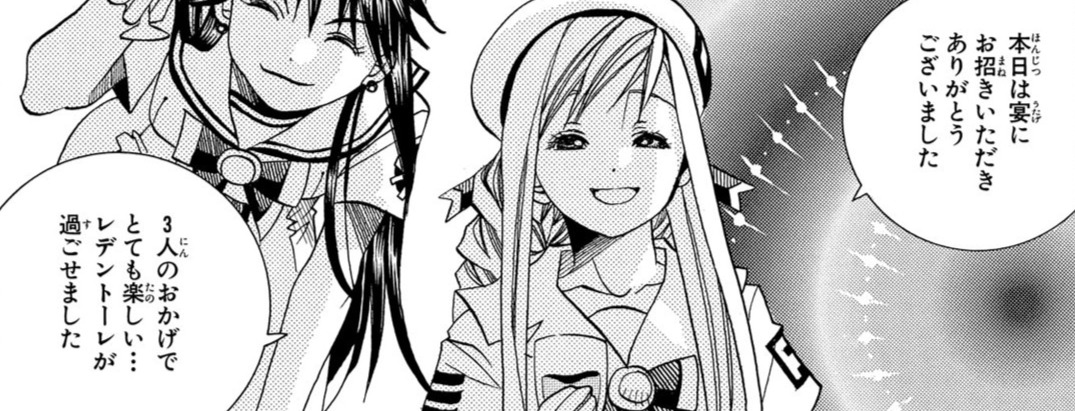
As part of their training, Akari, Aika, and Alice host a Festa del Redentore dinner. After, the guests gather before them.
- アリシア:
- 「本日は宴にお招きいただきありがとうございました」
- “Thank you for inviting me to the party today.”
- 「3人のおかげでとても楽しい…レデントーレが過ごせました」
- “Thanks to the three of you, I had a really fun time at the *Redentore*.”
As part of their training, Akari, Aika, and Alice have hosted a Festa del Redentore dinner, and the guests are thanking them as the evening ends. 3人のおかげで credits the three hosts, and 楽しい…レデントーレが過ごせました is the good result: a really fun Redentore. Here, おかげで works as a thank-you.
Example 2 of 2: Doing nothing but slack off with 〜てばっか
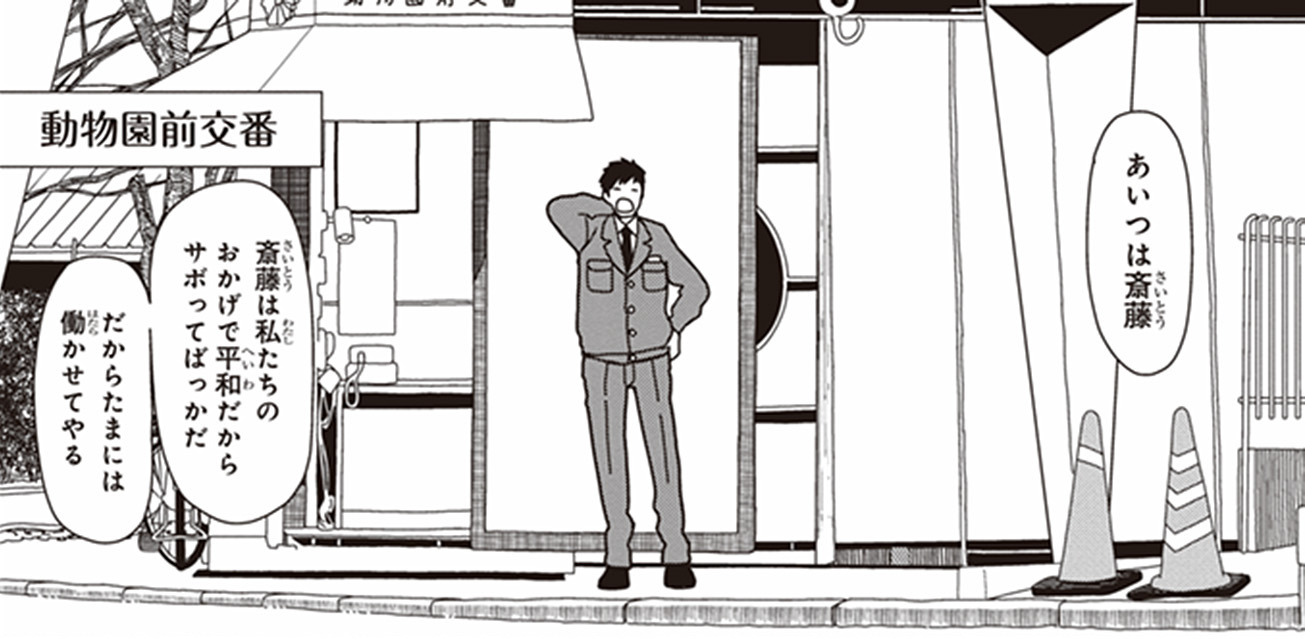
Yui, Sacchan, and Kotoha are making a video to introduce the Colors and the people of their town. After filming at a few local shops, they come to the police box by the zoo, where Officer Saitou works.
- 「動物園前交番」
- “Zoo-Front Police Box”
- さっちゃん:
- 「あいつは斎藤」
- “That guy is Saitou.”
- 「斎藤は私たちのおかげで平和だからサボってばっかだ」
- “Thanks to us, everything's peaceful, so Saitou does nothing but slack off.”
- 「だからたまには働かせてやる」
- “So for once, we're going to make him work.”
Sacchan is introducing Officer Saitou for the video the girls are making about their town. 私たちのおかげで credits the girls themselves with the good result, 平和, “peace”. This おかげで is a boast, not thanks.
Laying Blame with せいで
せいで is the mirror image of おかげで. It names the cause of a bad result, and when the cause is a person, it puts the blame on them: あなたのせいで失敗しちゃった, “I failed because of you”. The blame is usually plain to hear.
Speakers can blame themselves too. 寝る前にコーヒーを飲んだせいで、眠れなかった is “I couldn’t sleep because I drank coffee before bed”. The cause can also be something nobody controls: 大雨のせいで、花火大会が中止になった, “the fireworks show was canceled because of the heavy rain”. At the start of a sentence, そのせいで is “because of that”.
せい is used mostly, though not always, for bad results. A “neutral” せい also links a cause to an outcome without blame, and a welcome outcome can follow an unwelcome cause. For a good cause and a good result, though, use おかげで.
Example 1 of 2: Because of that guy with 〜せいで
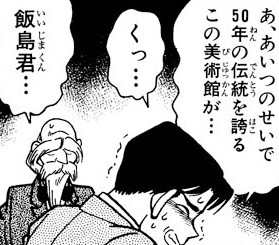
Ran, Conan, and Mouri are visiting an old art museum. Its new owner, Manaka, is closing it in ten days, and the director, Ochiai, explains that it will be torn down to build a hotel. The previous owner sold the museum on the promise that it would stay open, but Manaka announced the hotel plan as soon as he bought it. Iijima, a young staff member, mutters that it’s all Manaka’s fault.
- 飯島:
- 「あ、あいつのせいで50年の伝統を誇るこの美術館が…」
- “Because of th-that guy, this museum, with its proud fifty-year history…”
- 「くっ…」
- “Ngh…”
- 落合:
- 「飯島君…」
- “Iijima…”
Iijima works at an old art museum that its new owner, Manaka, plans to tear down for a hotel. あいつのせいで puts the blame for that squarely on Manaka. Iijima breaks off at この美術館が… before saying the bad result out loud, but everyone knows it: the museum will be torn down.
Example 2 of 2: Keeping a museum from shutting down with 事件
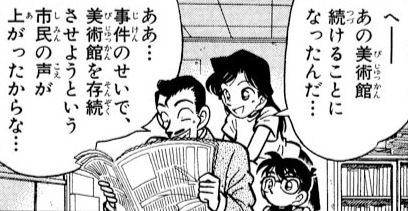
Following the solving of a murder case, Detective Mouri reads an article about the museum where the murder took place.
- 蘭:
- 「へーーー あの美術館続けることになったんだ…」
- “Wow... So they decided to keep the art museum open after all...”
- 毛利:
- 「ああ… 事件のせいで美術館を存続させようという市民の声が上がったからな…」
- “Yeah... Because of the incident, there was a public outcry to keep the art museum open...”
Later in the same story, Manaka is murdered at the museum. With the case solved, Mouri reads in the paper that the museum will stay open after all. 事件のせいで names the murder as the cause, and the result is 声が上がった: citizens spoke up to keep the museum going. Keeping the museum open isn’t a bad result, so this せいで doesn’t blame anyone. It fits because the cause itself, a murder, is unwelcome. 事件のおかげで would sound as if the murder had done the museum a favor.
Naming the Cause with せいだ and おかげだ
With だ or です at the end, the cause becomes the point of the sentence. The result comes first, either in an earlier sentence or as a clause with のは: 負けたのは私のせいだ, “it’s my fault we lost”. 勝てたのはみんなのおかげだ is “we won thanks to everyone”.
In conversation, the result often goes unsaid. 私のせいだ is “it’s my fault”, and お前のせいだ is “it’s your fault”. The negative, 〜のせいじゃない, is “it’s not ~’s fault”, and 誰のせいでもない is “it’s nobody’s fault”.
おかげだ is a common way to pass credit on to others. When someone congratulates you, みんなのおかげだよ is “it’s all thanks to everyone”.
Maybe Because with せいか and おかげか
Putting か in place of で turns the cause into a guess: “maybe because” or “perhaps thanks to”. 年のせいか、最近疲れやすくなった is “maybe it’s my age, but I tire easily lately”. お守りのおかげか、落ち着いて話せた is “maybe thanks to the charm, I could speak calmly”.
せいか is looser than せいで. The result is often bad, but it doesn’t have to be. 年が近いせいか、話しやすかった is “maybe because we’re close in age, they were easy to talk to”.
In speech, the guess often ends the sentence as 〜せいかな or 〜おかげかな, “maybe it’s because of ~”. 気のせいか is “maybe it’s just me, but…”.
Sarcastic おかげで
おかげで can also come before a bad result. Then the “thanks” is sarcastic, like English “thanks a lot”: 君のおかげで、何もかも失敗しちゃった, “thanks to you, everything went wrong”. 残業が多いのは上司のおかげだ is “all this overtime is thanks to my boss”.
Sarcastic おかげで can follow てくれた, which normally presents someone’s action as a favor. 間違った道を教えてくれたおかげで、倍の時間がかかったよ is “thanks to you telling me the wrong way, it took twice as long”.
Compared with せいで, sarcastic おかげで can sound half joking. せいで is the sharper complaint.
Blaming Someone with 〜のせいにする
ⒶをⒷのせいにする is “blame Ⓐ on Ⓑ”. It reports who someone holds responsible: 課長は失敗を部下のせいにしない, “the section chief doesn’t blame their subordinates for failures”. The bad result can be a clause with の: 遅れたのを電車のせいにした, “they blamed the train for being late”.
The speaker often thinks the blame is misplaced. 人のせいにするな, “don’t blame other people”, is a common rebuke. In the passive, 〜のせいにされる is “get blamed for it”.
Further Reading
- 〜せいで, 日本語文型バンク (NINJAL) (ninjal.ac.jp)
- 〜おかげで, 日本語文型バンク (NINJAL) (ninjal.ac.jp)
- 文法を楽しく「表現意図 -理由-」, 日本語教育通信 (Japan Foundation) (jpf.go.jp)
- せいだ/せいで/せいか, 教科書を作ろう (Japan Foundation) (kyozai.jpf.go.jp)
Related Grammar
- Because with 〜から
- から gives a reason without blame or credit. Unlike せいで and おかげで, it can lead into a request, a suggestion, or the speaker's decision.
- Objective reason with 〜ので
- ので explains a reason calmly. It doesn't say whether the result is good or bad.
- Purpose and cause with 〜ために
- Cause ため(に) names a cause without judging it, mostly in writing.
- Cause and means with 〜によって and 〜による
- によって is the formal, neutral way to say what brought a result about.
- Ways to say thank you in Japanese
- The thank-you page covers おかげさまで alongside other ways of expressing gratitude.
- Receiving kindness with 〜てくれる
- てくれたおかげで credits someone's favor. With a bad result, the same words turn sarcastic.