Casual reasons with 〜もん
Grammar: Reason and Cause » 〜もん
Sentence-final 〜もん (from もの) gives a reason with a childlike, self-justifying tone.
It defends the speaker and shows up wherever characters whine or dig in their heels.
Usage Notes
もん follows the plain form, usually reinforced as んだもん / だもん. It often pairs with だって (“but…”) that だって〜もん is practically a set frame for excuses.
The fuller ものだから / もんだから works mid-sentence as an apologetic reason: “it’s just that…”, often excusing something the speaker did. While もん sounds childish or feminine-cute in stereotyped character speech, ものだから is neutral.
Formation
View formation details
-
Plain form + (んだ)もん
- だって、知らなかったんだもん
- "But I didn't know, so there!"
-
Noun / な-adjective + だもん
- だって好きなんだもん
- "Well, it's because I like it!"
-
Clause + ものだから・もんだから (mid-sentence)
- 道が込んでいたものだから、遅れました
- "It's just that the roads were crowded, so I was late."
-
〜もの (feminine / literary)
- 仕方ないじゃない、子供なんですもの
- "It can't be helped. They're a child, after all."
The Childish Excuse
もん ends a protest with a verbal foot-stomp.
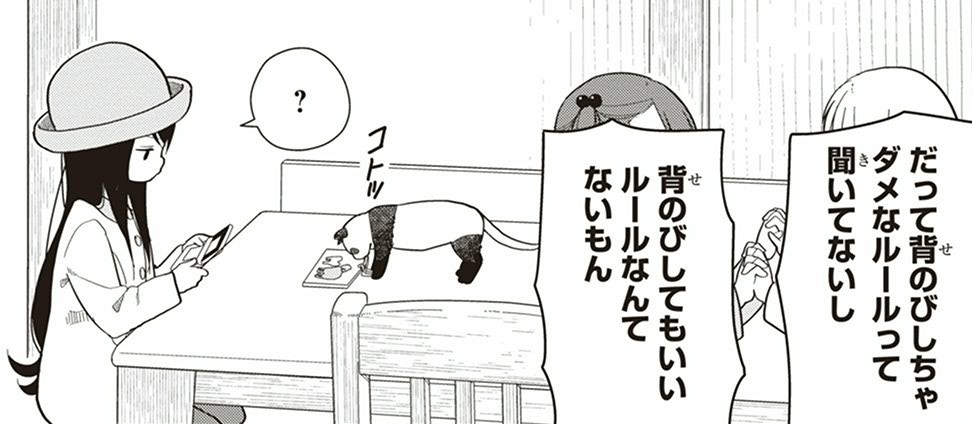
Standing back to back, Sacchan is slightly taller than Yui. Yui questions whether Sacchan is standing tip-toed, which Sacchan denies, but Yui looks and sees that Sacchan is.
- さっちゃん:
- 「だって背のびしちゃダメなルールって聞いてないし」
- “You say that, but I didn't hear a rule against tiptoes.”
- 結衣:
- 「背のびしてもいいルールなんてないもん」
- “There's no way there'd be a rule allowing tiptoes!”
Justifying a Refusal
The reason is presented as beyond argument.
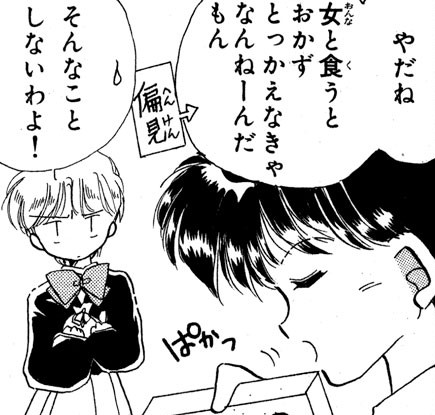
Rina asks Asuka Jr. if she can eat lunch with him.
- アスカ Jr.:
- 「やだね」
- “No way.”
- 「女と食うとおかずとっかえなきゃなんねーんだもん」
- “If I eat with a girl, I'd have to swap side dishes.”
- リナ:
- 「そんなことしないわよ!」
- “I wouldn't do that!”
Framing the Excuse with だって〜もん
だって opens the protest and もん closes it, bracketing the reason as a complete excuse.
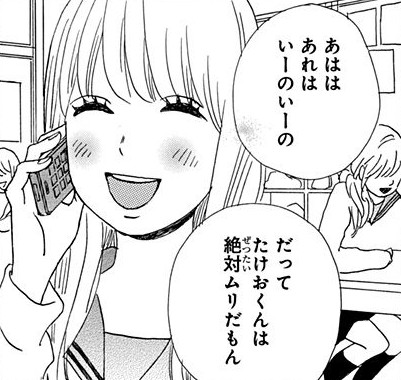
Takeo hopes to get into the same college as his girlfriend, Rinko. Going into a mock exam, he listed the top college Rinko is aiming for. However, the results came back saying it would be impossible for him to get into Rinko’s top choice. Rinko tells Takeo she didn’t do well for that college either, so they should both aim for her second choice. Takeo asks if Rinko is okay with giving up on her top choice.
- 凛子:
- 「あはは あれはいーのいーの」
- “Ha ha, I'm okay with that.”
- 「だってたけおくんは絶対ムリだもん」
- “I say that because it'd be impossible for you to go, Takeo.”
Apologetic Explanation with ものだから
Excuses without the childish tone.
Related Grammar
-
That said with だって
- だって opens the protest that もん closes.
-
Reasoning with 〜のだ
- のだ explains neutrally; もん pleads the speaker's case.
-
Objective reason with 〜ので
- ので presents a reason as objective; もん presents it as personal justification.
Supplemental Examples