Cause and means with 〜によって and 〜による
Grammar: Reason and Cause » 〜によって・〜による
〜によって connects a noun to what follows. It can identify a cause, a method, who or what did something, the rule an action follows, or a factor that changes the result. Depending on the sentence, English uses “because of”, “by”, “through”, “under”, or “depending on”.
The verb よる can mean “depend on”, “rely on”, or “be due to”. These meanings help connect the uses above. A result may depend on a factor, an action may rely on a method, or an event may be due to a cause.
〜による usually makes the same connection before a noun. 〜により is a written-style form of によって, common in notices and reports. 〜によっては can single out cases where a particular result occurs.
Usage Notes
よる is a godan verb, so its て-form is よって. によって combines に + よって, により uses the connecting stem より, and による uses the plain form よる.
A noun attaches directly, without の or だ. To use an action as the method or cause, turn it into a noun phrase with こと, as in 読むことによって.
The cause, method, and passive-agent uses are common in writing and formal explanations. The “depending on” use also appears in ordinary conversation, especially in replies such as 人による, “it depends on the person”.
Formation
View formation details
- Noun + によって + clause
- 大雪によってイベントが中止になった
- "The event was canceled because of heavy snow."
- Noun + による + noun
- 大雪によるイベントの中止
- "cancellation of the event because of heavy snow"
- Noun + により + clause
- 大雪によりイベントが中止になった
- "The event was canceled due to heavy snow."
- Note: Common in notices, reports, and announcements.
- Verb in plain form + ことによって + clause
- ビデオを見直すことによって、間違いに気づいた
- "I noticed the mistake by watching the video again."
- Noun + によっては + clause
- 店によっては、予約が必要です
- "Some shops require a reservation."
- Noun + による or によります at the end of a sentence
- 値段はサイズによります
- "The price depends on the size."
- Noun + によるものだ
- 事故は不注意によるものだった
- "The accident was due to carelessness."
Identifying a Cause
The noun before によって names what brought about the result.
- 大雪によってイベントが中止になった。
- The event was canceled because of heavy snow.
The cause can lead to a good or bad result. によって itself does not express gratitude or blame.
による can also end the sentence to say what something was due to. It often comes before もの.
- 事故は運転手の不注意によるものだった。
- The accident was due to the driver’s carelessness.
Don’t confuse this with 場合による, “it depends on the situation”, covered below.
によって sounds written or formal. In everyday conversation, で is the usual choice, as in 大雪で中止になった.
Explaining a Method
によって can name the method used to achieve something. With a verb, use ことによって.
- ビデオを見直すことによって、間違いに気づいた。
- I noticed the mistake by watching the video again.
This use often explains how an action produces a result. For everyday tools and transport, use で, as in バスで行く, “go by bus”. によって would sound out of place there.
Naming Who Did Something
In a receptive sentence, によって can mark the person or thing that performed the action. This is common in descriptions of works, inventions, and discoveries.
- この絵はロボットによって描かれた。
- This picture was drawn by a robot.
The picture is the subject. ロボットによって identifies who drew it.
With verbs of creating, such as 書く, 作る, 建てる, and 発明する, the agent takes によって or により, not に. The same goes for 発見する when it means a discovery, as in コロンブスによって発見された, “discovered by Columbus”.
This use belongs in receptives that report objective facts. For a personal experience such as 母に叱られた, “I was scolded by my mother”, the agent takes に. When a creation is told as a personal event, the active voice is more natural, as in 父が作った棚, “the shelf my father made”.
Saying What the Result Depends On
With words such as 違う, “differ”, or 変わる, “change”, によって identifies the factor that makes the result vary.
- 同じ言葉でも、言い方によって意味が変わる。
- Even the same words can mean different things depending on how you say them.
This is the use behind short replies such as 場合による, “it depends on the situation”. Here による ends the sentence as a verb. Its polite form is によります.
- 値段はサイズによります。
- The price depends on the size.
Specific Cases with によっては
When discussing variation, は can single out cases where something holds. English often uses “some” or “in some cases”.
- 店によっては、予約が必要です。
- Some shops require a reservation.
Compare 店によって値段が違う, “prices differ from shop to shop”. によって describes variation across shops. によっては draws attention to shops with a particular requirement.
は can also contrast a method with other methods, often before a negative.
- 手紙の温かさは、メールによっては伝えられない。
- The warmth of a letter can’t be conveyed by email.
This doesn’t mean “some emails”. The は sets email against other ways of communicating, such as a handwritten letter. The rest of the sentence tells you which reading fits.
Putting による Before a Noun
When the phrase directly modifies a noun, use による. The relationship can be a cause, a method, an agent, or the factor something depends on.
| Phrase | Meaning |
|---|---|
| 大雪による中止 | cancellation because of heavy snow |
| 投票による決定 | a decision made by voting |
| ロボットによる絵 | a picture by a robot |
| 人による考え方の違い | differences in thinking from person to person |
In 大雪によってイベントが中止になった, によって connects the cause to a clause, “the event was canceled because of heavy snow”.
In 大雪によるイベントの中止, による modifies the noun 中止, “cancellation of the event because of heavy snow”.
Recognizing により
により fills much the same role as によって in written and formal contexts. It often appears in announcements and reports.
- 設備の点検により、本日は休館いたします。
- We are closed today for an equipment inspection.
This is a difference in style, not politeness. In the example, the polite tone comes from いたします.
Notices often use により, or によって, to name the rule behind an action. English often uses “under”.
- 規則により、館内での撮影は禁止されています。
- Under the rules, photography is prohibited inside the building.
Compare 規則によると, which reports what the rules say. The next section covers that form.
Reporting a Source with によると and によれば
によると and によれば commonly introduce the source of information, meaning “according to”.
- 先生の話によると、テストは来週だそうだ。
- According to the teacher, the test is next week.
Here, 先生の話 names the source of the information. によると and によれば are other forms of the same verb よる, ending in と or ば. They report a source, so によって can’t replace them in this sentence.
For the source-reporting forms, see According to with 〜によると and 〜によれば.
Example 1 of 2: According to the rules with 〜によると
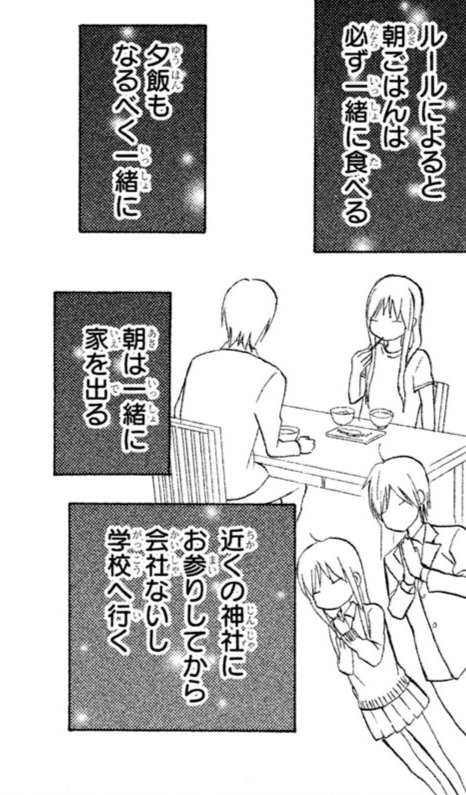
Now that Mao is living at Hiro’s house, Hiro presents her with a list of rules. Before going to bed, Mao looks the list over.
- 真魚:
- 「ルールによると朝ごはんは必ず一緒に食べる」
- “According to the rules, we must always eat breakfast together.”
- 「夕飯もなるべく一緒に」
- “We should eat dinner together too, as often as possible.”
- 「朝は一緒に家を出る」
- “We leave the house together in the morning.”
- 「近くの神社にお参りしてから会社ないし学校へ行く」
- “After praying at the nearby shrine, we go to work or school.”
Mao has moved into Hiro’s house, and before bed she reads over his list of house rules. ルールによると, “according to the rules”, names the source of what follows: they must always eat breakfast together. This によると points to where the information comes from, not to a cause.
Example 2 of 2: According to Nostradamus with 〜によれば
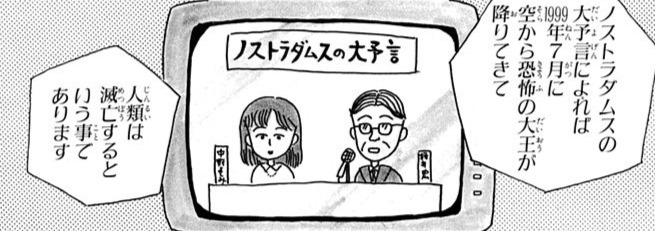
Maruko learns about Nostradamus and his predictions from a classmate. She tells her family about it, leading to them watching a TV show about it that night.
- アナウンサー:
- 「ノストラダムスの大予言によれば1999年7月に空から恐怖の大王が降りてきて」
- “According to Nostradamus's great prophecy, in July 1999 a great king of terror will descend from the sky...”
- 「人類は滅亡するという事であります」
- “...and humanity will perish.”
Maruko’s family is watching a TV show about Nostradamus. ノストラダムスの大予言によれば, “according to Nostradamus’s great prophecy”, introduces the source with ば in place of と. Either form works here.
A Related Negative Form
によらず can mean “regardless of” or “without relying on”. よらず is the written negative of よる, formed from よら plus ず, so によらず works like よらないで. It is not the everyday negative よらない.
- 経験によらず、誰でも参加できます。
- Anyone can participate, regardless of experience.
Here, experience does not determine who can participate. You will also meet the set phrase 見かけによらず, “despite appearances”.
Further Reading
- よる, NINJAL Basic Verbs Dictionary (www2.ninjal.ac.jp)
- によって・により・によっては・による, Japan Foundation (kyozai.jpf.go.jp)
- 〜によって・〜による, MLC Japanese Language School (mlcjapanese.co.jp)
- によると・によれば, Japan Foundation (kyozai.jpf.go.jp)
Related Grammar
- According to with 〜によると and 〜によれば
- によると and によれば introduce the source of information, meaning "according to".
- Receptive verbs with 〜れる
- によって can identify the agent in a receptive sentence.
- Hearsay with 〜そうだ
- によると and によれば name the source of reported information.
- Objective reason with 〜ので
- ので connects a reason clause to its result. によって follows a noun or a noun phrase.