Compound voicing with 連濁
Grammar: Sound Changes
連濁, or compound voicing, changes the first consonant of a compound’s second part to its voiced counterpart. For example, 手 and 紙 combine as 手紙, “letter”. The change is common, but it does not happen in every compound.
Recognize the Second Part
You may know 薬, “medicine”, and still hesitate over 目薬, “eye drops”. The second part is the same word. Its initial く has become ぐ through 連濁.
The main kana-row changes are:
| Plain Row | Voiced Row | Example |
|---|---|---|
| か・き・く・け・こ | が・ぎ・ぐ・げ・ご | 手 + 紙 → 手紙, letter |
| さ・し・す・せ・そ | ざ・じ・ず・ぜ・ぞ | 巻き + 寿司 → 巻き寿司, rolled sushi |
| た・ち・つ・て・と | だ・ぢ・づ・で・ど | 時 + 時 → 時々, sometimes |
| は・ひ・ふ・へ・ほ | ば・び・ぶ・べ・ぼ | 花 + 火 → 花火, fireworks |
The second part changes at its beginning. In てがみ, か becomes が; the rest of かみ stays the same. The h-row gives b-row sounds, so ひ becomes び in はなび.
Example 1 of 18: Dazed by a wristwatch with 気が遠くなる
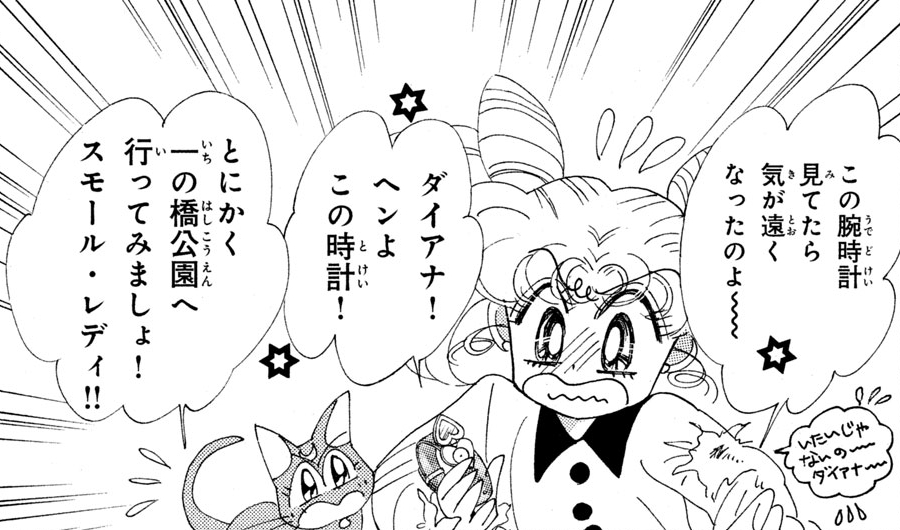
At the stroke of midnight, Chibiusa wakes to a mysterious glow from her new wristwatch. She gets out of bed in a daze, and begins to leave the room. Her cat, Diana, bites her on the arm, returning Chibiusa from her trance.
- ちびうさ:
- 「この腕時計見てたら気が遠くなったのよ〰〰」
- “When I looked at this wristwatch, I became lightheaded〰”
- 「ダイアナ! ヘンよ この時計!」
- “Diana! Something is strange about this watch!”
- ダイアナ:
- 「とにかく 一の橋公園へ行ってみましょ! スモール・レディ!!」
- “Anyway, let's try going to Ichinohashi Park! Small Lady!!”
Chibiusa’s new watch glowed at midnight and put her in a trance. 腕時計 is うで, “arm”, plus とけい, “clock”. The と of とけい voices to ど.
Example 2 of 18: Raised in a snowy region with 雪国
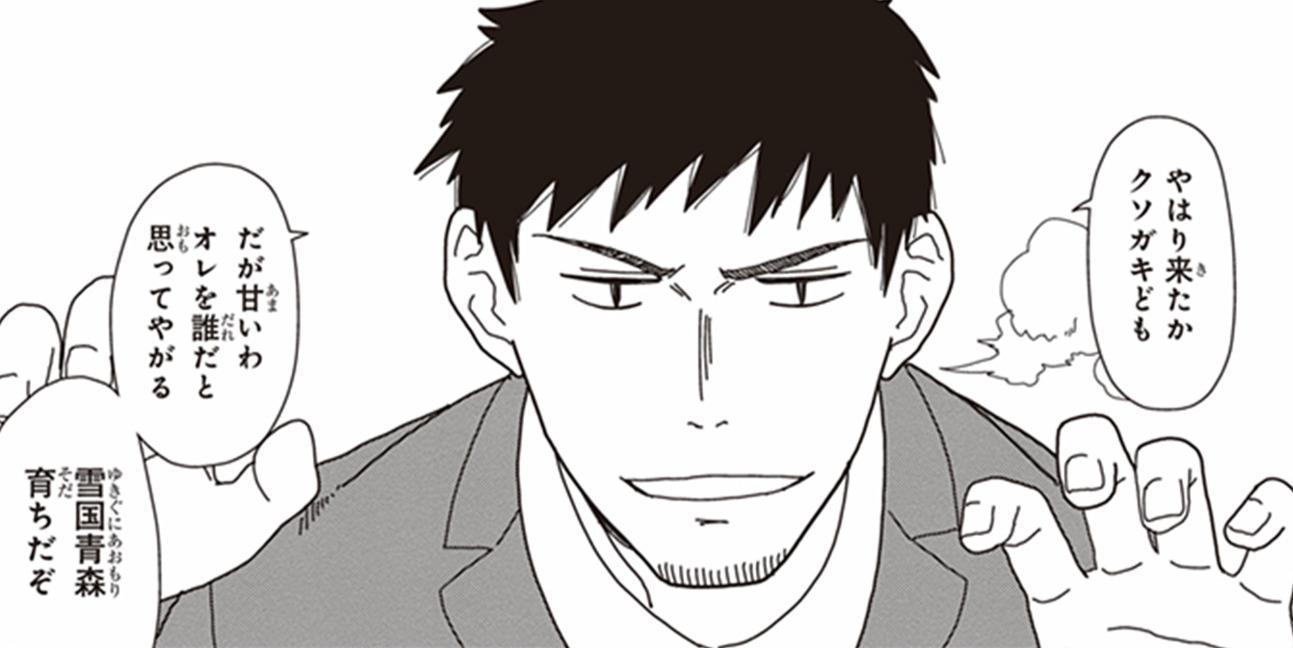
Sacchan, Yui, and Kotoha play in the snow in various ways. After running out of things to do, Sacchan comes up with an idea. They head over to Officer Saitou and greet him with snowballs in hand.
- 斎藤:
- 「やはり来たか クソガキども」
- “So you came after all, you little brats.”
- 「だが甘いわ オレを誰だと思ってやがる」
- “But you underestimate me! Just who do you think I am?”
- 「雪国青森育ちだぞ」
- “I grew up in Aomori, in snow country!”
Officer Saitou boasts that he grew up in snowy Aomori. 雪国 is ゆき, “snow”, plus くに, “country”, and く voices to ぐ.
Example 3 of 18: A schoolyard chicken coop with 小屋
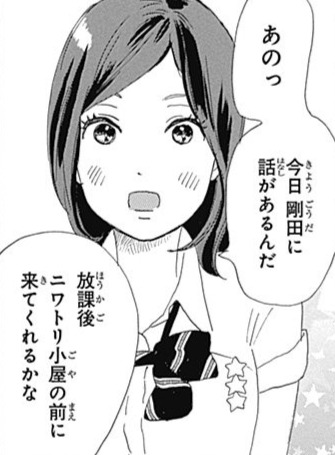
After Takeo (Gouda) has helped her out multiple times, Saijou considers confessing her feelings to him. She waits for him near the shoe lockers before class.
- 西城:
- 「あのっ 今日剛田に話があるんだ」
- “Um... I need to talk to you today.”
- 「放課後ニワトリ小屋の前に来てくれるかな」
- “Could you come to the chicken coop after school?”
Saijou asks Takeo to meet her at the chicken coop after school. On its own, 小屋 is “hut”. After ニワトリ, “chicken”, it becomes 小屋.
Example 4 of 18: Might get along with 〜かもしれない

Tippy remarks on how Cocoa adapted immediately to working in the café.
- お父さん:
- 「ただあの娘あっという間に店になじんでしまった」
- “Still, that girl settled into the café in no time.”
- ティッピー:
- 「チノにはああいう友達が合ってるかもしれん」
- “Maybe a friend like that suits Chino.”
Tippy thinks a friend like Cocoa suits Chino. 友達 is とも, “companion”, plus たち, the plural ending, and た voices to だ.
Example 5 of 18: Gotten completely lost in an abandoned building with 〜ちゃう
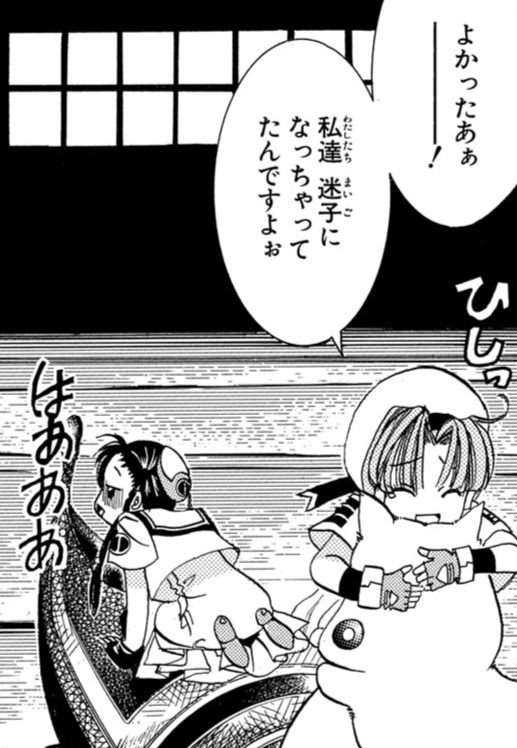
During training, Akari spots her company’s feline president, President Aria, sailing by in a small gondola. She instructs Aika to row the training gondola in the same direction, and the two follow him down an alley that’s normally gated from entry. The two lose sight of Aria and find themselves going in circles through flooded abandoned buildings. After some time, Aria’s gondola floats by.
- 灯里:
- 「よかったあぁーーーーー! 私達 迷子になっちゃってたんですよぉ」
- “Oh, thank goooodness! We had gotten completely lost, you know!”
Akari and Aika followed President Aria into a gated alley and lost their way. 迷子, “lost child”, is まい plus こ, “child”, and こ voices to ご.
Example 6 of 18: The trouble of forgetting about today with せっかく〜のに

After Cocoa has a string of bad luck throughout the day, Chiya takes her to the tea shop where Syaro works to get her mind off everything that happened.
Just as Cocoa’s finally cheered up, Syaro comments to herself about her own bad luck, returning Cocoa to gloom.
- 千夜:
- 「せっかく今日の出来事忘れてたのについてないなんて言っちゃだめ!」
- “We went through the trouble to forget about today, so don't say bad luck!”
- シャロ:
- 「よくわからないけどめんどくさい…」
- “I don't really understand, but this is a pain...”
Cocoa had bad luck all day, and Chiya brought her to Syaro’s tea shop to forget it. 出来事, “events”, is でき, from 出来る, “happen”, plus こと, “thing”, and こ voices to ご.
Example 7 of 18: Scheduled to work outside at night with 〜ことになる
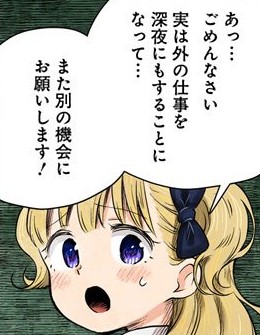
Kate says she wants to study together with Emiriko before bedtime.
- エミリコ:
- 「あっ… ごめんなさい。実は外の仕事を深夜にもすることになって…」
- “Ah, I'm sorry. The truth is, I'm scheduled to do late-night work outside...”
- 「また別の機会にお願いします!」
- “Please ask again another time!”
Kate wants to study with Emiriko before bed, but Emiriko has been assigned late-night work outside, 外の仕事. 仕事 is し, from する, plus こと, and こ voices to ご, as in 出来事.
Example 8 of 18: Want you always by my side with 〜てほしい
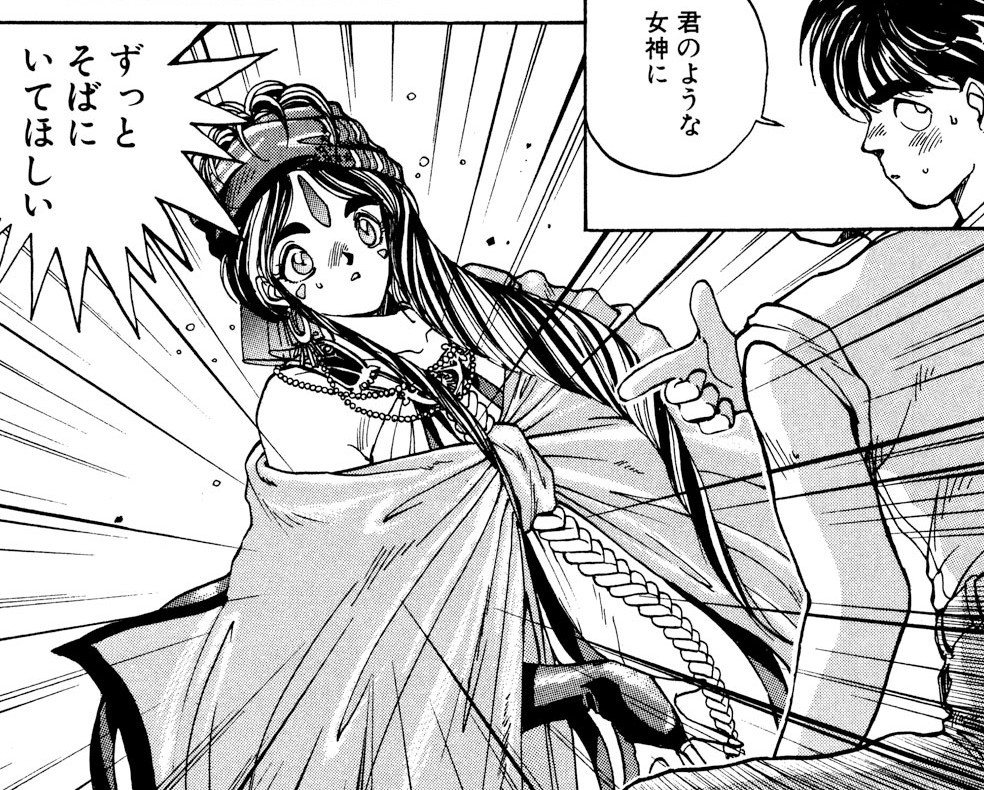
After accidentally dialing the Goddess Technical Help Line, Kei’ichi finds himself face-to-face with a Goddess offering him a wish. After a brief conversation, Kei-ichi flippantly makes a wish.
- 螢一:
- 「君のような女神にずっとそばにいてほしい」
- “I want a Goddess like you to always be by my side.”
Kei’ichi accidentally dialed the Goddess Technical Help Line, and a goddess appeared to grant him a wish. 女神 is め, “woman”, plus かみ, “god”, and か voices to が, as in 手紙.
Example 9 of 18: Attraction to the opposite sex with 異性
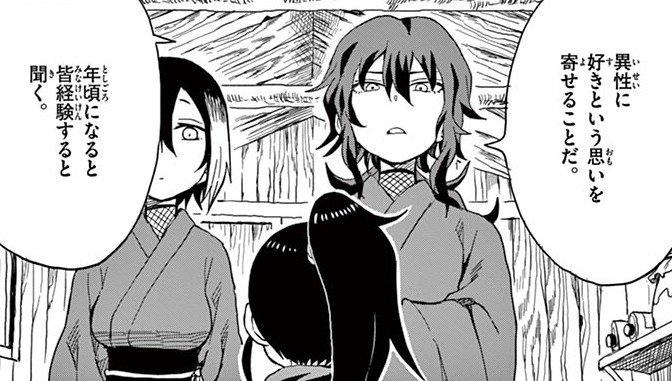
During a ninja training exercise, Tsubaki disguises herself as the teacher’s assistant in the hope of getting close enough to take the teacher’s mask. When the teacher unknowingly reveals that keeping boys and girls separate has been aided by lying to the female ninjas about men being scary, Tsubaki accidentally drops her disguise. The teacher has no choice but to take Tsubaki into her confidence and explain the reason for the separation, starting with the word “love”, of which Tsubaki is unfamiliar.
- ハナ先生:
- 「異性に好きという思いを寄せることだ。」
- “It means harboring feelings of affection for someone of the opposite sex.”
- 「年頃になると皆経験すると聞く。」
- “I hear that everyone goes through this when they reach a certain age.”
Hana-sensei explains what it means to have feelings for someone, and says everyone goes through it at a certain age, 年頃. とし, “age”, plus ころ, “time”, voices こ to ご.
Example 10 of 18: Interpretating dancing flower petals with 解釈
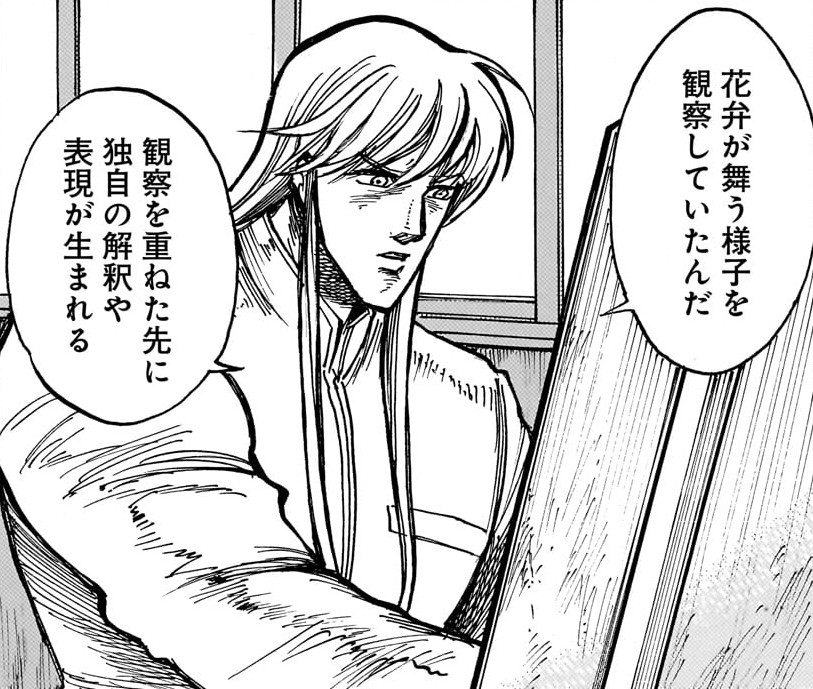
As she models for a sketch, Lulu recalls seeing Hideki blowing flower petals into the air. She brings it up to him.
- 秀樹:
- 「花弁が舞う様子を賢察していたんだ」
- “I was observing the petals as they danced.”
- 「観察を重ねた先に独自の解釈や表現が生まれる」
- “Through repeated observation, unique interpretations and expressions emerge.”
Lulu remembers Hideki blowing petals into the air, and he says he was watching them dance. 花弁 is はな, “flower”, plus ひら, “thin, flat piece”, and ひ voices to び, as in 花火.
Example 11 of 18: Nearby stores with 近隣店舗
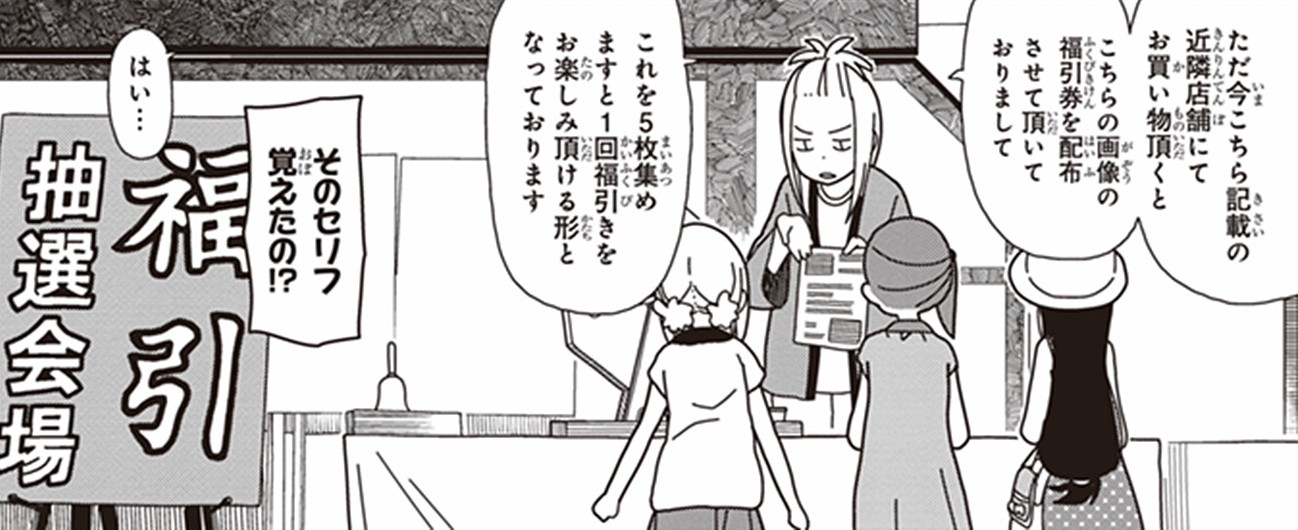
Upon entering the mall, Yui notices a lottery wheel. Sacchan and Kotoha join her, the two quickly pestering Subaru, the part-timer working the lottery, with random questions. Subaru pushes on with her script.
- すばる:
- 「ただ今こちら記載の近隣店舗にてお買い物頂くとこちらの画像の福引券を配布させて頂いておりまして」
- “Currently, when you make a purchase at a neighborhood store, we are distributing the raffle tickets shown in this image.”
- 「これを5枚集めますと1回福引きをお楽しみ頂ける形となっております」
- “If you collect five tickets, you'll be able to enjoy one lottery draw.”
- さっちゃん:
- 「そのセリフ覚えたの!?」
- “You memorized that line!?”
- すばる:
- 「はい…」
- “Yes...”
Subaru is reciting her script at the mall’s lottery booth. 福引き, “lottery draw”, is ふく, “fortune”, plus ひき, “pulling”, and ひ voices to び. The first part is an on-reading and the second is native Japanese.
Example 12 of 18: Suppressed presence with 〜た+つもり

While changing into her uniform, Rize hid in the closet when she sensed someone unfamiliar nearby. Cocoa, feeling as though she was being watched, opened the closet door.
- ココア:
- 「下着姿の…ドロボーさん?」
- “A burglar… in their underwear?”
- リゼ:
- 「完全に気配を殺してたつもりなのに」
- “I thought I completely suppressed my presence, and yet...”
Rize hid in the closet while changing, and Cocoa opens the door to find a “burglar” in her underwear, 下着姿. した, “under”, plus き, “wear”, gives したぎ.
Example 13 of 18: Decision made during the day yesterday with 〜うちに
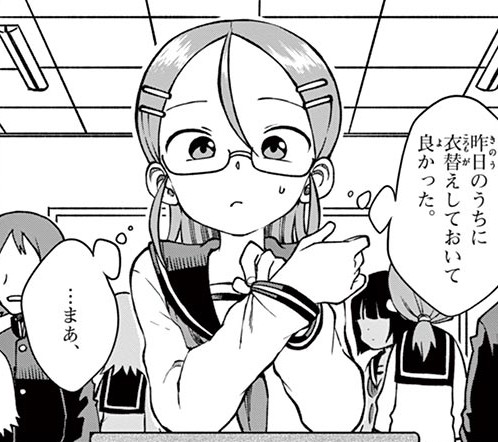
Yukari and her friends have a miscommunication on whether they’ll change from their summer uniforms to their winter uniforms yet. The decision is finalized just in time, as the following day is even colder.
- ユカリ:
- 「昨日のうちに衣替えしておいて良かった。」
- “I'm glad we (took the opportunity and) settled our uniform change (during) yesterday.”
Yukari and her friends switched to winter uniforms yesterday, and today is even colder. 衣替え, “seasonal change of clothes”, is ころも, “clothing”, plus かえ, “change”, and か voices to が.
Example 14 of 18: I'd totally die in the heat with 〜じゃう
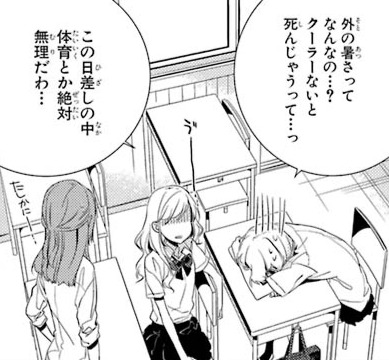
On a summer day, Hori and her friends in class can’t ignore the heat.
- 由紀:
- 「外の暑さってなんなの…? クーラーないと死んじゃうって…っ」
- “What's with this heat outside...? I'd totally die without the AC...”
- 「この日差しのなか体育とか絶対無理だわ…」
- “There's no way I can do PE in this blazing sun...”
It’s a hot summer day, and Yuki can’t face PE in this sun. 日差し, “sunlight”, is ひ, “sun”, plus さし, “shining”, and さ voices to ざ.
Example 15 of 18: Bedding by the window with 窓際
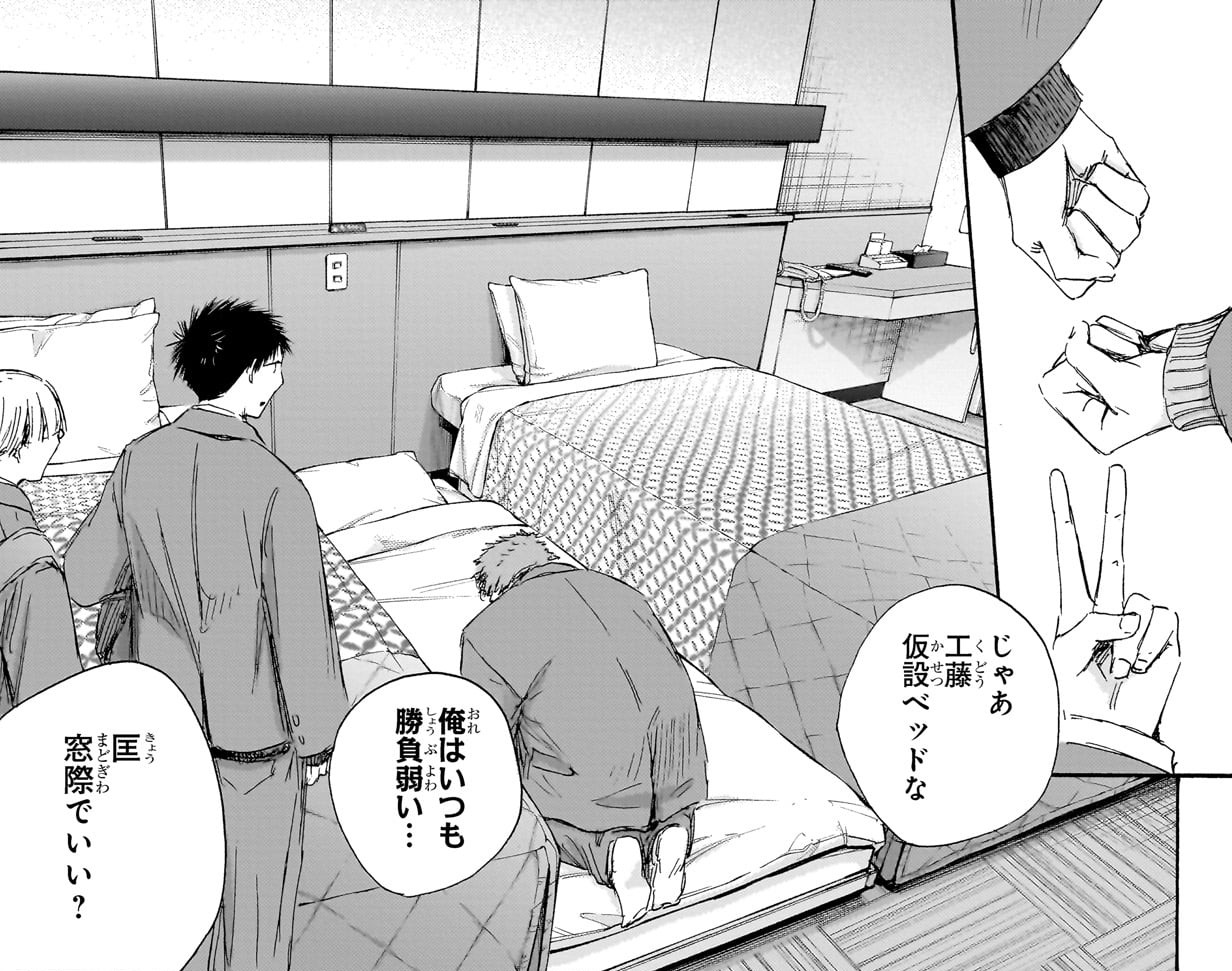
Taiki and his classmates are on the arrival day on their senior school trip. Taiki, Kyou, and Kudou are sharing a room, but with only two beds, they play a game of rock, paper, scissors to decide who sleeps on the floor. Kudou loses.
- ◯:
- 「じゃあ 工藤 仮設ベッドな」
- “All right then, Kudou, the makeshift bed is yours.”
- 工藤:
- 「俺はいつも勝負弱い…」
- “I always choke in competitions...”
- たいき:
- 「匡 窓際でいい?」
- “Kyou, is the spot by the window okay?”
On a school trip, Taiki, Kyou, and Kudou are sharing a room with two beds, and Kudou lost the game for one. Taiki offers Kyou the 窓際, “spot by the window”. まど, “window”, plus きわ, “edge”, voices きわ to ぎわ. The ど in まど doesn’t block it, because only a voiced sound in the second part does.
Example 16 of 18: Strange behavior with 異様
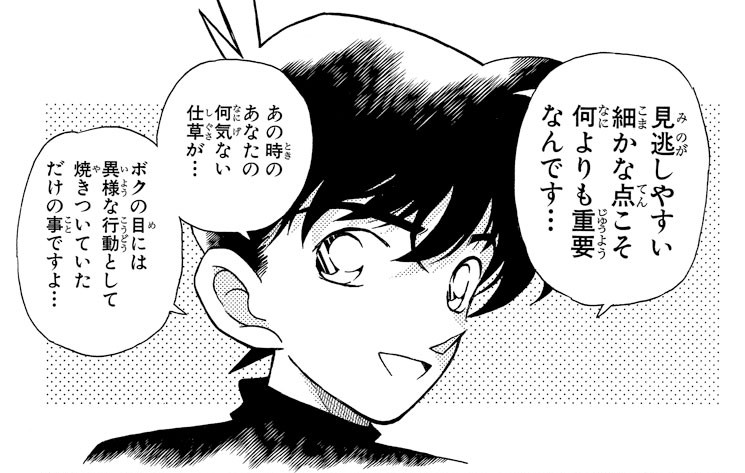
Shin’ichi reveals the details of a murder. The culprit asks how Shin’ichi discovered the hidden weapon, and he explains it was due to a specific movement the culprit made.
- 新一:
- 「見逃しやすい細かな点こそ何よりも重要なんです…」
- “It's precisely those subtle details that are easy to overlook that matter most of all...”
- 「あの時のあなたの何気ない仕草が…」
- “That casual gesture of yours back then...”
- 「僕の目には異様な行動として焼きついてただけの事ですよ…」
- “It's just that it was etched in my mind as strange behavior...”
Shin’ichi explains that the culprit gave himself away with a casual gesture, 何気ない仕草. 仕草 is し, from する, plus くさ, “kind”, and く voices to ぐ.
Example 17 of 18: Better to give up fortune telling with 〜た+方がいい

Cocoa did fortune telling for her friends, only for all their fortunes to happen to her in a bad way.
- チノ:
- 「ココアさんは人の不幸の身代わりになる才能があるんですか?」
- “Cocoa, do you have a talent for taking on other people's misfortune?”
- リゼ:
- 「今後占いやめた方がいいぞ自分のために」
- “For your own sake, you had better stop fortune telling from now on.”
- ココア:
- 「なんで!?」
- “Why!?”
Cocoa told her friends’ fortunes, and all the bad luck landed on her instead. Chino wonders if she has a talent for being a 身代わり, “stand-in”. み, “body”, plus かわり, “substitute”, voices か to が.
Example 18 of 18: Testing one's detective ability with 能力
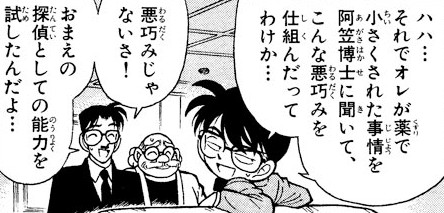
Conan finds himself in the clutches of a dangerous pair, only to discover it’s his parents in disguise.
- コナン:
- 「ハハ… それでオレが薬で小さくされた事情を阿笠博士に聞いて、こんな悪巧みを仕組んだってわけか…」
- “So you heard from Dr. Agasa about how I was shrunk by a drug and cooked up this evil scheme, huh...”
- 父さん:
- 「悪巧みじゃないさ! おまえの探偵としての能力を試してんだよ…」
- “It's not an evil scheme! I'm just testing your abilities as a detective...”
Conan was grabbed by a dangerous-looking pair who turned out to be his parents, and he calls it a 悪巧み, “evil scheme”. わる, “bad”, plus たくみ, “scheme”, voices た to だ.
Adjectives and Verbs Voice Too
連濁 isn’t limited to nouns. Compound adjectives and verbs voice the same way: 心 + 細い becomes 心細い, “uneasy”, and 欲 + 張る becomes 欲張る, “be greedy”.
Example 1 of 3: When you're small with 〜うちは
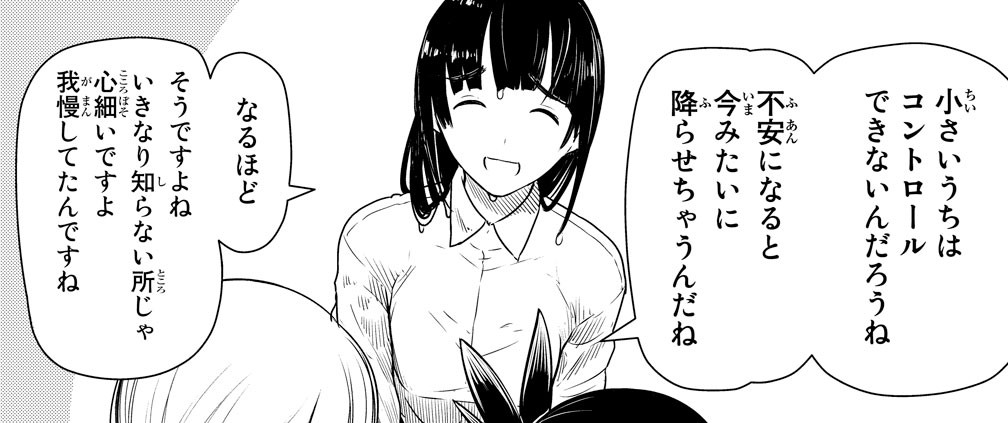
During a visit with Anzu’s family, Makoto receives a request to babysit for another witch. Things are fine at first, but after a while, rain begins to pour inside. Anzu’s mother realizes that the child they’re watching over has rain magic.
- 杏子の母:
- 「小さいうちはコントロールできないんだろうね。不安になると今みたいに降らせちゃうんだね」
- “You don't have control while you're small, right? When he gets uneasy, he makes it rain like just now.”
- 真琴:
- 「なるほど。そうですよね。いきなり知らない所じゃ心細いですよ。我慢してたんですね」
- “I see. So that's it. It's a little scary suddenly being in a place you don't know. You've been patient, haven't you?”
Makoto sympathizes with the young witch whose rain magic soaked the room: a strange place is 心細い, “lonely and uneasy”. こころ, “heart”, plus ほそい, “thin”, becomes こころぼそい.
Example 2 of 3: Even though it's still chilly with 〜が〜
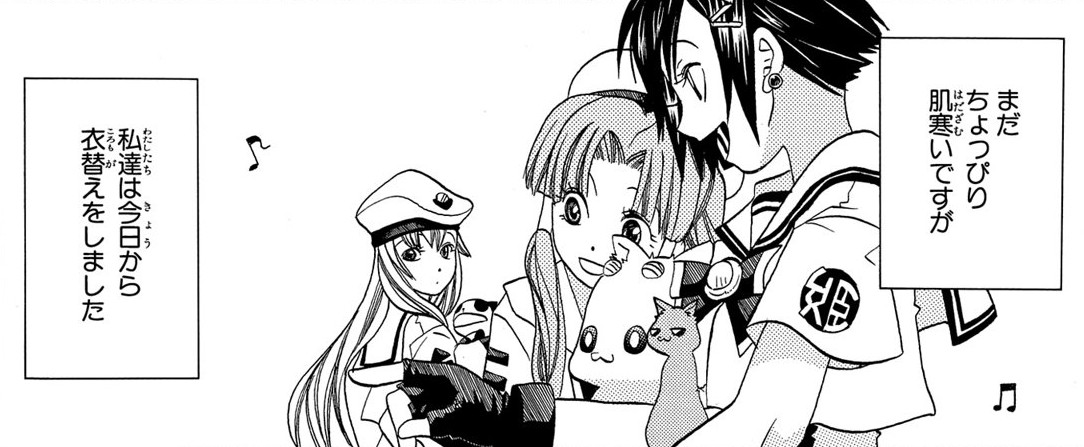
Akari narrates about her group’s change from winter uniforms to summer uniforms.
- 灯里:
- 「まだちょっぴり肌寒いですが私達は今日から衣替えをしました」
- “It is still a little chilly, but we changed our uniforms today.”
Akari narrates her group’s change to summer uniforms, though it’s still a little chilly, 肌寒い. はだ, “skin”, plus さむい, “cold”, voices さ to ざ. The だ in はだ is in the first part, so it doesn’t block the change.
Example 3 of 3: Grocery shopping plan understood with 了解
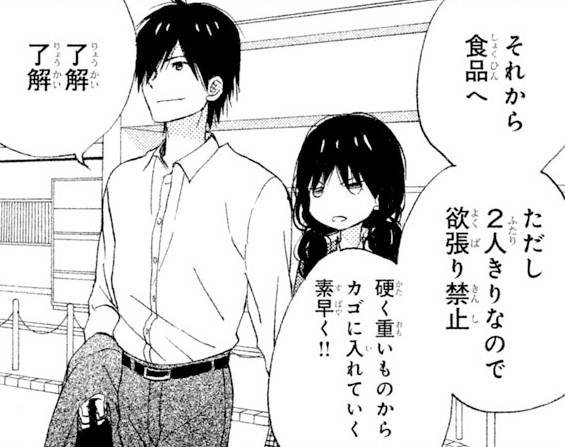
Mao needs Hiro to go grocery shopping with her due to a sale that’s limited per customer. She tells him the plan is to start by grabbing everyday household items first.
- 真魚:
- 「それから食品へ」
- “Then move on to food.”
- 「ただし2人きりなので欲張り禁止」
- “But since it's just the two of us, no hoarding allowed!”
- 「硬く重いものからカゴに入れていく素早く!!」
- “Quickly start putting hard, heavy items into the basket!!”
- 基:
- 「了解 了解」
- “Roger that.”
Mao has a plan for a sale with a limit per customer: no hoarding, 欲張り禁止, and grab the heavy items fast, 素早く. 欲張り is よく, “greed”, plus はり, from 張る, “stretch”. 素早い is す, “bare”, plus はやい, “fast”. Both voice は to ば.
Repeated Words Can Voice Too
連濁 also appears when a word repeats:
| Base Word | Repeated Form | Meaning |
|---|---|---|
| 時 | 時々 | sometimes |
| 人 | 人々 | people |
The mark 々 tells you to repeat the preceding kanji. The repeated part may have a different pronunciation, as とき becomes どき and ひと becomes びと.
Example 1 of 2: Ticket inspection aboard a water bus with 船内
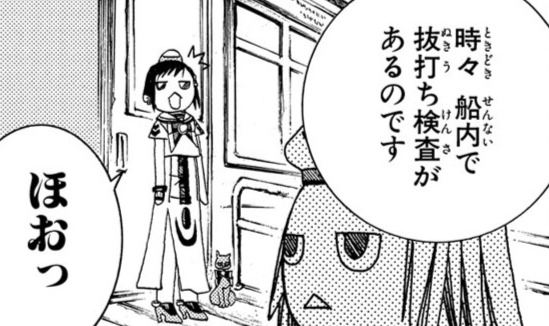
During a meal before practice, Aika notices how Akari is friends with many strangers. Akari says she’ll be missing practice that afternoon because Alicia asked her to buy something. Once she’s gone, Aika and Alice decide to tail her and see if they can learn her secret to being friends with everyone. The two lose sight of Akari, but Alice suggests Akari may have boarded the vaporetto, the water bus. They decided to board as well, but Aika’s never been on the vaporetto before. Alice explains the ticket system, which doesn’t require showing one’s ticket when getting off, but that doesn’t mean they can skip paying.
- アリス:
- 「時々 船内で抜き打ち検査があるのです」
- “Every now and then, they do surprise inspections on board.”
Aika and Alice have followed Akari onto a vaporetto, a water bus, and Alice explains that nobody checks tickets when you get off. That doesn’t mean you can skip paying: 時々, “now and then”, there are surprise inspections on board. 々 repeats 時, and the repeat voices: とき + とき becomes ときどき.
Example 2 of 2: Coming all the way up here in the mountains with 足を運ぶ
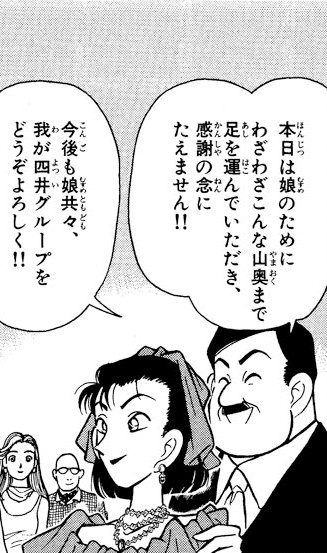
A large gathering takes place in a mansion deep in the mountains, in celebration of Reika, daughter of the head of Yotsui Group. After Reika blows out the candles on her birthday cake, her father congratulates her on turning 24, then he turns and addresses their guests.
- 四井:
- 「本日は娘のためにわざわざこんな山奥まで足を運んでいただき、感謝の念にたえません!!」
- “I can't thank you enough for coming all the way up here in the mountains today for my daughter!”
- 「今後も娘共々、我が四井グループを
どうぞ よろしく!!」 - “Please continue to be favorable to both my daughter and my Yotsui Group in the future!”
Reika’s father thanks his guests for coming all the way to the mountains for her birthday, and asks for their continued support for his daughter and his company alike: 娘共々. とも, “together”, repeated with 々, voices to ともども.
When 連濁 Is Blocked
If the second part already contains a voiced obstruent, a g, z, d, or b sound, it normally resists 連濁:
| Parts | Actual Reading | Why the Initial Sound Stays |
|---|---|---|
| 山 + 火事 | 山火事 | かじ already contains じ. |
| 合 + 鍵 | 合鍵 | かぎ already contains ぎ. |
In both words, the initial か of the second part stays か. This restriction concerns the second part. A voiced consonant in the first part does not automatically block the change: 渋 + 柿 gives 渋柿, “astringent persimmon”.
Here “voiced” has a narrower meaning than “any sound made with the voice”. An m, n, or r sound does not trigger this restriction. The み in かみ does not prevent てがみ.
Example 1 of 3: Protective hand mirror with 手鏡
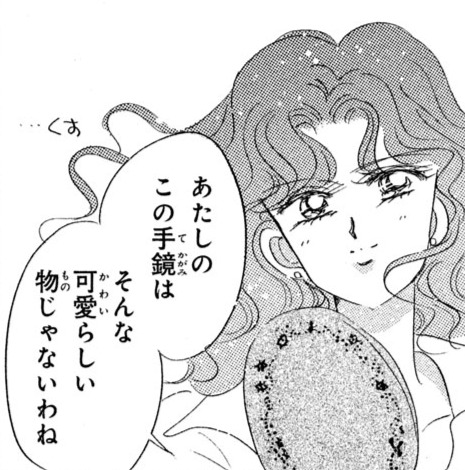
Seeing Chibiusa leaving Hotaru’s house, Haruka and Michiru stop over to pick her up. Michiru asks what the two were talking about, and Chibiusa explains that it was a conversation about amulets and their mysterious protective powers. She asks if Michiru has one. Michiru says her mirror may be protective, to which Chibiusa says it must be an amulet.
- みちる:
- 「あたしのこの手鏡はそんな可愛らしい物じゃないわね」
- “This hand mirror of mine isn't something that cute.”
Michiru’s hand mirror may protect her, but she says it’s nothing so cute as a charm. 手鏡 is て, “hand”, plus かがみ, “mirror”. Compare 手紙, where か voices. かがみ already contains が, so its か stays.
Example 2 of 3: Sensation of a bit cooled down with 〜気味

While visiting her friend Hiromi, Yukiko is the last one to use the heated bath. That is, except for Hiromi’s mother-in-law who will take a bath after returning from a late party.
- 広美:
- 「あ、どうだった湯加減?」
- “Ah, how was the water temperature?”
- 有希子:
- 「ちょっと冷めぎみ…だったかな…」
- “Maybe it's slightly cooled down a bit...”
Yukiko was the last to use the bath, and Hiromi asks about the water: 湯加減?, “how was the temperature?” ゆ, “hot water”, plus かげん, “adjustment”. かげん contains げ, so the か stays unvoiced.
Example 3 of 3: Chinese history lesson on talismans with 中国
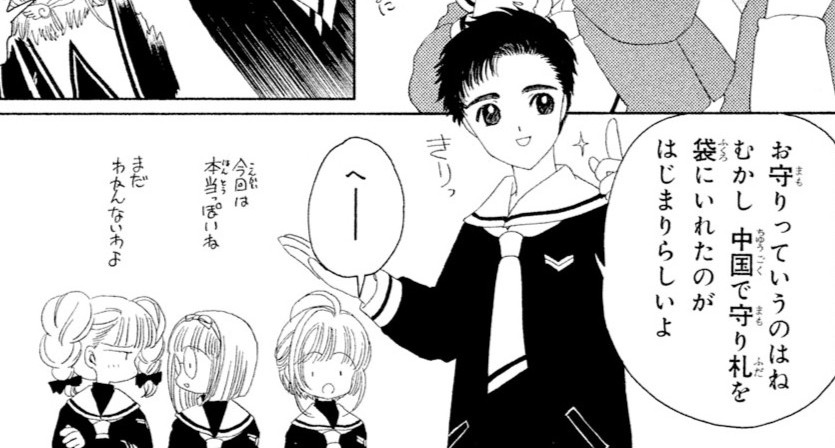
Sakura had to take a detour to get to class. She tells her friends at school about the shrine she saw along the way. Naoko says the talismans from there are popular, as they can grant wishes for things such as exams and romance.
- 山崎:
- 「お守りっていうのはね むかし 中国で守り札を袋にいれたのがはじまりらしいよ」
- “You know, apparently good-luck charms began long ago in China, when people put protective talismans into bags.”
- 奈緒子:
- 「今回は本当っぽいね」
- “This time it sounds true, huh?”
- 千春:
- 「まだ わかんないわよ」
- “We don't know that yet!”
Yamazaki claims charms began in ancient China, when people put 守り札, “protective talismans”, into bags. 札 already contains だ, so it stays ふだ rather than becoming ぶだ.
A Clue, Not a Complete Reading Rule
連濁 is most common with native Japanese words. Compounds built from on-readings and recent loanwords are less likely to follow it, though there are exceptions such as 文庫本, “paperback book”.
Even when no obvious restriction applies, a compound may keep the unvoiced sound. There is no complete rule that predicts every word’s reading. Learn a compound with its full reading. For a person’s name, use the reading given for that person.
When reading an unfamiliar compound, try restoring the second part’s plain consonant. A reading ending in がみ may contain かみ; a second part beginning with び may come from ひ. That gives you a word to look up.
Example 1 of 2: Leaving the mountain at the shortest route with 最短
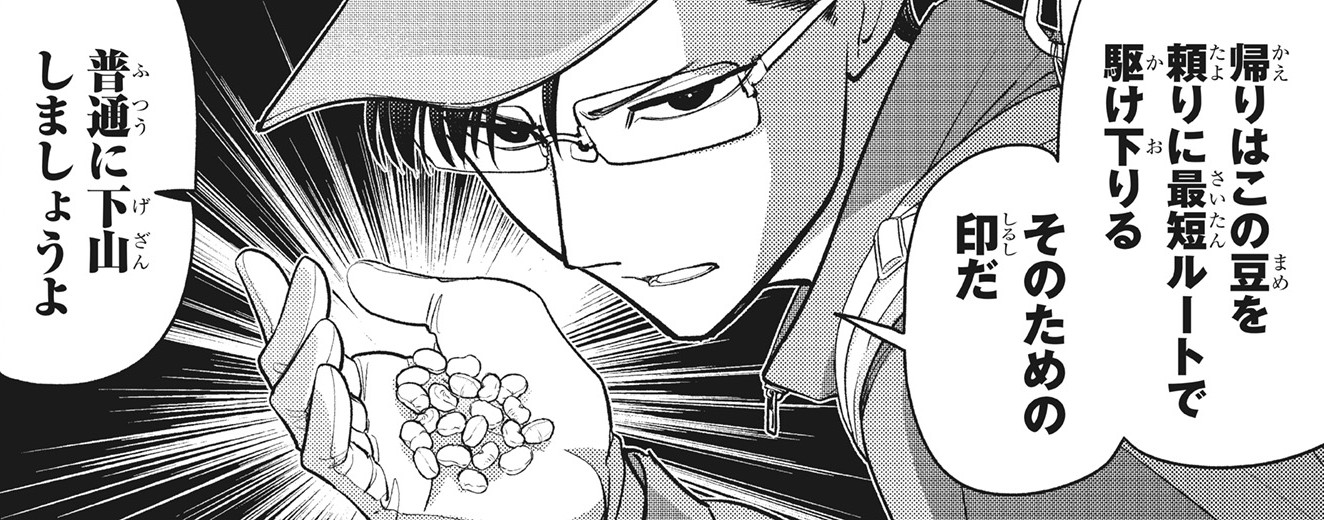
Kumada takes a trip to the mountain, in hope that the bear living in his apartment will follow him there, then he can run away and leave the bear stranded behind. He has with him his employee Sanami, an expert on mountains, to act as a guide. During their hike, Sanami asks Kumada why he’s placing beans on the ground as they go.
- 熊田:
- 「帰りはこの豆を頼りに最短ルートで駆け下りる」
- “On the way back, I'll use these beans as a guide and run down by the shortest route.”
- 「そのための印だ」
- “That's what the markers are for.”
- 砂波:
- 「普通に下山しましょうよ」
- “Let's just go down the mountain normally.”
Kumada plans to race down the mountain, and Sanami would rather go down normally. 下山 is built from on-readings, げ and さん, and さん voices anyway. Sino-Japanese compounds voice less often, but some do.
Example 2 of 2: Corresponding letters of the alphabet with 相当
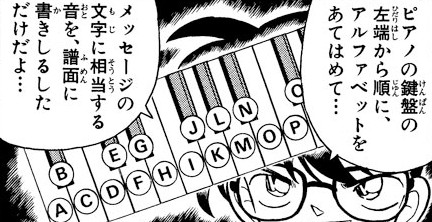
Following a series of murders, Conan discovers a message hidden in sheet music. He explains it to Ran.
- コナン:
- 「ピアノの鍵盤の左端から順に、アルファベットをあてはめて…」
- “Starting from the leftmost key on the piano keyboard, I assigned each key a letter...”
- 「メッセージの文字に相当する音を、譜面に書きしるしただけだよ…」
- “I simply wrote down the notes corresponding to the letters of the message on the sheet music...”
Conan explains the code in the sheet music, counting piano keys from the 左端, “left end”. ひだり, “left”, plus はし, “end”, stays はし. Nothing in はし blocks voicing. This is simply one of the compounds that keeps the plain sound.
Names Voice Too
Family names are full of 連濁. 高木 is たか + き, and 浜口 is はま + くち. But names don’t follow the pattern reliably: 山崎 can be やまざき or やまさき, and 中島 can be なかじま or なかしま, depending on the family. Use the reading given for the person.
Example 1 of 5: Getting good grades in school with 成績

Yukari stops by the preschool where Mina works, just as Takagi is there picking up her daughter. Yukari compares her life with theirs.
- ユカリ:
- 「高木ちゃんは成績よくて しっかりしてたし、」
- “Takagi-chan got good grades and had it together.”
- 「ミナは料理が得意だったりするじゃない。」
- “And Mina's good at cooking and such, right?”
Yukari runs into Takagi and Mina and compares her life with theirs. 高木 is たか, “tall”, plus き, “tree”, and き voices to ぎ.
Example 2 of 5: A junior or something with 〜か何か
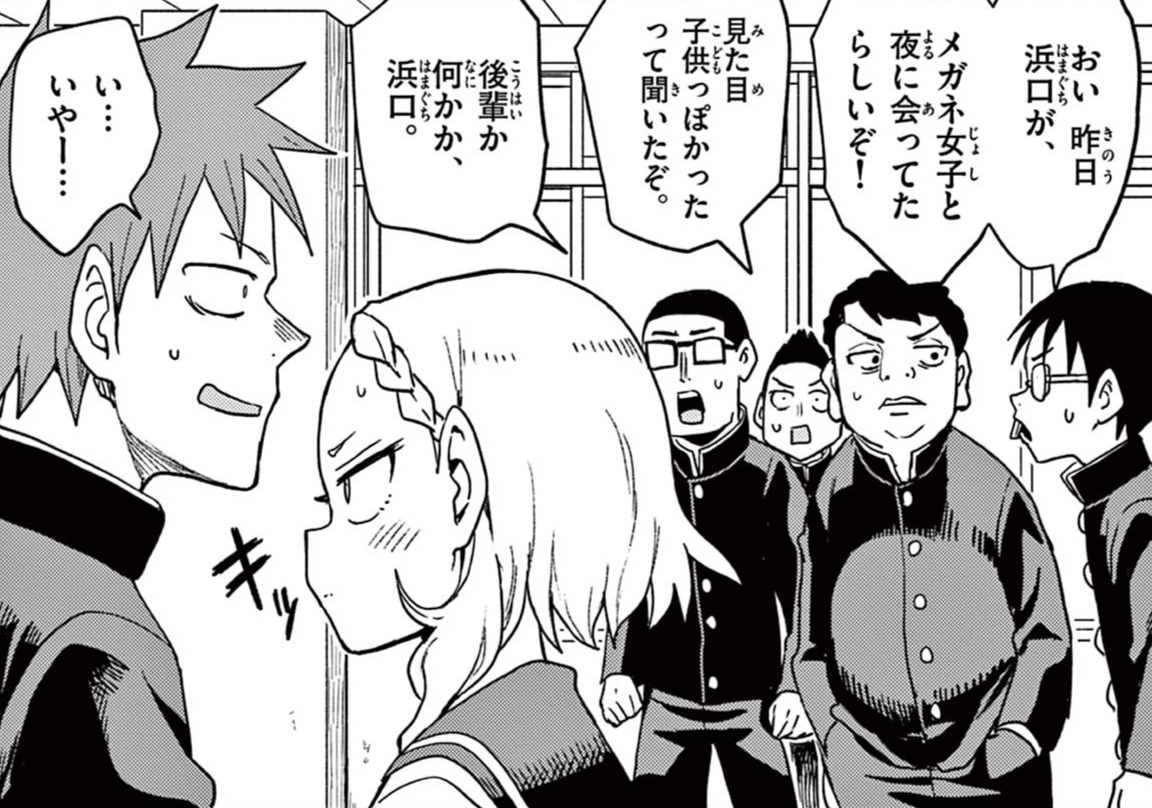
On a nighttime walk, Hamaguchi sees Hokujou casually dressed and wearing glasses. She’s fine with Hamaguchi seeing her like this, as they’ve known each other for a long time, but she tells him not to tell their classmates. At school the next morning…
- 高尾:
- 「おい 昨日浜口が、メガネ女子と夜に会ってたらしいぞ!」
- “Hey, I heard Hamaguchi was hanging out with a girl in glasses last night!”
- 生徒A:
- 「見た目子供っぽかったって聞いたぞ。」
- “I heard she looked kind of childish.”
- 生徒B:
- 「後輩か何かか、浜口。」
- “Is she a junior or something, Hamaguchi?”
- 浜口:
- 「い… いやー…」
- “Uh... well...”
Hamaguchi was seen out at night with a girl in glasses, and the class is buzzing. 浜口 is はま, “beach”, plus くち, “mouth”, and く voices to ぐ, the same change as in 入口, “entrance”.
Example 3 of 5: Don't suspect only me with 〜だけ
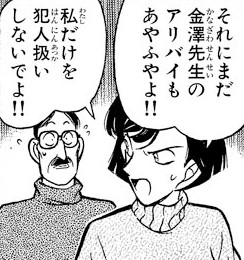
In a snow-covered mountain villa, a room full of suspects listen as Detective Mouri explains how their host was murdered. The accused notes she has a receipt showing she was at the convenience store at the bottom of the mountain when the murder took place.
- 中原:
- 「それにまだ金澤先生のアリバイもあやふやよ!!」
- “Moreover, Mr. Kanazawa's alibi is also vague!”
- 「私だけを犯人扱いしないでよ!!」
- “Don't treat only me as the suspect!”
Kogoro’s prime suspect points out that Kanazawa’s alibi is shaky too. 金澤 is かな, a form of かね, “metal”, plus さわ, “marsh”, and さ voices to ざ. 澤 is the traditional form of 沢.
Example 4 of 5: They'll target not just me with 〜だけじゃなく〜も
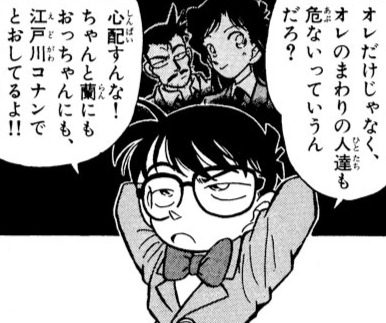
After Shin’ichi was forced to take a deadly drug that instead shrank him back to a child, he took on the undercover name Conan and went to stay with his childhood friend Ran and her detective father in the hope of a lead to the black-clad men who drugged him. He later discusses with Professor Agasa about how useless Detective Mouri is. The professor reminds Conan that the poison was supposed to have killed him, so he can’t rush and let others know his true identity.
- コナン:
- 「オレだけじゃなく、オレのまわりの人達も危ないっていうんだろ?」
- “You're saying it won't be just me, but the people around me will be in danger too, right?”
- 「心配すんな!ちゃんと蘭にもおっちゃんにも、江戸川コナンでとおしてるよ!!」
- “Don't worry! I'm keeping up the Conan Edogawa act with Ran and the old man, too!!”
Conan assures Professor Agasa that he’s keeping up the Conan Edogawa act. 江戸川 is えど plus かわ, “river”, and か voices to が, as in many river names. The ど in えど doesn’t block it.
Example 5 of 5: Came to be studying with us with 〜ことになる
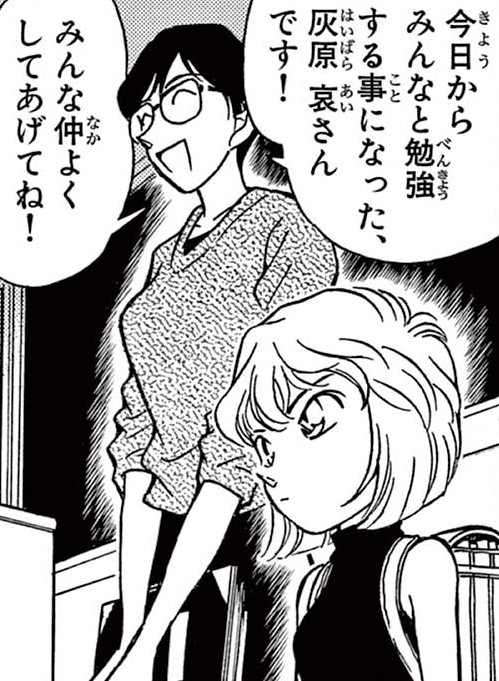
A new student joins Conan’s elementary school classroom. The teacher introduces her.
- 先生:
- 「今日からみんなと勉強する事になった、灰原 哀さんです!」
- “This is Ai Haibara. It came to be that she'll be studying with us starting today.”
- 「みんな仲良くしてあげてね!」
- “Everyone be friendly with her!”
A new student, Ai Haibara, joins Conan’s class. 灰原 is はい, “ash”, plus はら, “field”, and は voices to ば.
Why 鼻血 Uses ぢ
When ち and つ voice in recognizable compounds, the spelling can preserve that connection:
| Parts | Compound | Meaning |
|---|---|---|
| 鼻 + 血 | 鼻血 | nosebleed |
| みか + 月 | 三日月 | crescent moon |
In standard Japanese, ぢ and じ have the same pronunciation, as do づ and ず. These spellings retain the relationship to ち and つ. Both words appear in the Agency for Cultural Affairs’ kana spelling rules. Those rules also specify exceptions, so use a dictionary for uncertain spellings.
Example 1 of 3: A pretty clean room with 相当
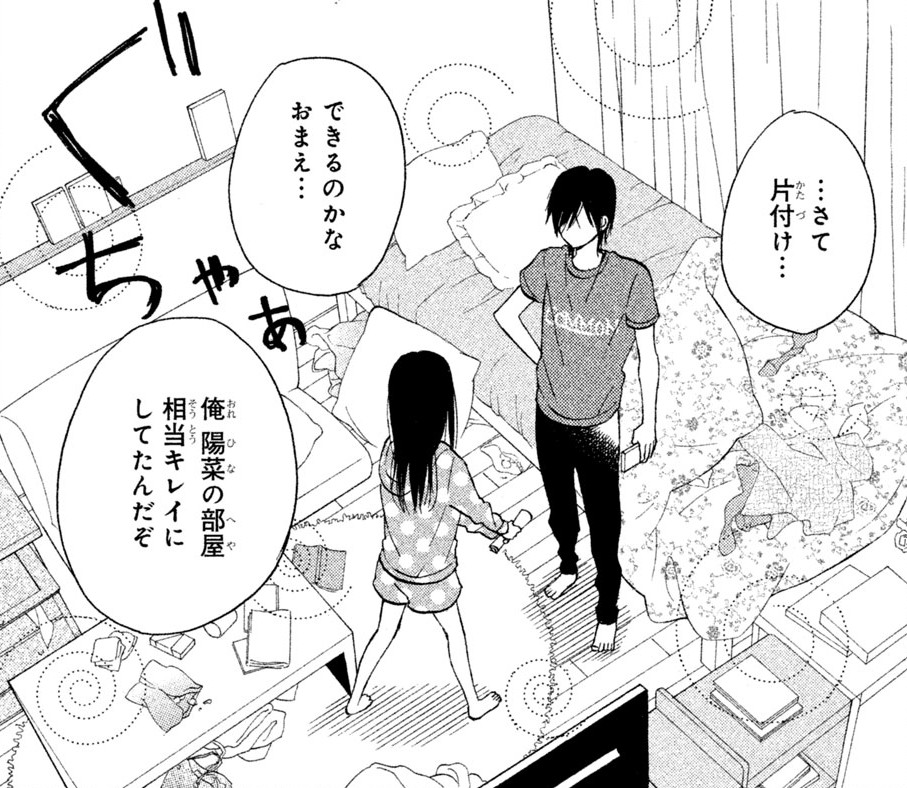
Hiro lets Mao move into his sister’s bedroom, as Hina is living with relatives. After, he comes up with a list of rules that Mao needs to follow if she’s to keep living there.
- 基:
- 「…さて 片付け…」
- “Now then, cleaning...”
- 「できるのかな おまえ…」
- “I wonder if you can do it.”
- 「俺 陽菜の部屋相当キレイにしてたんだぞ」
- “I kept Hina's room pretty clean, you know.”
Hiro has given Mao his sister’s room, and he doubts she can keep it tidy. 片付け comes from かた plus つける, and the voiced つ is written づ, not ず. Like ぢ in 鼻血, the spelling keeps the link to つける.
Example 2 of 3: Might have similar tastes with 〜かもしれない

At the library, Cocoa thinks she’s realized which book Chino is trying to find but forgot the title of.
- ココア:
- 「今まで気付かなかったけど」
- “I didn't notice until now, but...”
- 「私本の趣味合うのかもしれないねっ」
- “...maybe we have similar taste in books.”
At the library, Cocoa realizes something she hadn’t noticed: 気付かなかった. 気付く is き, “attention”, plus つく, “attach”, and the voiced つ is written づ, keeping the link to つく.
Example 3 of 3: Littering a soft drink can with ポイ捨て

As Kenji Fudazuki ponders ways to increase his image as a delinquent, he hears a teacher asking who littered an empty soft drink can. Seeing an opportunity, Kenji takes credit for the misdeed. With this revelation, the teacher backs off and leaves quietly.
- Students:
- 「札月だったのか。」
- “So it was Fudazuki, huh?”
- 「しかしポイ捨てしといて全く悪びれてないぜ…」
- “But to litter, he really has no shame...”
- 「むしろ怒ってた先生ニラんでたぜ。」
- “Instead, he glared at the scolding teacher.”
- 「ホント…怖いなぁ。」
- “He truly is scary.”
The students have just decided that Fudazuki is the one who littered: 札月だったのか. The name ends in 月, and the voiced つ is written づ, as in 三日月.
Voicing and Doubling Are Different Changes
In 手紙, か becomes が. In 学校, the first reading がく becomes がっ before こう. The first is 連濁; the second produces a 促音.
Likewise, は becoming ぱ in 出発 is a change to a p sound, not 連濁. See consonant doubling with 促音 for that pattern and the contrasting readings いっぽん, にほん, and さんぼん.
Related Grammar
- Consonant doubling with 促音
- Small っ lengthens a consonant and appears in another family of compound-reading changes.
- How casual contractions work
- Sound changes in conversational forms.