Consonant doubling with 促音
Grammar: Sound Changes
A small っ or ッ marks a 促音, a consonant held for an extra beat. You hear it in 学校, 切手, and 待って. A sound change that produces this doubled consonant is called 促音化.
Give Small っ Its Own Beat
In きって, the rhythm is き・っ・て. The small っ takes one timing unit, called a mora. Hold the consonant rather than saying a separate “tsu”. Compare these words:
| Without っ | Meaning | With っ | Meaning |
|---|---|---|---|
| 来て | come, as a request | 切って | cut, as a request |
| 音 | sound | 夫 | husband |
How you hold the consonant depends on the sound after っ. Before k, t, or p, hold the closure before releasing it. Before an s sound, keep the hiss going longer. So ざっし has a longer sh sound rather than a silent gap.
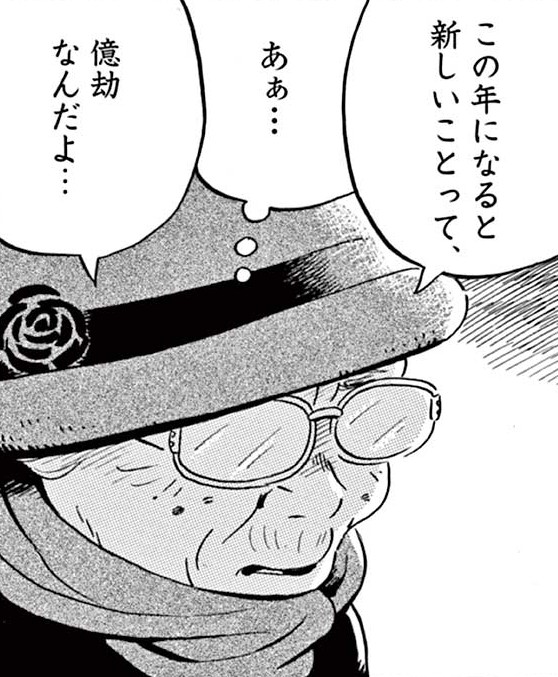
At dusk, Hanae takes the bus to the grocery store to buy ingredients for dinner. There she encounters Hiroto, doing the same on his way home from work. Hiroto says he rode his motorcycle today and can give Hanae a lift home. She refuses, as she’s never ridden on a motorcycle before.
- はなえ:
- 「この年になると新しいことって、億劫なんだよ…」
- “At my age, trying new things is such a hassle…”
Hiroto offers Hanae a ride on his motorcycle, and she turns him down: at her age, new things are a hassle. 億劫 is お・っ・く・う, four beats. Hold the k for the length of the っ before saying く.
When Kanji Readings Meet
In many compounds, the end of the first kanji’s reading changes to っ before the next consonant:
| Readings Before Combining | Compound | Meaning |
|---|---|---|
| がく + こう | 学校 | school |
| にち + き | 日記 | diary |
| しつ + もん | 質問 | question |
| しゅつ + はつ | 出発 | departure |
The first two rows show く or ち giving way to っ. The third keeps つ because the next sound is m. A reading ending in つ or ち usually becomes っ before a k, s, t, or h sound, and an h then turns into p. That’s why the last row has two changes: つ becomes っ, and は becomes ぱ. A reading ending in く or き changes only before k, so がく + せい stays 学生.
Example 1 of 16: Call me Teacher with と呼べ
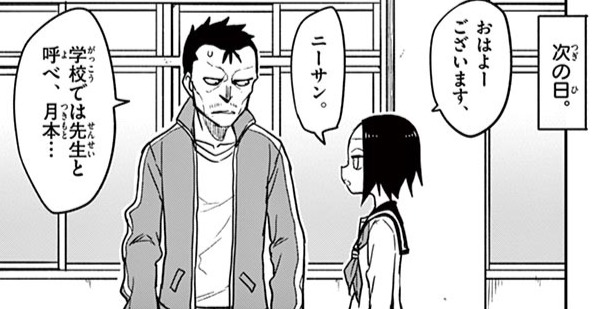
Sanae’s teacher, Mr. Tanabe, has proposed to her older sister, who is also a teacher at the school.
- 「次の日。」
- “The following day.”
- サナエ:
- 「おはよーございます、ニーサン。」
- “Good morning, Big Brother.”
- 田辺:
- 「学校では先生と呼べ、月本…」
- “Call me 'Teacher' at school, Tsukimoto.”
Mr. Tanabe, Sanae’s teacher, has proposed to her older sister, and the next morning Sanae greets him as “Big Brother”. He tells her to call him “Teacher” at school, 学校では. The word combines がく and こう as がっこう. Read the first part as が・っ, holding the k for a beat, then continue with こう.
Example 2 of 16: Because this is chance encounter with 〜ので

When Cocoa picks up another student’s dropped handkerchief, she uses the opportunity to show off her devilish nature to Chiya they discussed earlier.
- ココア:
- 「先輩ハンカチ落としましたよ」
- “Senpai, you dropped your handkerchief.”
- 「これも何かの縁なので今度お昼一緒にどうですか?」
- “How about we have lunch together next time, since this, too, is a meeting of chance?”
Cocoa invites an older student to lunch: 今度お昼一緒にどうですか? 一緒 combines いち and しょ, and the ち of いち gives way to っ: いっしょ.
Example 3 of 16: Trying to make bread with 〜てみる

Cocoa shows off the bread she made.
- ココア:
- 「じゃーんティッピーパン作ってみたんだ」
- “Ta-da, I tried making Tippy bread.”
- リゼ:
- 「看板メニューはこれで決定だな」
- “That settles our signature menu item, then.”
Rize declares Cocoa’s Tippy bread the shop’s signature item, now 決定, “decided”. The parts are けつ and てい, and つ becomes っ before the t.
Example 4 of 16: Something like a general store with 〜か何か
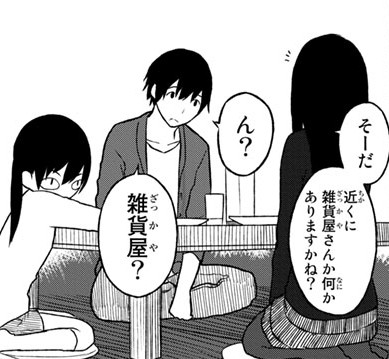
Having just settled in at her relative’s house where she will be living, Makoto has a meal with her cousins.
- 真琴:
- 「そーだ。近くに雑貨屋さんか何かありますかね?」
- “Oh yeah, is there a general store or something nearby?”
- 圭:
- 「ん? 雑貨屋?」
- “Hm? A general store?”
Makoto has just moved in with her cousins, and she asks whether there’s a general store nearby. 雑貨屋 starts with ざつ + か, and つ becomes っ: ざっか. Kei repeats the word back to her.
Example 5 of 16: Training so as to be able to swim with 〜ように

Cocoa and her friends visit an indoor hot spring. Rize admits she doesn’t know how to swim.
- ココア:
- 「ではこれからリゼちゃんが泳げるように特訓を始めます」
- “Now then, we're going to start special training so that Rize-chan can swim.”
- シャロ:
- 「あ 待って」
- “Ah, wait.”
Rize can’t swim, so Cocoa announces special training, 特訓. とく + くん loses the く of とく to っ, the same change as がく in 学校.
Example 6 of 16: Receiving exam results by mail with 郵送
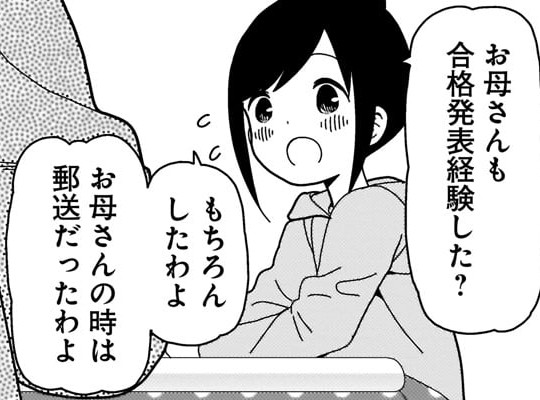
Bocchi’s mother confirms with Bocchi that her exam results will be available online.
- ぼっち:
- 「お母さん合格発表経験した?」
- “Mom, have you ever been through the experience of waiting for exam results?”
- お母さん:
- 「もちろん したわよ」
- “Of course!”
- 「お母さんの時は郵送だったわよ」
- “Back in my day, it was sent by mail.”
Bocchi asks her mother whether she ever waited for exam results, 合格発表. 発表 is はつ + ひょう with two changes, like 出発: つ becomes っ, and ひ becomes ぴ.
Example 7 of 16: I'd totally die in the heat with 〜じゃう
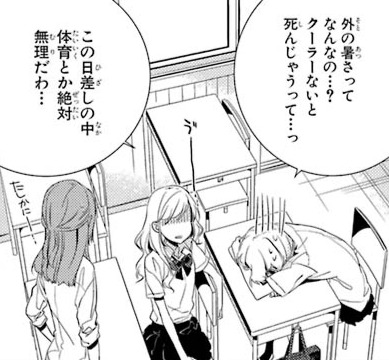
On a summer day, Hori and her friends in class can’t ignore the heat.
- 由紀:
- 「外の暑さってなんなの…? クーラーないと死んじゃうって…っ」
- “What's with this heat outside...? I'd totally die without the AC...”
- 「この日差しのなか体育とか絶対無理だわ…」
- “There's no way I can do PE in this blazing sun...”
It’s a hot summer day, and Yuki can’t face PE in this sun: 絶対無理, “absolutely impossible”. 絶対 is ぜつ + たい. つ becomes っ before the t, so the word has four beats: ぜ・っ・た・い.
Example 8 of 16: A spendid estate with 屋敷
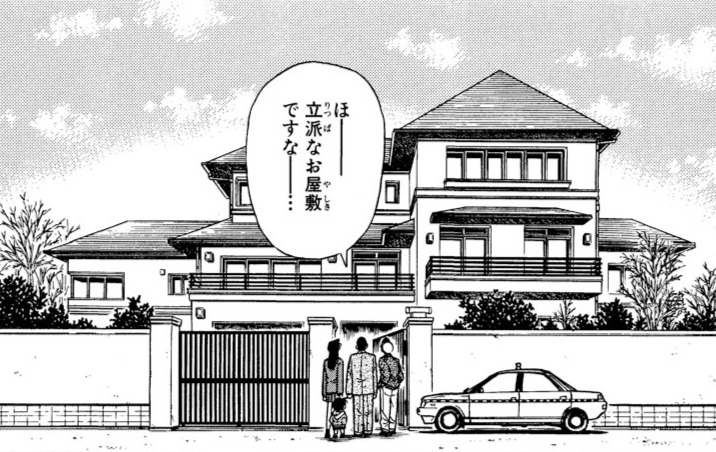
Heiji shows up at Detective Mouri’s office looking for the missing Shin’ichi. While there, a case presents itself. Heijii tags along with Mouri to investigate.
- 毛利:
- 「ほーーーーー 立派なお屋敷ですなーーー…」
- “Oh, what a splendid estate.”
Heiji has tagged along with Kogoro on a case, and they arrive at the client’s home. Kogoro is impressed: 立派なお屋敷, “a splendid estate”. 立派 is りつ + は with the same two changes as 出発: つ becomes っ, and は becomes ぱ.
Example 9 of 16: Receiving a throwing with 〜れる

After learning the fortunes she told didn’t come true for Chino and Rize, Cocoa lists the bad fortune she ran into.
- ココア:
- 「そっかー」
- “I see.”
- 「私あんこが落下してきたりスカートめくれちゃってたりシャロちゃんにお金投げられたり色々あって大変だったよー」
- “All sorts of things happened to me, like Anko falling on me, my skirt flipping up, and having Syaro-chan throw money at me, so it was rough.”
- 「占い勝負はティッピーの勝ちだね」
- “Then Tippy wins the fortune-telling contest.”
Cocoa lists the bad luck she ran into, starting with Anko the rabbit falling on her: 落下してきたり. 落下 is らく + か. A reading ending in く changes only before a k sound, and here it gets one.
Example 10 of 16: Might appear bigger with 〜かもしれない

Due to Chino’s concerns about her height, Rize suggests a solution.
- リゼ:
- 「声が大きければ存在も大きく見えるかもしれない」
- “If your voice is loud, your presence might seem bigger too.”
- ココア:
- 「錯覚ですか」
- “An optical illusion?”
Chino worries about being short, and Rize suggests a loud voice might make her seem bigger. Cocoa sums it up: 錯覚ですか, “an optical illusion?” 錯覚 is さく + かく, and く becomes っ before the k, as in 学校.
Example 11 of 16: Clearing out a room with 〜ておく

After Cocoa suggests if she were staying at Chiya’s place rather than Chino’s, that she’d be working for Chiya’s family’s tea house, Chiya takes to the idea.
- 千夜:
- 「じゃあ部屋を空けておくから早速荷物をまとめて来てね」
- “Then I'll clear out a room in advance, so go gather your things and come right away.”
- ココア:
- 「誰か止めてよ!」
- “Somebody stop her!”
Chiya wants Cocoa to move in and work at her family’s café, and she wants it to happen 早速, “right away”. さつ + そく: つ becomes っ before the s, so the s is held longer.
Example 12 of 16: Coming to buy coffee mugs with 〜に来る

Rize explains to Syaro why she and her friends are at the store.
- リゼ:
- 「喫茶店で使うカップ買いに来たんだよ」
- “We came to buy cups to use at the café.”
- シャロ:
- 「そうだったんですか」
- “Oh, I see.”
Syaro runs into Rize and the others at a shop, and Rize explains that they came to buy cups for the café, the 喫茶店. 喫茶 is きつ + さ, and つ becomes っ before the s.
Example 13 of 16: Requesting a duel with 申し込む
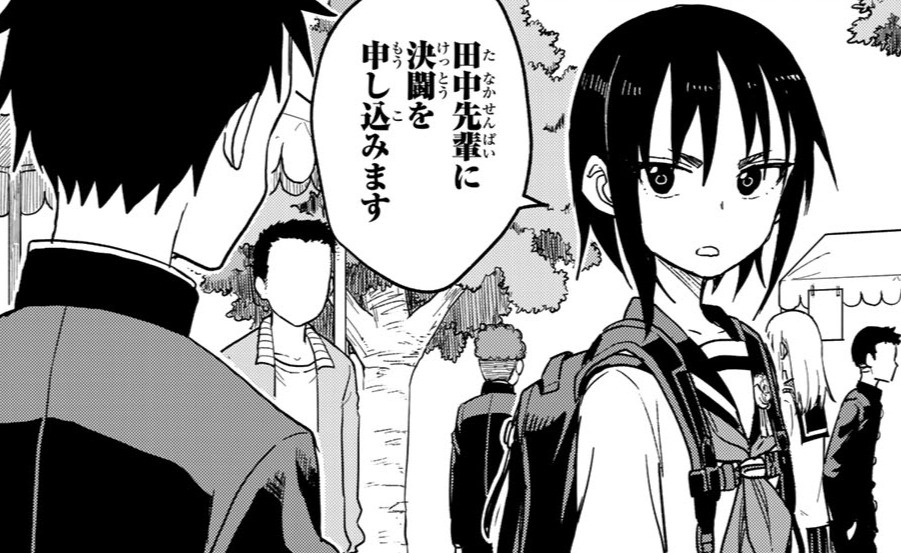
After starting her first year of high school, Rin signs up for the same club as her upperclassmen from middle school. She expected to be signing up for the kendo club, only to find that Ayumu (Tanaka) and Takeru are in the shogi club now. Rin tells Urushi, as the club’s leader, to give them back.
- 凛:
- 「田中先輩に決闘を申し込みます」
- “I challenge Tanaka to a duel.”
Rin joined the shogi club expecting kendo, and she wants her old kendo senpai back. She challenges Ayumu to a 決闘, “duel”. けつ + とう: つ becomes っ before the t, the same change as in 決定.
Example 14 of 16: Wanting to bake bread again with 〜たい

Cocoa and Chiya pass by a bakery. Cocoa stops to admire the bread in the window.
- ココア:
- 「実家がベーカリーでよく作ってたんだ」
- “My family runs a bakery, so I used to bake bread all the time.”
- 「また作りたいなぁ」
- “I want to make it again.”
- 千夜:
- 「お手製なの?すごい!」
- “You made these yourself? Amazing!”
Cocoa stops to admire the bread in a bakery window and explains that her family runs a bakery: 実家がベーカリーで. 実家, “family home”, is じつ + か, and つ becomes っ before the k.
Example 15 of 16: Difficult to pass on with 〜がたい

Visiting her new friend’s family’s café, Cocoa ponders over which menu item to order.
- ココア:
- 「わー抹茶パフェもいいし クリームあんみつ白玉ぜんざいも 捨てがたいなあ」
- “Wow, the green tea parfait is good, but the cream anmitsu and dumpling red bean soup are difficult to pass on.”
- リゼ:
- 「わかるのか!?」
- “You understand that!?”
Cocoa is choosing a dessert at Chiya’s family’s café, and the 抹茶パフェ, “green tea parfait”, is one option. まつ + ちゃ: ちゃ starts with a sound from the t row, so つ becomes っ.
Example 16 of 16: To end up cleaning for you with 〜ことになる
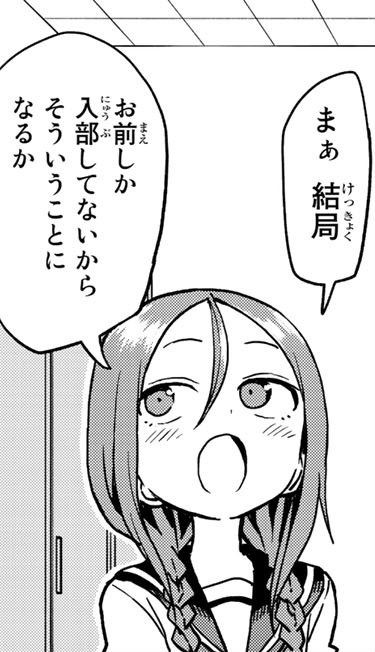
Urushi and Ayumu give their makeshift clubroom a cleaning to welcome potential new members. Considering that Urushi was the only club member before he joined, Ayumu remarks how she alone had cleaned the room for his sake last year.
- うるし:
- 「まぁ 結局」
- “Well, in the end...”
- 「お前しか入部してないからそういうことになるか」
- “You were the only new member, so it ended up as you say, huh?”
Urushi was the shogi club’s only member before Ayumu joined, so she cleaned the club room alone last year. 結局, “in the end”, opens her answer. けつ + きょく: つ becomes っ before the k.
The っ in Verb Forms
Godan verbs ending in う, つ, or る use って in the て-form and った in the plain past. This pattern is called 促音便.
| Dictionary Form | て-Form | Plain Past |
|---|---|---|
| 買う | 買って | 買った |
| 待つ | 待って | 待った |
| 取る | 取って | 取った |
The る rule applies to godan verbs. Ichidan 食べる becomes 食べて, and 見る becomes 見て. 行く is an exception among く-ending verbs: 行って and 行った. The て-form page covers the other ending groups.
Example 1 of 4: Lunch is heating with レンチンする
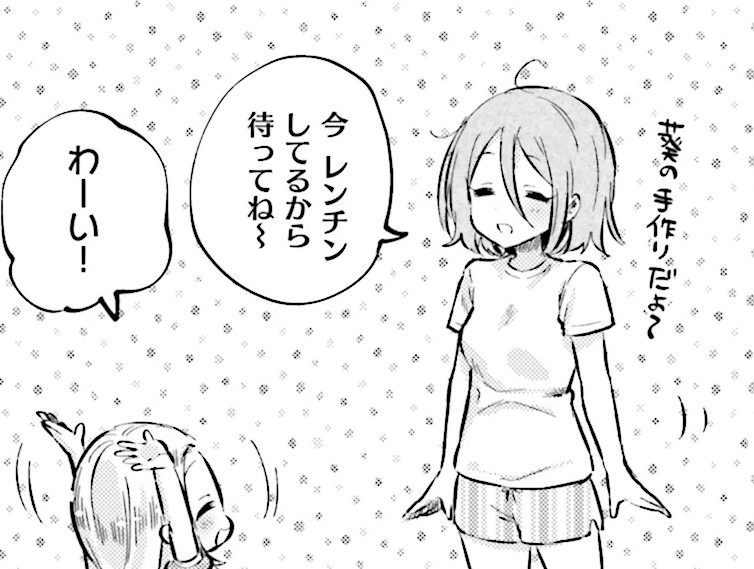
Satsuki is left to watch Sara for the day. As the afternoon arrives, Satsuki discovers their lunch had already been prepared and placed the refrigerator, with a note saying to heat it and eat it.
- 皐:
- 「今 レンチンしてるから待ってね〜」
- “The food's heating up right now, so wait a bit, okay?”
- サラ:
- 「わーい!」
- “Yay!”
Satsuki is looking after Sara, and their lunch is in the microwave. 待ってね, “wait, okay?”, uses the て-form of 待つ. Verbs ending in つ take って, so the t is held for a beat: ま・っ・て.
Example 2 of 4: Picked up in my place with 〜の代わりに
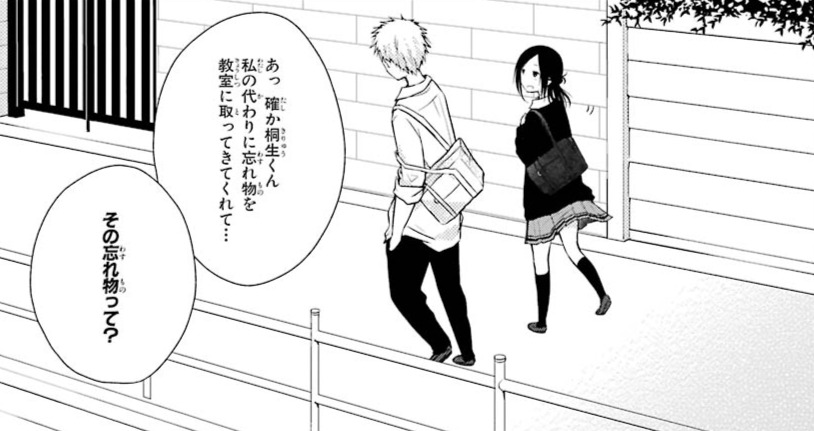
Fujimiya was able to work around forgetting her friends every Monday by using a journal to record her time spent with Hase. After Fujimiya discovers she can remember Hase’s friend Kiryuu, Hase gets jealous and reacts poorly. The following Monday, Fujimiya arrives at school with no memory of Hase or her journal, and Hase isn’t able to regain her trust. After school, Kiryuu walks with Fujimiya. Without mentioning Fujimiya eating lunch with Hase each day, he asks about how she spent her lunches last week. She isn’t certain. Without mentioning that Fujimiya previously had forgotten her journal at her desk and classmates found it, Kiryuu questions her about the after-school event.
- 藤宮:
- 「あっ 確か桐生くん私の代わりに忘れ物を教室に取ってきてくれて…」
- “Ah, right… Kiryuu, you went to the classroom and picked up my forgotten item in place of me, didn't you…?”
- 桐生:
- 「その忘れ物って?」
- “That forgotten item was...?”
Fujimiya recalls that Kiryuu fetched something she’d left in the classroom, 取ってきてくれて. 取る ends in る, so its て-form is 取って.
Example 3 of 4: A preference for pudding with 嗜好

After Yousuke finishes moving his belongings into his new home with the help of his friend Jumbo, Jumbo offers to pick up some gifts for Yousuke to give his new neighbors when he goes around the neighborhood to introduce himself.
- 葉介:
- 「変なもん持ってくんなよ」
- “Don't bring back anything weird.”
- ジャンボ:
- 「俺はプリンが好きなんだ」
- “I happen to like pudding.”
- 葉介:
- 「いや おまえの嗜好はいい」
- “No, your personal tastes are fine.”
Yousuke tells Jumbo not to bring back anything weird, 持ってくんなよ. 持つ ends in つ, so its て-form is 持って.
Example 4 of 4: Feeling you've gained weight with 〜気がする
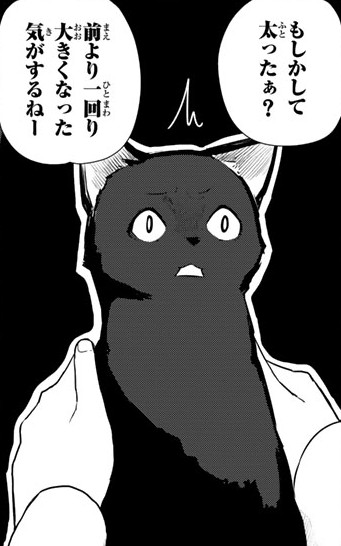
Nao sees Makoto’s cat, Chito. She stops to pet the cat when she notices something.
- なお:
- 「もしかして太ったぁ?前より一回り大きくなった気がするねー」
- “Could it be you've gotten fatter? I feel you've grown a size bigger than before.”
Nao is petting Makoto’s cat, Chito, and notices something. もしかして太ったぁ? is “did you put on weight?” 太る is a godan verb ending in る, so its plain past is 太った.
Why 一本 Has ぽん
The counter 本 changes pronunciation with certain numbers:
| Number and Counter | Reading |
|---|---|
| 一本 | いっぽん |
| 二本 | にほん |
| 三本 | さんぼん |
In いっぽん, the first part ends in っ and the counter starts with p. The ぽ has a handakuten, the small circle ゜. It is a different change from 連濁, which produces a voiced consonant such as the b in さんぼん. Learn these counter readings as a set.
Example 1 of 4: Relieving stress with 解消
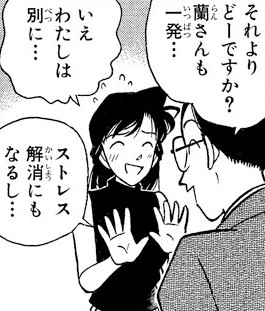
Kogoro, Ran, and Conan are at a convention for game software makers, since Kogoro helped as a consultant for a murder mystery video game. There, a punch strength test game catches Ran’s eye. She sees one of the developers throw a punch at it.
- 竹下:
- 「それよりどーですか?蘭さんも一発…」
- “What about you? Would you like to take a shot at it, too?”
- 蘭:
- 「いえ わたしは別に」
- “No, I'm not particularly...”
- 竹下:
- 「ストレス解消にもなるし…」
- “It's also a great way to relieve stress...”
A game developer at a convention invites Ran to try the punching machine: 蘭さんも一発…, “how about a punch, Ran?” いち + はつ becomes いっぱつ, with the same two changes as いっぽん: ち becomes っ, and は becomes ぱ.
Example 2 of 4: Far from getting information with 〜どころか

Conan moves in with Ran and her detective father in hopes of learning more about the black-clad men responsible for him shrinking to a child. Days later, Conan has become disillusioned by the idea.
- コナン:
- 「奴らの情報どころか、一件の依頼も来ねーぜ…」
- “Far from information on those guys, not even a single case commission has come...”
Conan moved in with Ran’s detective father hoping for leads, and not one case has come in. 一件 is いち + けん, and ち becomes っ before the k. Unlike いっぱつ, けん keeps its k.
Example 3 of 4: Nearby stores with 近隣店舗
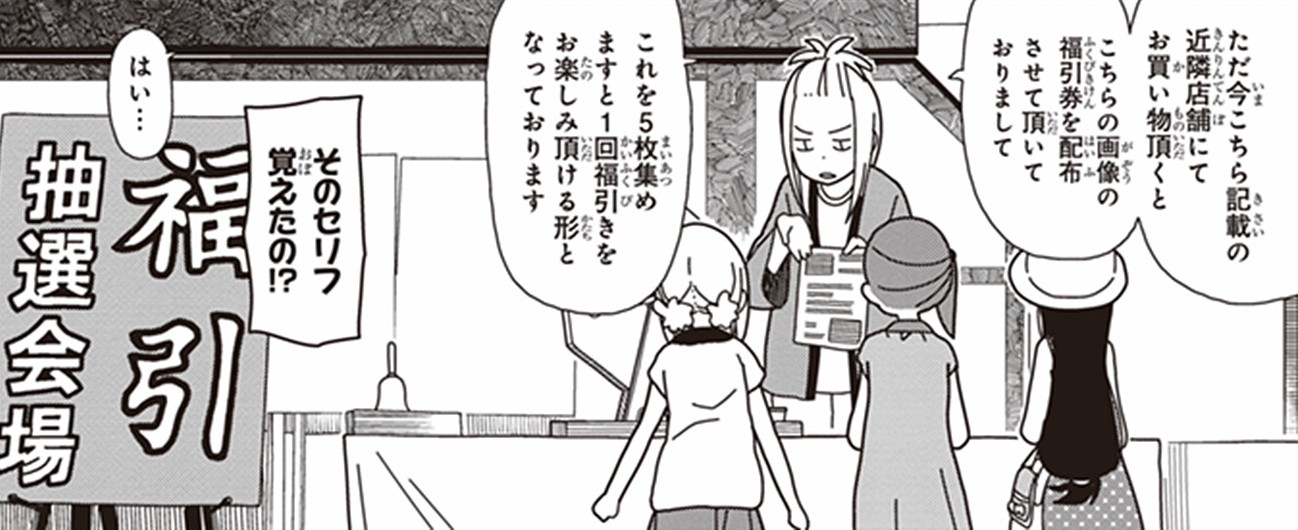
Upon entering the mall, Yui notices a lottery wheel. Sacchan and Kotoha join her, the two quickly pestering Subaru, the part-timer working the lottery, with random questions. Subaru pushes on with her script.
- すばる:
- 「ただ今こちら記載の近隣店舗にてお買い物頂くとこちらの画像の福引券を配布させて頂いておりまして」
- “Currently, when you make a purchase at a neighborhood store, we are distributing the raffle tickets shown in this image.”
- 「これを5枚集めますと1回福引きをお楽しみ頂ける形となっております」
- “If you collect five tickets, you'll be able to enjoy one lottery draw.”
- さっちゃん:
- 「そのセリフ覚えたの!?」
- “You memorized that line!?”
- すばる:
- 「はい…」
- “Yes...”
Subaru is reciting her lottery script at the mall: collect five tickets for one draw, 1回福引き. 1回 is いち + かい, and ち becomes っ before the k. As with 一件, the か keeps its k.
Example 4 of 4: James's rental is a stolen car with 盗難車
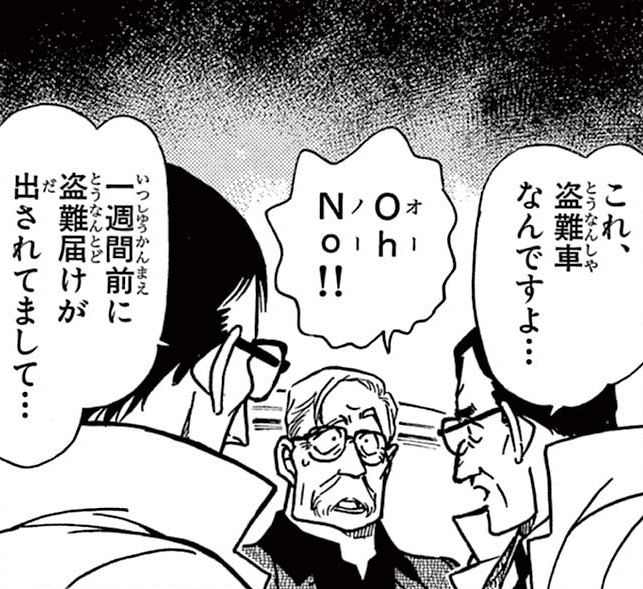
James Black leaves a show and returns to his car. Before he can get in, two men stop him. They say they are police officers and ask whether the car is his. James tells them it is a rental.
- Man 1:
- 「これ、盗難車なんですよ…」
- “This is a stolen car...”
- James:
- 「Oh no!!」
- “Oh no!!”
- Man 2:
- 「一週間前に盗難届けが出されてまして…」
- “A theft report was filed a week ago...”
Two men stop James Black at his rental car and tell him it’s stolen. It was reported 一週間前, “a week ago”. いち + しゅう: ち becomes っ before the sh sound, so the sh is held: いっしゅう.
Small っ at the End of a Bubble
Manga also uses small っ in reactions such as あっ! and えっ?. At the end of an utterance, it can suggest an abrupt stop or a caught breath. There is no following consonant to double in the usual way.
Use the position to interpret it. The っ inside がっこう or まって is part of the word’s pronunciation. A final っ can instead tell you how the character’s voice stops.
Example 1 of 3: Where are you at with いんの

Azu is with her friends, waiting for Suwa. They call him to find what’s keeping him, and while Azu talks with Suwa by phone, she hears an echo of his voice in the distance.
- あずさ:
- 「須和? 今どこにいんの?」
- “Suwa? Where is it you're at right now?”
- 須和:
- 「じゃあ もう切る」
- “Well, I'm hanging up now.”
- あずさ:
- 「えっ」
- “Eh?”
Azu calls Suwa to ask where he is, and he says he’s hanging up. Her reply is えっ, “huh?” The final っ cuts the sound off short, the way a surprised gasp stops.
Example 2 of 3: Finishing clubhouse insulation with 完成
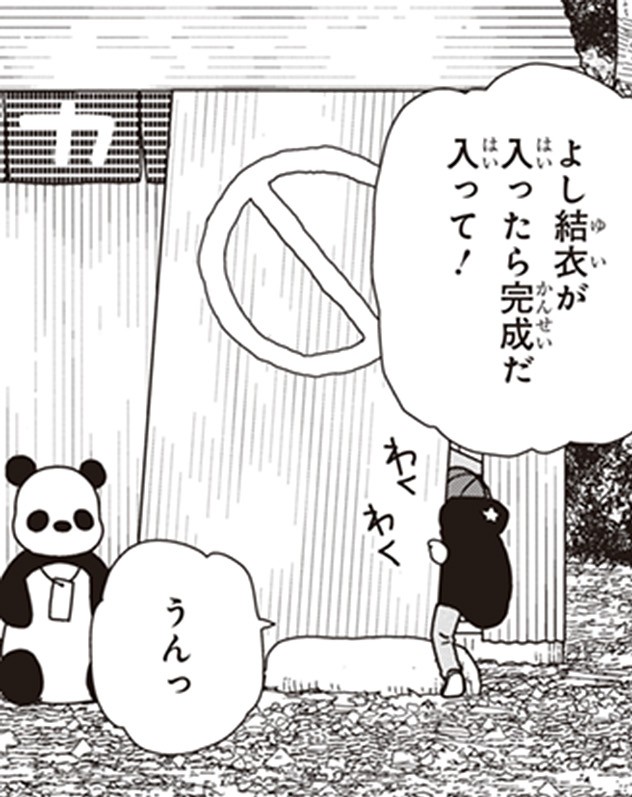
Planning for winter temperature drops, Yui and her friends use cardboard and masking tape to cover all the openings in their clubhouse. The final step is to close the door and see how it works.
- 友達:
- 「よし結衣が入ったら完成だ 入って!」
- “Yui, once you're in, it's complete. Get in!”
- 結衣:
- 「うんっ」
- “Right!”
Yui’s friends have covered every gap in their clubhouse, and the last step is for Yui to step inside. Her answer, うんっ, is an eager “okay!” The final っ makes it short and bouncy.
Example 3 of 3: Another round with おかわり

Akari visits Caffè Florian to wait until Alicia’s association meeting is over. There she meets a gentleman and the two pass the time together.
- おじいさん:
- 「ウェイターおかわりをっ」
- “Waiter, I'll have another.”
- 灯里:
- 「あ 私も」
- “Ah, me too.”
An old gentleman at Caffè Florian calls the waiter: ウェイターおかわりをっ. The final っ clips the を, as if he says it briskly and stops. No consonant follows it.
Related Grammar
- Compound voicing with 連濁
- Voicing changes the consonant at the start of a compound's second part.
- Connecting actions with 〜て・〜で
- The full set of て-form endings, including って.
- Past tense with 〜た・〜だ
- The same verb-ending patterns with た and だ.
- How casual contractions work
- Other sound changes that shorten spoken forms.