Difficult to do with 〜がたい
Grammar: Difficulty » 〜がたい
The auxiliary adjective がたい says that an action is “very difficult” or “nearly impossible”, usually for emotional or psychological reasons.
Usage Notes
がたい marks an action as extremely hard to carry out. The obstacle is often the speaker’s judgment, feelings, or moral resistance.
It appears mainly in formal, written, or literary language and is stronger than にくい or づらい .
It favors mental and emotional verbs such as 言( い ) う, 信( しん ) じる, 忘( わす ) れる, and 理解( りかい ) する over routine physical actions. For example, 食( た ) べがたい, “hard to eat”, is rare, while 理解( りかい ) しがたい, “hard to understand”, is common.
Verb stem + がたい
言( い ) う (to say) to 言( い ) いがたい (difficult to say)忘( わす ) れる (to forget) to 忘れがたい (difficult to forget)
The kanji form 難い is commonly used, though it may also appear in hiragana as がたい.
Examples
Grammar Explanation:
Difficult to do with 〜がたい
思い、思われ、ふり、ふられ »
Volume 7 » Page 30
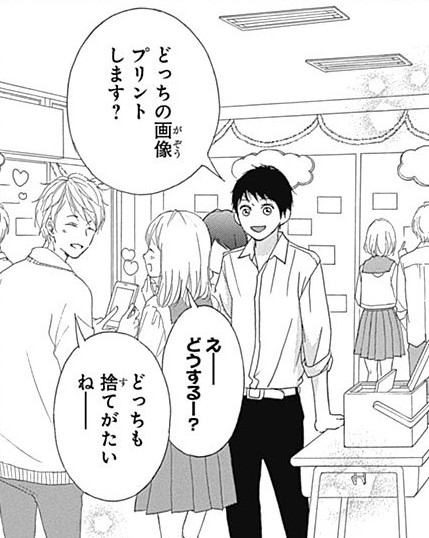
Inui’s class is gathering photos of couples for a school festival contest. Another couple comes to join in.
乾( いぬい ) :「どっちの画像( がぞう ) プリントします?」
“Which image should I print?”
彼女( かのじょ ) :「えーーー どうするー?」
“Oh my gosh... What should we do?”
彼氏( かれし ) :「どっちも捨( す ) てがたい ねーーー」
“Both are hard to abandon .”
Challenge Yourself
Show translation
Challenge
Why does the couple have trouble choosing which image to print?
Clues
どっちも
both of them
捨( す ) てがたいhard to reject or give up
What does the speaker mean?
Neither photo is easy for them to reject.
どっちも applies 捨( す ) てがたい equally to both images.
Neither photo can be printed by the machine.
The difficulty is choosing against one image, not a technical printing problem.
They dislike both photos and want new ones.
捨( す ) てがたい means both options have enough appeal that giving either one up is difficult.
They have already decided to print both images.
They are still being asked to choose which one to print.
They cannot tell which image belongs to them.
The couple recognizes both photos. Their problem is selecting between them.
Inui has asked them to throw both photos away.
Inui asks which image to print, and the couple uses 捨( す ) てる figuratively for rejecting the other choice.
The couple likes both photos enough that neither is easy to reject. どっちも applies the emotional difficulty of 捨( す ) てがたい to both choices.
Grammar Explanation:
Difficult to do with 〜がたい
ご注文はうさぎですか? »
Volume 1 » Page 46
Visiting her new friend’s family’s café, Cocoa ponders over which menu item to order.
ココア:
「わー抹茶( まっちゃ ) パフェもいいし クリームあんみつ白玉( しらたま ) ぜんざいも 捨( す ) てがたい なあ」
“Wow, the green tea parfait is good, but the cream anmitsu and dumpling red bean soup are difficult to pass on .”
リゼ:
「わかるのか!?」
“You understand that!?”
Challenge Yourself
Show translation
Challenge
What does ココア mean in the highlighted line?
Clues
捨( す ) てがたい(捨:す)てがたい means difficult to reject as an option
What does the speaker mean?
Wow, the green tea parfait is good, but the cream anmitsu and dumpling red bean soup are difficult to pass on.
Cocoa is not discussing throwing food away; she finds the other desserts too appealing to pass up.
Cocoa says the desserts are physically difficult to eat.
The highlighted form is 捨( す ) てがたい. Here 捨( す ) てがたい means difficult to reject as an option, so this choice does not match the Japanese.
Cocoa says she wants the unwanted desserts thrown away.
The highlighted form is 捨( す ) てがたい. Here 捨( す ) てがたい means difficult to reject as an option, so this choice does not match the Japanese.
Cocoa says she has already chosen one dessert and rejected the rest.
The highlighted form is 捨( す ) てがたい. Here 捨( す ) てがたい means difficult to reject as an option, so this choice does not match the Japanese.
捨( す ) てがたい means difficult to reject as an option. Cocoa is not discussing throwing food away; she finds the other desserts too appealing to pass up.
Grammar Explanation:
Difficult to do with 〜がたい
怪盗セイント・テール »
Volume 1 » Page 74
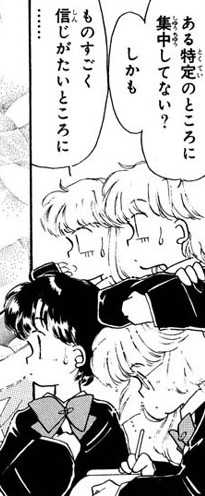
A student from a lower grade enters the classroom. She stops and stares at Asuka Jr., one of the boys in the class.
涼子( りょうこ ) :「ある特定( とくてい ) のところに集中( しゅうちゅう ) してない? しかも」
“Isn't she focused on one particular area? And on top of that...”
恭子( きょうこ ) :「ものすごく信( しん ) じがたい ところに……」
“It's in a frightfully hard to believe area...”
Challenge Yourself
Show translation
Challenge
How does Kyoko describe the area that has the younger student's attention?
Clues
ある特定( とくてい ) のところに集中( しゅうちゅう ) してない?
Ryoko notices that the student's attention is fixed on one particular place
ものすごく信( しん ) じがたいところ
Kyoko finds that place extremely difficult to believe
What does the speaker mean?
It is an extremely surprising place for her to be focused on.
ものすごく intensifies 信じがたい, which describes the target of her attention as very hard to believe.
It is the only place where she can concentrate on studying.
集中 describes where the student is looking, while 信じがたい expresses Kyoko's disbelief about that target.
It is a familiar place that everyone expected her to notice.
信じがたい means difficult to believe, so Kyoko finds her focus unexpected rather than familiar.
It is too frightening for the students to look at directly.
The speakers express surprise, not fear or an inability to look there.
It is an area where the younger student is not paying attention.
Ryoko asks whether her attention is concentrated on a particular area, so the issue is where she is looking.
It is a place Kyoko has never been able to find.
信じがたい describes how unbelievable the target is, not whether Kyoko can locate it.
Ryoko notices the younger student’s attention gathering in one particular direction. Kyoko calls that target ものすごく信じがたい, showing that she finds the object of the stare extremely unexpected.