Doing completely or ending up doing with 〜てしまう and 〜ちゃう
Grammar: Time and Sequence » 〜てしまう
〜てしまう follows a verb in the て-form and shows that an action is completed or ends up happening. Depending on context, it can also add a feeling of regret.
Usage Notes
The meaning depends heavily on the scene. Sometimes 〜てしまう simply means the action is finished completely. In dialogue, it often sounds like “ended up doing”. Casual speech often contracts 〜てしまう to 〜ちゃう and 〜でしまう to 〜じゃう.
Formation
View formation details
Verb て-form + しまう
作( つく ) ってしまう"make completely; end up making"
Verb で-form + しまう
読( よ ) んでしまう"read completely; end up reading"
〜てしまう → 〜ちゃう
作( つく ) ってしまう → 作( つく ) っちゃう"end up making; make completely"
〜でしまう → 〜じゃう
読( よ ) んでしまう → 読( よ ) んじゃう"end up reading; read completely"
Completion
〜てしまう can mean that an action is completed fully.
食( た ) べてしまう読( よ ) んでしまう
In this use, the focus is on the action reaching completion. There is not necessarily any regret.
名探偵コナン »
Volume 1 » Page 17
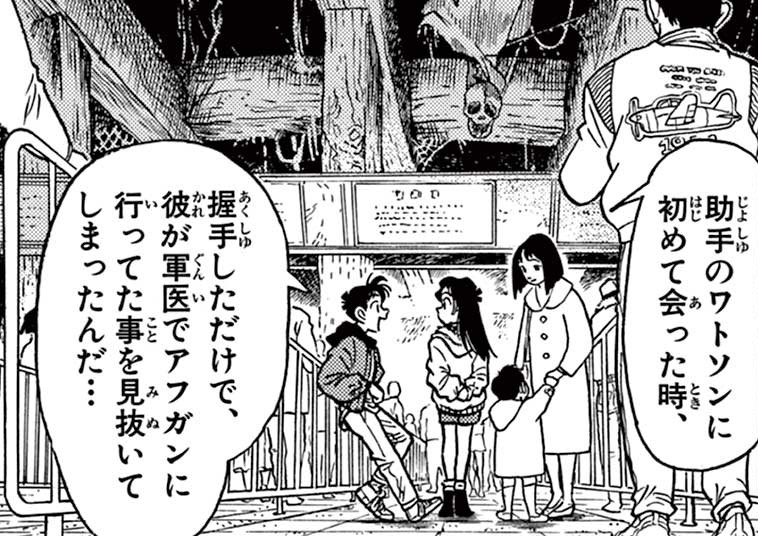
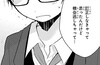
Shin’ichi treats Ran to a day at Tropical Land as a reward for winning the city karate tournament. As they wait in line for a ride on the roller coaster, Shin’ichi explains all the reasons why Sherlock Holmes was the greatest detective.
新一( しんいち ) :「助手( じょしゅ ) のワトソンに初( はじ ) めて会( あ ) った時( とき ) 、握手( あくしゅ ) しただけで、彼( かれ ) が軍医( ぐんい ) でアフガンに行( い ) ってた事( こと ) を見( み ) 抜( ぬ ) いてしまった んだ…」
“The first time he met his assistant Watson, Holmes could tell just from a handshake that he was a military doctor who had been stationed in Afghanistan...”
Challenge Yourself
Show translation
Challenge
What did Holmes deduce merely from shaking Watson's hand?
Clues
握手( あくしゅ ) しただけでmerely by shaking hands
彼( かれ ) が軍医( ぐんい ) でアフガンに行( い ) ってた事( こと ) that he was a military doctor who had been to Afghanistan
What does the speaker mean?
Watson was a military doctor who had been to Afghanistan.
The long 事( こと ) clause gives the fact Holmes saw through from the handshake alone.
Watson had never worked as a doctor.
Shin'ichi identifies him specifically as a 軍医( ぐんい ) , military doctor.
Watson planned to travel to Afghanistan next.
行( い ) ってた describes a past experience, not a future plan.
Watson wanted to become Holmes's enemy.
The scene concerns their first meeting and Holmes's deduction, not hostility.
Watson injured Holmes during the handshake.
The handshake provides evidence. No injury occurs.
Watson had served as a detective in London.
The role named in the deduction is military doctor.
Holmes inferred from a single handshake that Watson was a military doctor who had been to Afghanistan. だけで stresses how little evidence he needed.
View Full Example
Ended Up Doing
〜てしまう often presents the action as something that happened despite the speaker’s intention.
忘( わす ) れてしまった壊( こわ ) してしまったやってしまった : I went and did it; I messed up
This can sound regretful or simply unintended. The speaker is looking at the action as something that has already happened and cannot be taken back.
キラキラ100% »
Volume 2 » Page 158
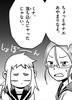
After recovering from over-dieting, Miku quickly gained back the weight she had lost. She receives a text message from her boyfriend, Shibutani, about scheduling time to meet up between their summer classes, but she turns him down.
みく:
「ごめんね渋谷( しぶたに ) 」
“I'm sorry, Shibutani.”
「なんかやっぱり会( あ ) いづらい…」
“It's still difficult to meet with you...”
「また太( ふと ) っちゃって 」
“I've put on weight again...”
Challenge Yourself
Show translation
Challenge
Why does Miku say it is hard to meet Shibutani?
Clues
会( あ ) いづらいemotionally difficult or awkward to meet
また太( ふと ) っちゃって
she ended up gaining weight again, with an unhappy or embarrassed tone
What does the speaker mean?
She feels self-conscious because she has gained weight again.
また太( ふと ) っちゃって gives her weight gain as the reason, while 会( あ ) いづらい describes the resulting emotional difficulty.
Their summer class schedules leave no time to meet.
会( あ ) いづらい could describe a practical obstacle elsewhere, but Miku immediately explains that she has gained weight again.
She is upset because Shibutani has gained weight.
The omitted subject of 太( ふと ) っちゃって is Miku. She is embarrassed about her own appearance.
She has decided that she no longer wants to date him.
Miku sounds hesitant and apologetic. She says meeting feels difficult, not that she wants to end the relationship.
She is still too sick to leave home.
Her explanation concerns regaining weight. The line does not say that illness prevents her from going out.
She thinks Shibutani will refuse to see her again.
Miku describes her own reluctance to meet. She does not say that Shibutani has rejected her.
Miku turns down the meeting because regaining weight has made her self-conscious. Here 会( あ ) いづらい describes emotional awkwardness, and 〜ちゃって presents the weight gain as an unwelcome result.
View Full Example
Context Decides the Feeling
〜てしまう does not automatically mean the speaker is sad or upset. It can appear in positive, neutral, or negative contexts.
For example, 言( い ) われちゃった
名探偵コナン »
Volume 1 » Page 9
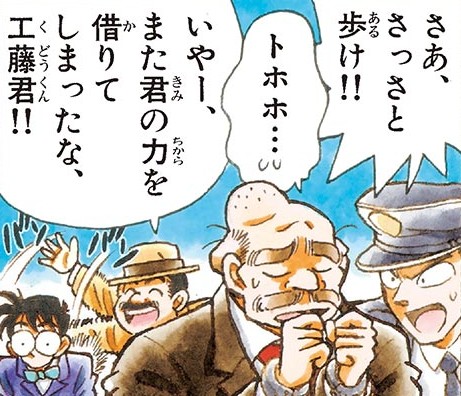
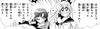
After Kudo helps Inspector Megure solve a murder case, he also catches the fleeing culprit.
警察官( けいさつか ) :「さあ、さっさと歩( ある ) け!!」
“Come on, hurry up and walk!!”
目暮( めぐれ ) :「いやー、また君( きみ ) の力( ちから ) を借( か ) りてしまった な、工藤( くどう ) 君( くん ) !!」
“Man, I ended up relying on your help again, Kudo!!”
Challenge Yourself
Show translation
Challenge
What does Megure say happened again?
Clues
また
again
君( きみ ) の力( ちから ) を借( か ) りてしまったI ended up relying on your help
What does the speaker mean?
He ended up relying on Kudo's help.
力( ちから ) を借( か ) りる means to rely on someone's assistance, and また marks repetition.
He lent Kudo his own investigative notes.
Megure is the one borrowing help from Kudo, not lending something to him.
He arrested Kudo by mistake.
The arrest command is directed at the culprit. Megure thanks Kudo for helping.
He solved the case without any assistance.
The line explicitly credits Kudo's 力( ちから ) , or help.
He asked Kudo to return borrowed money.
力( ちから ) を借( か ) りる is an idiom for receiving help, not borrowing money.
He regretted allowing the culprit to escape.
The culprit has been caught, and Megure reflects warmly on Kudo's assistance.
Megure says that he has once again ended up relying on Kudo’s help. Here 〜てしまった frames the completed result with pleased surprise rather than regret.
View Full Example
Casual Contractions
In casual speech, 〜てしまう and 〜でしまう often contract.
Contraction
Example
〜てしまう → 〜ちゃう
作( つく ) ってしまった作( つく ) っちゃった
〜てしまった → 〜ちゃった
疲( つか ) れてしまう疲( つか ) れちゃう
〜でしまう → 〜じゃう
読( よ ) んでしまう読( よ ) んじゃう
〜でしまった → 〜じゃった
死( し ) んでしまう死( し ) んじゃう
ちゃう and じゃう are very common in casual speech. The fuller てしまう and でしまう forms sound more neutral or written.
カードキャプターさくら »
Volume 1 » Page 131
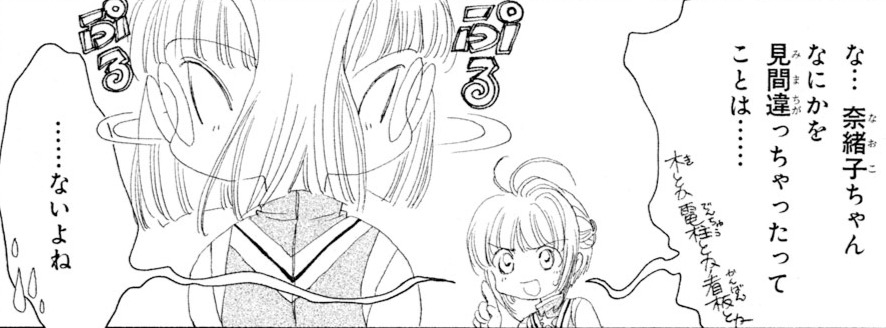
After piano class, Naoko hurries home only to see a ghostly figure appear from within a lake at the park. She recalls the events to her friends at school.
桜( さくら ) :「な…奈緒子( なおこ ) ちゃん なにかを見( み ) 間( ま ) 違( ちが ) っちゃった ってことは…… (木( き ) とか電柱( でんちゅう ) とか看板( かんばん ) とか)」
“Na... Naoko, could it be that you ended up seeing something wrong...... (like a tree or a utility pole sign or something)?”
「……ないよね」
“......I guess not.”
Challenge Yourself
Show translation
Challenge
What possibility does Sakura hesitantly suggest?
Clues
なにかを見( み ) 間( ま ) 違( ちが ) っちゃった
Naoko accidentally mistook something she saw
木( き ) とか電柱( でんちゅう ) とか看板( かんばん ) とかexamples of ordinary objects such as a tree, utility pole, or sign
ってことは……ないよね
could it be that, followed by Sakura backing away from the suggestion
What does the speaker mean?
Naoko may have mistaken an ordinary object for the ghostly figure.
見( み ) 間( ま ) 違( ちが ) っちゃった suggests an accidental misidentification, and Sakura lists ordinary objects Naoko might have seen.
Naoko may have seen the ghost turn into a tree.
The tree is one possible object Naoko mistook for the figure. Sakura does not say the figure transformed.
Naoko may have invented the story to frighten her friends.
Sakura wonders whether Naoko misidentified what she saw, not whether she deliberately lied.
Naoko may have gone to the wrong park after class.
見( み ) 間( ま ) 違( ちが ) う concerns seeing something incorrectly. It does not mean choosing the wrong location.
Naoko may have read a warning on a sign incorrectly.
看板( かんばん ) is listed as an object she might have mistaken for the figure, not as text she misread.
Naoko may have confused Sakura with someone near the lake.
Sakura proposes a tree, utility pole, or sign as the mistaken object. She does not place herself at the lake.
Sakura wonders whether Naoko accidentally mistook an ordinary object for the ghostly figure. Her examples make the suggestion concrete, but ……ないよね shows that she doubts her own explanation.
View Full Example
三ツ星カラーズ »
Volume 1 » Page 11
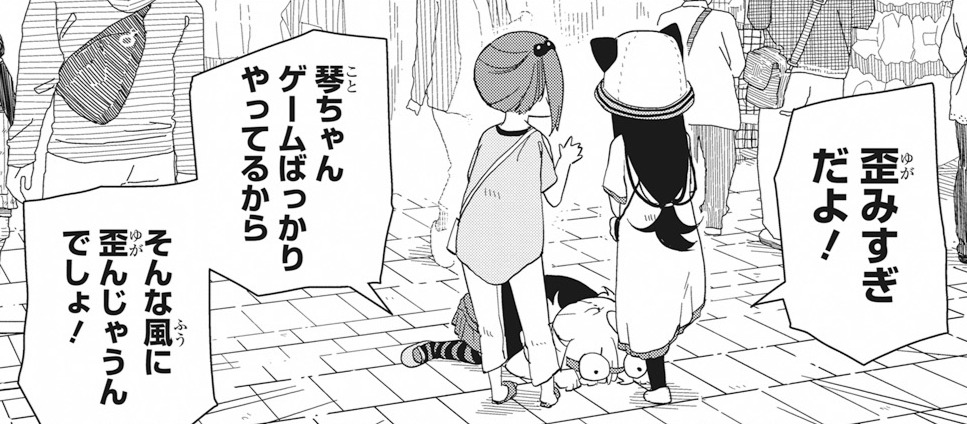
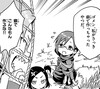
Sacchan tries crawling on the ground to help find the cat that’s been stealing from the area lately. Kotoha takes this opportunity to step on Sacchan’s head.
さっちゃん:
「歪( ゆが ) みすぎだよ!」
“You're way too twisted!”
「琴( こと ) ちゃんゲームばっかりやってるからそんな風( ふう ) に歪( ゆが ) んじゃう んでしょ!」
“It's 'cause you only ever play video games, Koto-chan, that's why you've gotten all warped like that!”
Challenge Yourself
Show translation
Challenge
Why does Sacchan say Kotoha has become so twisted?
Clues
ゲームばっかりやってるから
because she does nothing but play video games
そんな風( ふう ) に歪( ゆが ) んじゃうんでしょ
that is why she ends up warped like that, right
What does the speaker mean?
She spends all her time playing video games.
ゲームばっかり means nothing but games, and から marks that habit as Sacchan's blamed cause.
She stopped playing games before she learned the rules.
やってる describes an ongoing habit, not something Kotoha stopped doing.
She lets Sacchan win every game they play.
The line says only that Kotoha plays games constantly. It says nothing about letting Sacchan win.
She has been crawling on the ground like Sacchan.
Sacchan blames games for Kotoha's attitude after Kotoha steps on her.
Her games have physically bent out of shape.
歪( ゆが ) んじゃう describes how Kotoha has supposedly turned out, not the condition of the games.
She is upset because her game is too difficult.
Sacchan criticizes Kotoha's general behavior. The line does not mention difficulty or frustration with a game.
Sacchan blames Kotoha’s twisted behavior on playing nothing but video games. 歪( ゆが ) んじゃう is the casual contraction of 歪( ゆが ) んでしまう and presents that state as an unfortunate result.
View Full Example
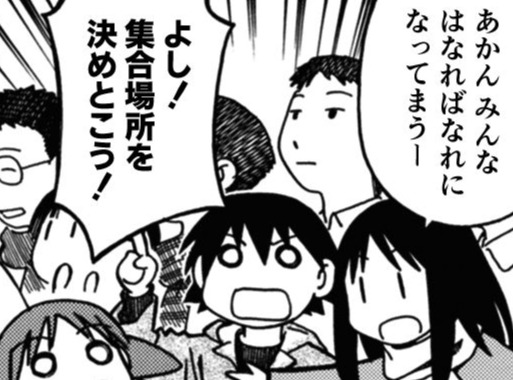
Kansai speech often shortens 〜てしまう to 〜てまう. It carries the same completion, unintended-result, or regret meanings as the standard form. The past often appears as 〜てもた or 〜てもうた.
あずまんが大王 »
Volume 3年生 » Page 175
Chiyo and her friends from class to go a new year shrine visit together. Chiyo remarks on how crowded it is.
歩( あゆむ ) :「あかんみんなはなればなれになっ てまう ー」
“Oh no, everyone's going to end up separated!”
とも:
「よし!集合( しゅうごう ) 場所( ばしょ ) を決( き ) めとこう!」
“All right! Let's decide on a meeting spot!”
Challenge Yourself
Show translation
Challenge
What does Tomo propose before anyone gets separated?
Clues
はなればなれになってまう
will end up separated
集合( しゅうごう ) 場所( ばしょ ) meeting place
決( き ) めとこうlet's decide in advance
What does the speaker mean?
The group should choose a meeting place in advance.
集合( しゅうごう ) 場所( ばしょ ) names the meeting place, and 決( き ) めとこう proposes deciding it as preparation.
Everyone should split up and meet again at home.
Becoming separated is the problem they want to guard against, not Tomo's plan.
The group should leave the crowded shrine immediately.
Tomo proposes choosing a location. She does not tell the group to leave.
Chiyo should decide where each person stands in line.
The proposal is collective and concerns a fallback meeting place, not positions in a line.
They should wait until they are lost before choosing a place.
〜とこう marks preparation in advance, before the unwanted separation occurs.
Everyone should gather at the spot where they are standing now.
The line says to decide on a 集合( しゅうごう ) 場所( ばしょ ) ; it does not identify the current spot as that place.
Ayumu worries that the crowd will separate them. Tomo responds by proposing that they choose a meeting place ahead of time.
View Full Example
In the example, なってまう corresponds to standard なってしまう and means “we’ll end up separated”.
あずまんが大王 »
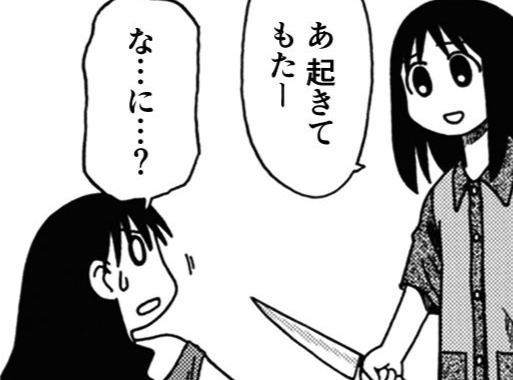
Volume 3年生 » Page 86
During a vacation trip with her teacher and friends from class, Ayumu plans to wake the teacher by banging a ladle against a frying pan. Since Ayumu is still half asleep herself, she doesn’t realize all she’s grabbed is a kitchen knife. She enters the teacher’s room only to find her sitting up already.
歩:
「あ 起( お ) きてもた ー」
“Oh, you're already awake!”
ゆかり:
「な…に…?」
“What...?”
Challenge Yourself
Show translation
Challenge
Why is Ayumu surprised when she enters Yukari's room?
Clues
起( お ) きるto wake up
〜てもた
Kansai form of 〜てしまった, marking an unexpected completed result
あ
an immediate reaction on noticing something
What does the speaker mean?
Yukari has already woken up before Ayumu can wake her.
起( お ) きてもた presents Yukari's waking as an already completed result that disrupts Ayumu's plan.
Ayumu has accidentally fallen asleep in Yukari's room.
The verb is 起( お ) きる, to wake up, not 寝( ね ) る, to sleep.
Yukari refuses to get out of bed.
起( お ) きてもた says the waking has already happened. It does not describe a refusal.
Ayumu realizes she has woken everyone in the building.
The line concerns the person Ayumu finds in the room. It does not mention everyone else.
Yukari asks Ayumu to wake her later.
Ayumu is reacting to a present result, not receiving a future request.
Ayumu is surprised that Yukari brought a kitchen knife.
Ayumu is the one holding the knife in the scene. Her line reacts to Yukari being awake.
Ayumu planned to wake Yukari herself, but 起( お ) きてもた shows that Yukari has already woken up. The Kansai form carries Ayumu’s sense that the result happened before she wanted it to.
View Full Example
Here, 起( お ) きてもた起( お ) きてしまった
Examples
Grammar Explanation:
Doing completely or ending up doing with 〜てしまう and 〜ちゃう
それでも歩は寄せてくる »
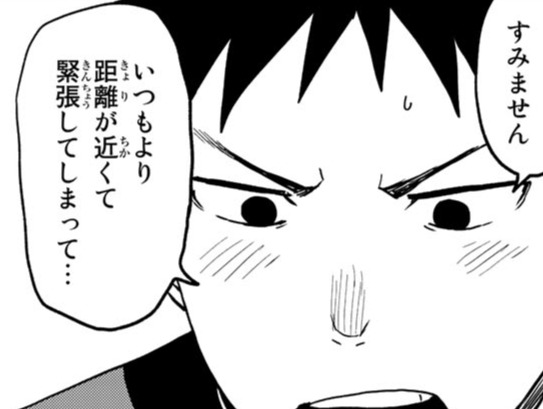
Volume 4 » Page 107
Ayumu and Urushi head to the library so Urushi can help Ayumu study for an upcoming test. The library tables are filled with studying students, so Takeru offers to let the two join him and Sakurako at the library staff desk. Urushi sits beside Ayumu and explains the material as he works through it, but she stops to make sure he’s listening.
歩( あゆむ ) :「すみません」
“Sorry.”
「いつもより距離( きょり ) が近( ちか ) くて緊張( きんちょう ) してしまって …」
“You're a bit closer than usual, so I got nervous ...”
Challenge Yourself
Show translation
Challenge
Why does Ayumu apologize for losing focus?
Clues
いつもより距離( きょり ) が近( ちか ) くて
"because the distance is closer than usual"
緊張( きんちょう ) してしまって…"I ended up getting nervous..." describing an unintended reaction.
What does the speaker mean?
Urushi is sitting closer to him than usual, making him nervous.
いつもより距離( きょり ) が近( ちか ) くて gives the cause, and 緊張( きんちょう ) してしまって gives Ayumu's involuntary response.
He is nervous because he did not study before coming.
The line names the unusually close distance as the cause, not a lack of preparation.
The library is noisier than usual.
いつもより modifies the distance between Ayumu and Urushi, not the noise level.
He is embarrassed because Urushi answered incorrectly.
Ayumu explains his own nervousness. He does not criticize Urushi's explanation.
He deliberately ignored Urushi to tease her.
〜てしまって presents the nervous reaction as something that happened despite him, not a deliberate act.
He wants to move closer but cannot find a seat.
He says they are already closer than usual, and that closeness is making him nervous.
Ayumu says the 距離( きょり ) between them is closer than usual. He then trails off with 緊張( きんちょう ) してしまって…, admitting that he ended up nervous and distracted.
Grammar Explanation:
Doing completely or ending up doing with 〜てしまう and 〜ちゃう
ARIA The MASTERPIECE »
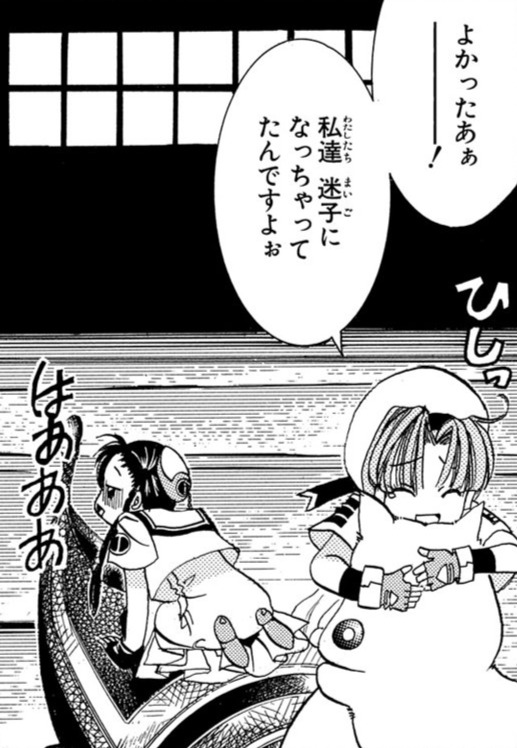
Volume 1 » Page 138
During training, Akari spots her company’s feline president, President Aria, sailing by in a small gondola. She instructs Aika to row the training gondola in the same direction, and the two follow him down an alley that’s normally gated from entry. The two lose sight of Aria and find themselves going in circles through flooded abandoned buildings. After some time, Aria’s gondola floats by.
灯里( あかり ) :「よかったあぁーーーーー! 私達( わたしたち ) 迷子( まいご ) になっ ちゃって たんですよぉ」
“Oh, thank goooodness! We had gotten completely lost , you know!”
Grammar Explanation:
Doing completely or ending up doing with 〜てしまう and 〜ちゃう
ホリミヤ »
Volume 1 » Page 45
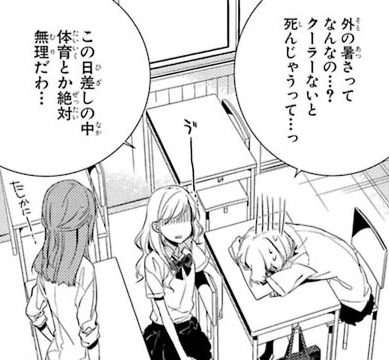
On a summer day, Hori and her friends in class can’t ignore the heat.
由紀( ゆき ) :「外( そと ) の暑( あつ ) さってなんなの…? クーラーないと死( し ) んじゃう って…っ」
“What's with this heat outside...? I'd totally die without the AC...”
「この日差( ひざ ) しのなか体育( たいいく ) とか絶対( ぜったい ) 無理( むり ) だわ…」
“There's no way I can do PE in this blazing sun...”
Challenge Yourself
Show translation
Challenge
What does Yuki say would happen without air conditioning?
Clues
クーラーないと
if there is no air conditioning, with が omitted
死( し ) んじゃうwould end up dying, said as an exaggerated reaction
What does the speaker mean?
She would end up dying from the heat.
クーラーないと sets the lack of AC as the condition, and 死( し ) んじゃう gives the exaggerated result.
The air conditioner would stop working because of the heat.
ない describes the absence of AC. The subject of 死( し ) んじゃう is Yuki, not the machine.
She would have to leave class and exercise outside.
Yuki says outdoor PE is impossible in the sunlight. She does not present it as the result of having no AC.
She would become accustomed to the heat eventually.
死( し ) んじゃう gives a disastrous result, even if exaggerated. It does not suggest adaptation.
She would refuse to turn on the air conditioner.
Yuki treats AC as necessary relief. She does not reject using it.
She would already have died before reaching school.
The condition is hypothetical and present. She says what would happen without AC, not that it has already happened.
Yuki exaggerates that she would die without air conditioning. 死( し ) んじゃう contracts 死( し ) んでしまう and presents death as the extreme unwanted result.
Supplemental Examples
Try finding this grammar in the following examples: