Doing for a reason with 〜ように
Grammar: Purpose » 〜ように
〜ように after a verb gives the goal of an action. English usually translates it as “so that” or “so as to”. The clause before ように describes the result someone hopes for, and the clause after it says what they do to get there.
The verb before ように usually describes a result rather than a deliberate act. Potential forms such as 泳げる, negative forms such as 忘れない, and verbs such as 見える and 分かる are typical.
Usage Notes
When the goal is an action the subject sets out to do, Japanese usually uses ために instead, as in 大学に入るために, “to get into college”. ように fits when the goal is an ability, a state, or something to avoid. It also fits when the result depends on someone else. The ように clause then has its own subject marked with が, as in リゼちゃんが泳げるように.
Purpose ように follows a verb. After a noun, as in 猫のように, ように means “like” instead.
Formation
View formation details
- Verb (potential form) + ように
- 日本語が話せるように、毎日練習している
- "I practice every day so that I can speak Japanese."
- Verb (ない-form) + ように
- 忘れないように、メモしておく
- "I'll write it down so that I don't forget."
- Verb (dictionary form) + ように
- 黒板の字がよく見えるように、前の席に座った
- "I sat in the front so that I could see the board."
- Note: Common with verbs that describe a result, such as 見える, 聞こえる, 分かる, and なる.
- Verb (て-form) + もらえるように
- みんなに分かってもらえるように、ゆっくり説明した
- "I explained it slowly so that everyone would understand."
- Verb (ない-form) + ように + 気をつける
- 風邪をひかないように気をつけてね
- "Be careful not to catch a cold."
- Verb (stem) + ますように
- 明日晴れますように
- "I hope it's sunny tomorrow."
- Note: The main clause is left unsaid, and the sentence states a wish.
Naming the Goal
The clause before ように describes the result someone is aiming for. The clause after it is the action taken to reach that result. English usually reverses the order and puts “so that” after the action.
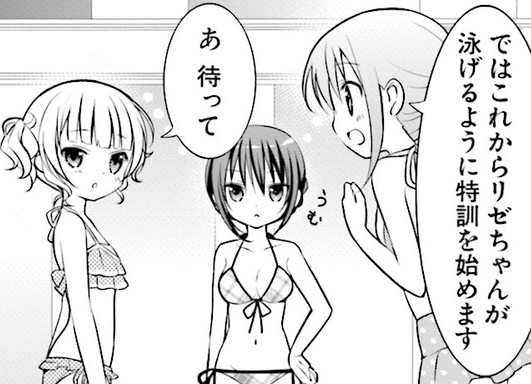
Cocoa and her friends visit an indoor hot spring. Rize admits she doesn’t know how to swim.
- ココア:
- 「ではこれからリゼちゃんが泳げるように特訓を始めます」
- “Now then, we're going to start special training so that Rize-chan can swim.”
- シャロ:
- 「あ 待って」
- “Ah, wait.”
Rize has just admitted that she can’t swim. Cocoa announces special training, and リゼちゃんが泳げるように gives its goal. Whether Rize can swim at the end of it is the hoped-for result, so the potential form 泳げる comes before ように.
Preventing Something with ないように
A negative verb before ように says what someone wants to avoid. English often uses “so that … won’t” or “so as not to”.
Example 1 of 2: Going to school together so as to not get lost with 〜ように
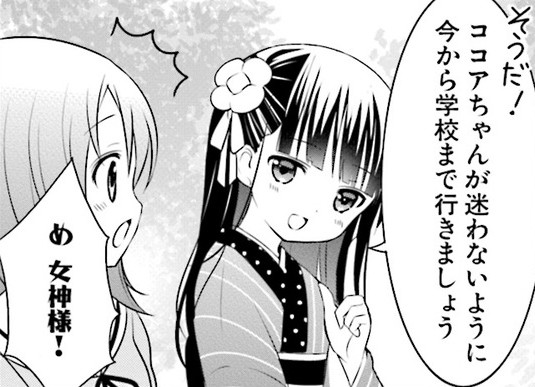
After Cocoa gets lost looking for her new school, she meets Chiya, who will be going to the same school as her.
- 千夜:
- 「ココアちゃんが迷わないように今から学校まで行きましょう」
- “Let's go from here to the school now so you won't get lost.”
- ココア:
- 「め 女神様!」
- “A-a goddess!”
Cocoa got lost while looking for her new school. Chiya will attend the same school, and she offers to walk there with Cocoa now. ココアちゃんが迷わないように means “so that you won’t get lost”. Chiya uses Cocoa’s name where English would say “you”.
Example 2 of 2: Filling a pot for a double boiler with 鍋に水を張る
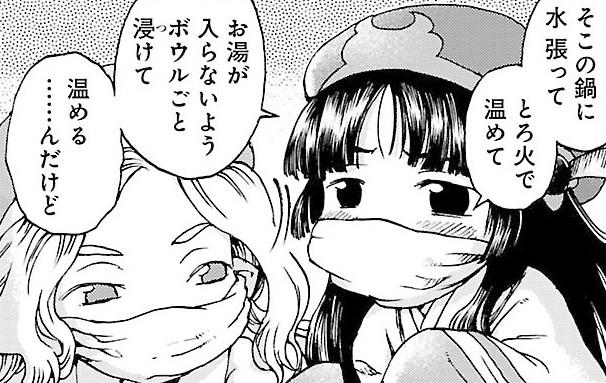
Konju drops by Hakumei and Mikochi’s new house and talks Mikochi into letting her help make honey waffles. Mikochi tells her to whisk the eggs and honey over a double boiler on low heat. Konju asks what a double boiler is, and Mikochi realizes she has to start from the basics.
- ミコチ:
- 「そこの鍋に水張って」
- “Fill that pot there with water.”
- 「とろ火で温めて」
- “Heat it on a low flame.”
- 「お湯が入らないようボウルごと浸けて」
- “Set the whole bowl in it without letting the water get inside.”
- 「温める……んだけど」
- “And that warms it… is the idea, anyway.”
Mikochi is teaching Konju how a double boiler works. お湯が入らないよう means “so the hot water doesn’t get in”, the thing to avoid while setting the bowl in the pot. Casual speech often drops the に from ように.
〜ないように often comes before 気をつける. 風邪をひかないように気をつけてね means “take care not to catch a cold”.
When the Result Depends on Someone Else
The person acting and the person who reaches the goal can be different. In that case, が marks the subject inside the ように clause, as in リゼちゃんが泳げるように above.
With 〜てもらえるように, the goal is something another person does, and the speaker’s side benefits from it.
Example 1 of 2: Working hard so as to satisfy customers with 〜ように
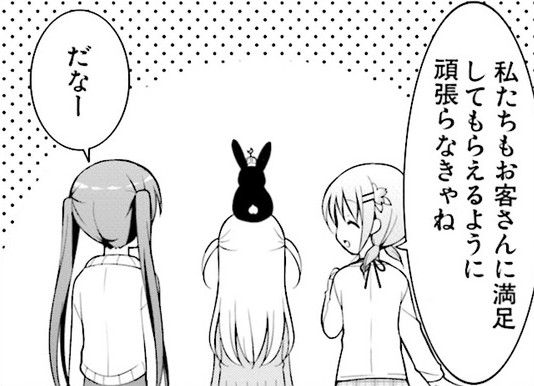
After visiting Chiya’s family’s café, Cocoa’s sense of work is reinvigorated.
- ココア:
- 「私たちもお客さんに満足してもらえるように頑張らなきゃね」
- “We've got to work hard too so that customers will be satisfied.”
- リゼ:
- 「だなー」
- “Yeah.”
Cocoa has just visited Chiya’s family’s café and comes back eager to work. She can’t make customers feel satisfied. She can only work hard and hope they do. お客さんに満足してもらえるように presents customer satisfaction as something the café receives.
Example 2 of 2: Megure wants his apple peeled with 皮をむく
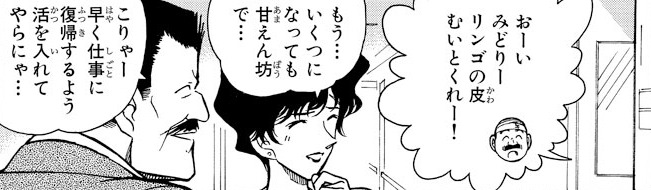
Inspector Megure is in the hospital after an old head wound reopened during a case. Superintendent Matsumoto has just told Kogoro and the others how Megure got the scar twenty years ago. Now Megure’s wife, Midori, has stepped out of his room to greet the visitors.
- 目暮:
- 「おーい みどりー リンゴの皮むいとくれー!」
- “Heeey, Midori! Peel an apple for me!”
- みどり:
- 「もう… いくつになっても甘えん坊で…」
- “Honestly... He's such a baby, no matter how old he gets...”
- 松本:
- 「こりゃー早く仕事に復帰するよう活を入れてやらにゃ…」
- “Looks like I'll have to light a fire under him so he gets back to work soon...”
Inspector Megure is in the hospital, calling for his wife to peel him an apple, and his boss decides he needs a push. 仕事に復帰するよう活を入れる is “fire him up so he gets back to work”. The boss does the rousing, but Megure is the one who has to return. Casual speech often drops the に from ように.
Verbs That Describe a Result
Some verbs describe something that happens rather than something a person does on purpose. 見える “be visible”, 聞こえる “be audible”, 分かる “understand”, and なる “become” often come before ように.
上手になるように毎日練習している means “I practice every day so that I’ll get better”. Practice is the action. Getting better is the result it should lead to.
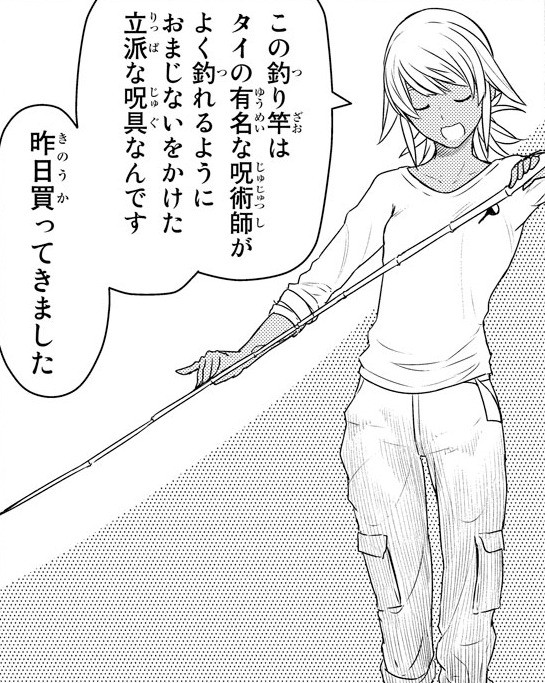
Akane drives Makoto, Kei, Chinatsu, and Nao to a river for the day. When they arrive, she shows off a bamboo rod she bought for the trip and calls it the “big-catch fishing rod”. The others think it looks cheap, and Kei asks whether it can even catch anything. Akane plays a street vendor and tells him it’s no ordinary rod.
- 茜:
- 「この釣り竿はタイの有名な呪術師がよく釣れるようにおまじないをかけた立派な呪具なんです」
- “This fishing rod is a proper magic charm. A famous sorcerer in Thailand cast a spell on it so the fish will bite.”
- 「昨日買ってきました」
- “I bought it yesterday.”
Akane is showing off a cheap-looking bamboo rod. She claims a famous sorcerer in Thailand put a spell on it. よく釣れるように gives the spell’s purpose, “so that it catches lots of fish”. 釣れる describes fish getting caught, which no one can make happen just by wanting it, so it takes ように.
Wishes and Prayers with ますように
When the main clause is left off, polite 〜ますように states a wish. The missing verb is something like 祈る “pray” or 願う “wish”. Characters say it at shrines, write it on Tanabata wish slips, and use it in New Year greetings.
明日晴れますように means “I hope it’s sunny tomorrow” or “please let it be sunny tomorrow”. For something the speaker hopes won’t happen, the form is 〜ませんように. 雨が降りませんように means “please don’t let it rain”.
Instructions with ように
〜ように言う reports an instruction without quoting it word for word. 先生に早く帰るように言われた means “the teacher told me to go home early”. 頼む “ask” and 伝える “pass on” work the same way. In this use, the verb before ように is whatever the listener was told to do, so a deliberate action such as 帰る is fine.
Teachers, bosses, and posted notices also end a sentence with ように to give an instruction. 廊下を走らないように means “no running in the halls”. It sounds like a rule handed down from someone in charge.
Comparing ように with ために
Both mark a purpose, and both can translate as “so that” or “in order to”. The verb in front usually decides which one fits.
- 大学に入るために、毎日勉強している。
I study every day to get into college.
- 大学に入れるように、毎日勉強している。
- I study every day so that I can get into college.
入る is something the speaker sets out to do, so it takes ために. 入れる, “be able to get in”, depends on more than the speaker’s effort, so it takes ように. The ために sentence states an aim. The ように sentence names an outcome the speaker is working toward.
Two other clues point to ように. One is a different subject in the purpose clause, as in リゼちゃんが泳げるように. The other is a goal of avoiding something. 〜ないように is the usual choice there. 〜ないために is less common, and ために after a verb can also give a cause, “because”.
Other Patterns with ように
ように appears in several other patterns. What comes right before and after it tells them apart.
| Pattern | Example | Meaning |
|---|---|---|
| Verb + ように + action | 忘れないようにメモする | write it down so as not to forget |
| Verb + ようにする | 毎日歩くようにしている | make a point of walking every day |
| Verb + ようになる | 泳げるようになった | became able to swim |
| Verb + ように言う | 帰るように言われた | was told to go home |
| 〜ますように | 晴れますように | I hope it’s sunny |
| Noun + のように | 猫のように | like a cat |
ようにする and ようになる build on the same goal sense. ようにする means making a deliberate effort, and ようになる describes a change that came about. Noun + のように is a different use. It compares two things and means “like” or “as”.
Further Reading
- 文法を楽しく よう(2), Japan Foundation (jpf.go.jp)
- ように, Bunpro (bunpro.jp)
- 〜ように (目標・期待), 日本語NET (nihongokyoshi-net.com)
Related Grammar
- Making an effort to with 〜ようにする
- ようにする turns the goal into a habit or a deliberate effort, as in 忘れないようにする, "make sure not to forget".
- Coming to do with 〜ようになる
- ようになる describes a change that has come about, as in 泳げるようになった, "became able to swim".
- Able to do with 〜れる・〜られる
- Potential verbs such as 泳げる often come before purpose ように.
- Having someone do something with 〜てもらう
- 〜てもらえるように aims for a result that another person brings about.
- Going to for a purpose with 〜に行く
- に行く gives the purpose of going somewhere with a verb stem, as in 買いに行く.
- Hoping with 〜といい
- 晴れるといい is another way to hope for good weather. 〜ますように sounds more like a prayer.
- Metaphor with 〜ようだ
- Noun + のように compares two things and means "like".