Even if with 〜ても
Grammar: Unexpected » 〜ても
〜ても says that a condition doesn’t change the result. For something that may or may not happen, it means “even if”: 雨が降っても、行く, “I’ll go even if it rains”. For something that already happened, it means “even though”: 薬を飲んでも、熱が下がらなかった, “even though I took the medicine, my fever didn’t go down”.
The first clause names a condition that would normally lead to some other result. ても says the main clause holds anyway.
Usage Notes
ても is the て-form plus the particle も. Verbs whose て-form ends in で take でも: 読んでも, 泳いでも. い-adjectives take くても, and nouns and な-adjectives take でも. A negative takes なくても: 行かなくても, “even if I don’t go”.
たとえ in front marks the condition as imagined, “even supposing”. いくら and どんなに make it “no matter how much”, and a question word makes it “no matter who” or “no matter what”: 何を言っても, “no matter what I say”. Two ても clauses in a row cover two cases, as in 勝っても負けても, “whether we win or lose”.
ても also appears inside other patterns. 〜てもいい gives permission, and 〜なくてもいい or 〜なくても大丈夫 says you don’t have to. Casual speech often uses 〜たって instead of 〜ても.
Noun + でも isn’t always this pattern. お茶でも飲もう offers tea as one option, “let’s have tea or something”, and 子供でも分かる usually reads “even a child understands”. The “even if” reading is clearest when the noun is the predicate of its own clause: 明日が雨でも, “even if tomorrow is rainy”.
Formation
View formation details
- Verb (て-form) + も
- 雨が降っても、試合はある
- "Even if it rains, the match is on."
- Verb (で-form) + も
- 薬を飲んでも、熱が下がらなかった
- "Even though I took the medicine, my fever didn't go down."
- Note: Verbs ending in ぐ, ぬ, ぶ, and む have て-forms in で, so they take でも.
- い-adjective (drop い) + くても
- 高くても、買うつもりだ
- "Even if it's expensive, I intend to buy it."
- Note: いい becomes よくても.
- Noun / な-adjective + でも
- 明日が雨でも、自転車で行きます
- "Even if it rains tomorrow, I'll go by bike."
- Negative (ない → なくても)
- 行かなくても、結果は同じだ
- "Even if I don't go, the result is the same."
- たとえ 〜 ても
- たとえ親友でも、許せない
- "I can't forgive them, even if they're my best friend."
Even If It Happens
In its basic use, the ても clause names something that hasn’t happened, or may never happen. The speaker grants that it could happen and says the main clause holds anyway. The main clause is often a decision, a promise, or a prediction.
- 失敗しても、あきらめない。
- Even if I fail, I won’t give up.
たとえ in front makes it clear the condition is imagined, like “even supposing”. It’s optional: ても alone already means “even if”.
- たとえ雨が降っても、花火大会は中止しません。
- Even if it rains, the fireworks show won’t be canceled.
When the Expected Result Doesn’t Come
The ても clause can also name an established fact or state, or something that happens regularly as a rule. Something would normally follow from it, but it doesn’t. Here ても means “even though”, “even when”, or “even after”.
- 約束の時間になっても、一郎さんは来ませんでした。
- Even when the agreed time came, Ichirou didn’t show up.
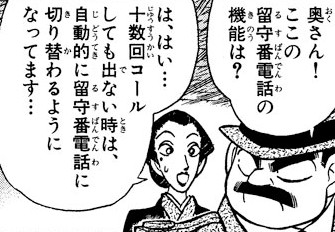
After a suspect recalls that his call to the victim’s house rang many times before the answering machine picked up, Inspector Megure asks the woman of the house how the machine works.
- 目暮:
- 「奥さん!ここの留守番電話の機能は?」
- “Ma'am! How does this answering machine function?”
- 奥さん:
- 「は、はい… 十数回コールしても出ない時は、自動的に留守番電話に切り替わるようになってます…」
- “Well... When nobody answers even after a dozen or so rings, it automatically switches to the answering machine...”
A suspect has just recalled that his call rang many times before the answering machine picked up. Inspector Megure asks how the machine here works, and the woman he addresses as 奥さん explains that when a call goes 十数回, “a dozen or so” rings, and still nobody answers, the machine picks up. Ringing that many times should get an answer, and ても marks that this expected result doesn’t come. She is describing a general rule, so both 出ない and the sentence’s ending stay nonpast.
ても doesn’t work when the first clause pins an action to a specific recent moment and the main clause reports what has happened since. のに handles that: 昨日買ったのに、もう壊れている, “I only bought it yesterday, and it’s already broken”. ても fits when the condition should have brought a result and didn’t: a set time passing, medicine taken, a phone left ringing a dozen times.
No Matter How Much with いくら and どんなに
いくら or どんなに before the ても clause pushes the condition to an extreme: “no matter how much” or “however hard”. The main clause often reports that something still doesn’t work.
- いくら探しても、出口がない。
No matter how much I search, there’s no exit.
- どんなに忙しくても、朝ごはんは食べる。
- No matter how busy I am, I eat breakfast.
いくら also works with a noun: いくら子供でも, “even for a child” or “child though they are”. It grants the point and says there’s still a limit, as in いくら子供でも、それはひどい, “even for a child, that’s going too far”.
No Matter Who or What
A question word in the ても clause covers every possible answer: 誰が来ても, “no matter who comes”, 何を言っても, “no matter what I say”, どこへ行っても, “wherever I go”. Keep the particle the question word would normally take.
- 誰が選ばれても、驚きません。
- No matter who is chosen, I won’t be surprised.
何度 and 何回, “how many times”, work the same way: 何度やっても同じだ, “it’s the same however many times you try”.
Either Way with 〜ても〜ても
Two ても clauses naming different conditions say the result holds in either case. With opposites, this is “whether A or B”.
- 勝っても負けても、これが最後の試合だ。
- Whether we win or lose, this is the last match.
With a verb and its negative, it’s “whether or not”: 食べても食べなくても, “whether I eat or not”. A related use repeats the same verb to stress effort that goes nowhere: 待っても待っても来ない, “I wait and wait, but they don’t come”.
Further Reading
- ても, Japan Foundation teaching materials (kyozai.jpf.go.jp)
- 譲歩, Tokyo University of Foreign Studies (coelang.tufs.ac.jp)
- ても, デジタル大辞泉 (Kotobank) (kotobank.jp)
- ても, Bunpro (bunpro.jp)
Related Grammar
- Permission to do with 〜てもいい
- The permission pattern built on this same ても. 〜なくてもいい, "you don't have to", is there too.
- Even if with 〜たって
- A casual equivalent of 〜ても in speech.
- Even though with 〜のに
- のに reports a real result that contradicts expectations, often with surprise or frustration. ても also covers imagined conditions.
- Offering an example with 〜でも
- Noun + でも can also offer one option, as in お茶でも飲もう, "let's have tea or something". That でも isn't concessive.
- Natural result with 〜と
- と says the result follows the condition; ても says it holds despite the condition.