Grammar in the Kansai dialect
Grammar: Dialect
Kansai dialogue in manga often uses や, へん, and ねん.
The comparisons below read standard Japanese → Kansai .
Copula
The copula says what something is after a noun or な-adjective.
Saying What Something Is
や is the Kansai counterpart of the plain copula だ , often translated as “is” or “am”.
Formation: だ → や
名探偵コナン »
Volume 12 » Page 125
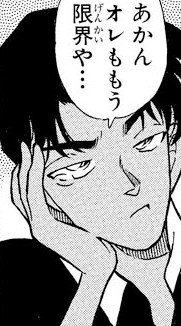
At a special event, the expected host doesn’t show for dinner. After finishing their meals, the guests continue to wait until past midnight. As most guests decide to retire to their rooms for the night, Heiji finds himself yawning.
平次( へいじ ) :「あかんオレももう限界( げんかい ) や …」
“No good, I'm also already at my limit...”
Challenge Yourself
Show translation
Challenge
What does Heiji mean by あかん in this scene?
Clues
あかん
this is no good, I cannot manage
オレももう限界( げんかい ) や
I am already at my limit too
What does the speaker mean?
He cannot keep going because he has reached his limit.
もう限界( げんかい ) や explains あかん as Heiji giving in to exhaustion.
He thinks the dinner tasted bad.
His limit after waiting late into the night is the issue, not the food's quality.
He believes everyone else should remain awake.
オレも shows that he is joining the others who are retiring.
He has decided to leave the event immediately.
The line says he is exhausted, without specifying that he will depart the location.
He wants another meal before sleeping.
The scene takes place after dinner, and his reaction comes with fatigue.
He says that his limit is still far away.
もう限界( げんかい ) means he is already at that limit.
Heiji says he cannot keep waiting because he too has reached his limit. あかん is the Kansai equivalent of “no good” or “I can’t”, and や is the Kansai copula.
View Full Example
Standard Japanese would end the line with 「限界( げんかい ) だ 」, “I’m at my limit”.
Past Copula
やった is the past form of や, corresponding to だった , “was”.
Formation: だった → やった
Agreement
せや and そや express agreement, like “that’s right”, using a shortened form of そう with the copula や .
Formation: そうだ → せや・そや
名探偵コナン »
Volume 16 » Page 18
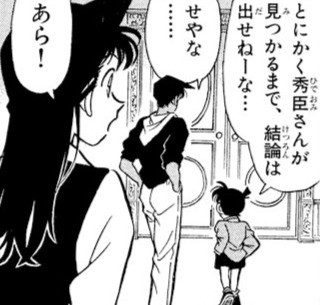
Conan and Heiji end up staying at the same mansion when a murder occurs. They decide to put their heads together to try and determine who the culprit is.
コナン:
「とにかく秀臣( ひでおみ ) さんが見( み ) つかるまで、結論( けつろん ) は出( だ ) せねーな…」
“Anyway, I guess we can't come to a conclusion until we find Hideomi...”
平次( へいじ ) :「せや な……」
“That's right.”
蘭( らん ) :「あら!」
“Oh!”
Challenge Yourself
Show translation
Challenge
Why do Conan and Heiji hold off on reaching a conclusion?
Clues
秀臣( ひでおみ ) さんが見( み ) つかるまでuntil Hideomi is found
結論( けつろん ) は出( だ ) せねーwe cannot reach a conclusion
What does the speaker mean?
They need Hideomi to be found first.
〜まで with the negative says they cannot conclude the case before Hideomi is found.
They have already agreed on the culprit.
結論( けつろん ) は出( だ ) せねー says they cannot yet settle on an answer.
They are waiting for Ran to choose between their theories.
The stated condition is finding Hideomi, not Ran's judgment.
They need the police to leave the mansion.
No departure by the police is tied to their conclusion.
They cannot understand each other's dialect.
Heiji immediately agrees with Conan using せやな.
They have decided there was no murder.
They are still investigating the murder and lack a final conclusion.
Conan says they cannot draw a conclusion until Hideomi is found, and Heiji agrees. The negative potential 出( だ ) せねー means they are not yet able to reach one.
View Full Example
あずまんが大王 »
Volume 1年生 » Page 66
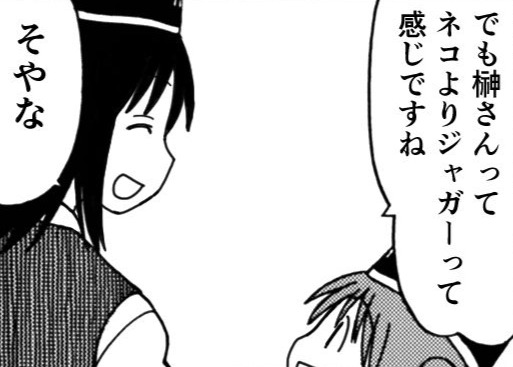
Ayumu and Chiyo get a summer job at Magnetron Hamburger. Their classmate stops by and orders the special that includes a toy of a cat and kitten.
ちよ:
「でも榊( さかき ) さんってネコよりジャガーって感( かん ) じですね」
“But Sakaki gives off more of a jaguar vibe than a cat, doesn't she?”
歩( あゆむ ) :「そや な」
“That's right.”
Challenge Yourself
Show translation
Challenge
What impression does Chiyo have of Sakaki?
Clues
榊( さかき ) さんってas for Sakaki
ネコより
than a cat, setting the comparison baseline
ジャガーって感( かん ) じ
a jaguar sort of impression
What does the speaker mean?
Sakaki gives off more of a jaguar impression than a cat impression.
ネコより makes a cat the baseline, while ジャガーって感( かん ) じ gives Chiyo's stronger impression.
Sakaki likes cats more than she likes jaguars.
The line compares how Sakaki comes across. It does not compare her preferences.
Sakaki seems more like a cat than a jaguar.
This reverses the comparison. ネコ is the baseline, and ジャガー supplies the stronger impression.
Sakaki says that Chiyo reminds her of a jaguar.
Chiyo is speaking about 榊( さかき ) さん, not reporting something Sakaki said about Chiyo.
Chiyo cannot decide whether the toy is a cat or a jaguar.
感( かん ) じ describes Chiyo's impression of Sakaki. It does not identify the toy.
Chiyo thinks Sakaki should choose the cat toy.
The line makes an observation and seeks agreement with ですね. It does not recommend a toy.
Chiyo says Sakaki has more of a jaguar vibe than a cat vibe. Ayumu’s そやな agrees with that comparison.
View Full Example
Explanations
Explanatory endings give the listener background or explain why the speaker says something.
Giving an Explanation
ねん presents an explanation or information the speaker wants to tell the listener, similar to のだ or んだ .
Formation: のだ・んだ → ねん
あずまんが大王 »
Volume 1年生 » Page 132
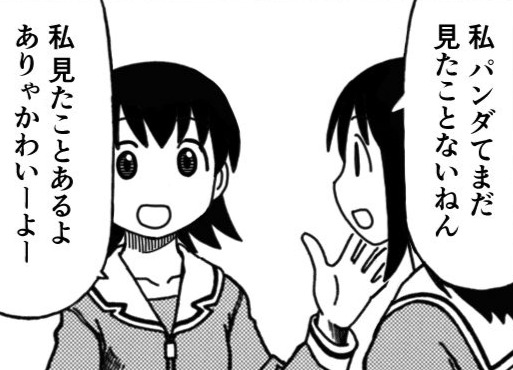
Chiyo shows her friends in class the panda picture book she bought.
歩( あゆむ ) :「私( わたし ) パンダてまだ見( み ) たことないねん 」
“I haven't seen a panda yet.”
とも:
「私( わたし ) 見( み ) たことあるよ ありゃかわいーよー」
“I've seen one. They're cute!”
Challenge Yourself
Show translation
Challenge
How do Ayumu's and Tomo's panda experiences differ?
Clues
まだ見( み ) たことない
has not seen one yet
見( み ) たことあるhas seen one before
ありゃかわいーよ
those are cute
What does the speaker mean?
Ayumu has never seen a panda, while Tomo has and says they are cute.
Ayumu uses 見( み ) たことない, while Tomo answers with the affirmative 見( み ) たことある and comments that pandas are cute.
Ayumu has seen a panda, while Tomo has not.
This swaps the two experiences. Ayumu uses ない, and Tomo uses ある.
Neither girl has ever seen a panda.
Tomo explicitly says 見( み ) たことある, so she has seen one.
Both girls have seen pandas and found them cute.
Ayumu's まだ見( み ) たことない says she has not seen one yet.
Ayumu saw a panda recently but Tomo saw one long ago.
Ayumu describes no past viewing at all. まだ with the negative means not yet.
Tomo has seen the picture book but not a real panda.
Tomo's 見( み ) たことある answers Ayumu's statement about seeing a panda, not about seeing the book.
Ayumu says she has never seen a panda yet. Tomo contrasts that with her own experience and adds that pandas are cute.
View Full Example
Here, 「見( み ) たことないねん」 corresponds to 「見( み ) たことないんだ」.
Explaining Nouns and Adjectives
やねん combines the copula や with explanatory ねん after a noun or な-adjective.
Formation: なんだ → やねん
あずまんが大王 »
Volume 2年生 » Page 46
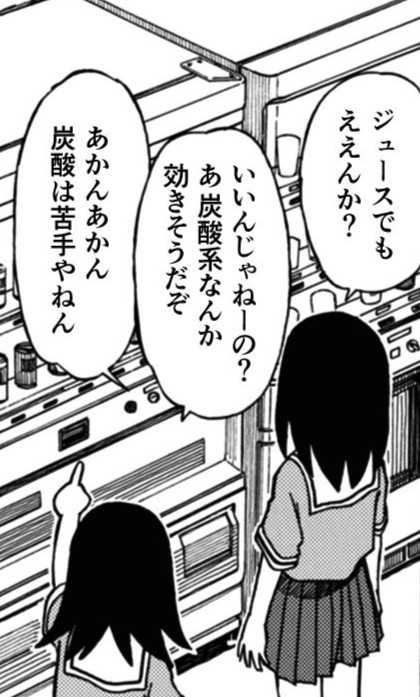
A case of the hiccups sends Ayumu down the path of trying each of her friends’ potential solutions. Tomo suggests drinking water as a cure.
歩( あゆむ ) :「ジュースでもええんか?」
“Is juice okay too?”
とも:
「いいんじゃねーの?あ炭酸( たんさん ) 系( けい ) なんか効( き ) きそうだぞ」
“Yeah, that should be fine, right? Actually, carbonated stuff might work even better.”
歩( あゆむ ) :「あかんあかん炭酸( たんさん ) は苦手( にがて ) やねん 」
“No no, I can't do carbonated drinks. I'm bad with them.”
Challenge Yourself
Show translation
Challenge
Why does Ayumu reject Tomo's drink suggestion?
Clues
炭酸( たんさん ) 系( けい ) なんか効( き ) きそうsomething carbonated looks likely to work
あかんあかん
no, no in Kansai speech
炭酸( たんさん ) は苦手( にがて ) やねんI cannot handle carbonated drinks
What does the speaker mean?
She cannot handle carbonated drinks.
Ayumu rejects Tomo's 炭酸( たんさん ) 系( けい ) suggestion and explains that 炭酸( たんさん ) is 苦手( にがて ) for her.
She thinks carbonated drinks will make the hiccups worse.
Ayumu gives her personal difficulty with carbonation as the reason, not a claim about its effect on hiccups.
She says juice is not allowed at school.
The conversation asks whether juice is acceptable for the cure. No school rule is mentioned.
She believes only plain water can work.
Tomo is the one judging what might work. Ayumu rejects carbonation because she dislikes it.
She has already tried a carbonated drink without success.
The line describes what Ayumu cannot handle. It does not report an earlier attempt.
She does not know what 炭酸( たんさん ) means.
Ayumu understands the suggestion well enough to reject that category of drink immediately.
Tomo thinks a carbonated drink might cure the hiccups, but Ayumu says no because she is bad with carbonation.
View Full Example
Standard Japanese uses な before the explanatory ん, as in 「苦手( にがて ) なんだ」. Kansai uses や in 「苦手( にがて ) やねん」.
Past Explanations
〜てん can express a past event with the explanatory meaning of 〜たんだ .
Formation: 行( い ) ったんだ → 行( い ) ってん
Ongoing Explanations
〜てんねん combines the ongoing action or state of 〜ている with an explanatory ending .
Formation: 〜ているんだ → 〜てんねん
名探偵コナン »
Volume 19 » Page 88
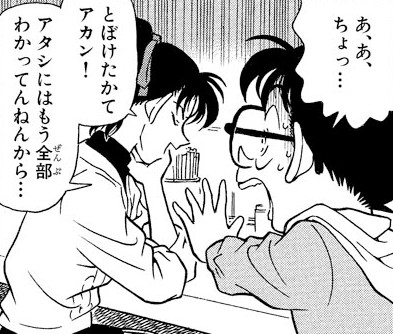
Heiji invites Conan, Ran, and Mouri on a tour of Osaka. While Heiji steps away, his childhood friend who’s been following the group confronts them. She opens by saying “You’re Kudo, right?” and that she heard it from Heiji. Conan, realizing his true identity is about to be revealed to Ran, tries to stop her.
コナン:
「あ、あ、ちょっ…」
“Ah, ah, wai--!”
和葉( かずは ) :「とぼけたかてアカン! アタシにはもう全部( ぜんぶ ) わかってんねん から…」
“It's no use playing dumb. Since I already know everything...”
Challenge Yourself
Show translation
Challenge
What does Kazuha claim despite Conan's attempt to stop her?
Clues
とぼけたかてアカン
it is no use playing dumb
アタシにはもう全部( ぜんぶ ) わかってんねん
I already know everything
What does the speaker mean?
She already knows everything, so pretending is useless.
もう全部( ぜんぶ ) わかってんねん states that Kazuha believes she has the full truth already.
She has forgotten everything Heiji told her.
She claims the opposite with 全部( ぜんぶ ) わかってる.
She wants Conan to explain the situation later.
Kazuha says playing dumb now will not work because she already understands.
She thinks Heiji has been pretending not to know her.
Her accusation is directed at the person she believes is Kudo.
She knows only one small part of the story.
全部( ぜんぶ ) means everything, not a limited piece.
She agrees to keep silent before saying anything.
Conan tries to stop her, but Kazuha continues with confidence.
Kazuha says that playing dumb will not work because she already knows everything. アタシ is her casual feminine first-person pronoun, colored by the Kansai speech around it.
View Full Example
「もう全部( ぜんぶ ) わかってんねんから」 corresponds to 「もう全部( ぜんぶ ) わかっているんだから」, “because I already know everything”. The てん in this longer ending comes from ている; the whole expression describes a current state.
In Kazuha’s first line, 〜たかて means “even” .
Negatives and Obligation
Negative forms say that something does not happen, and they also help form expressions meaning “must”.
Plain Negatives
〜へん makes a verb negative, corresponding to 〜ない .
Formation: 〜ない → 〜へん
The verb stem can change too. Examples include 食( た ) べない → 食( た ) べへん, しない → せえへん, and 来( こ ) ない → けえへん.
カードキャプターさくら »
Volume 1 » Page 108
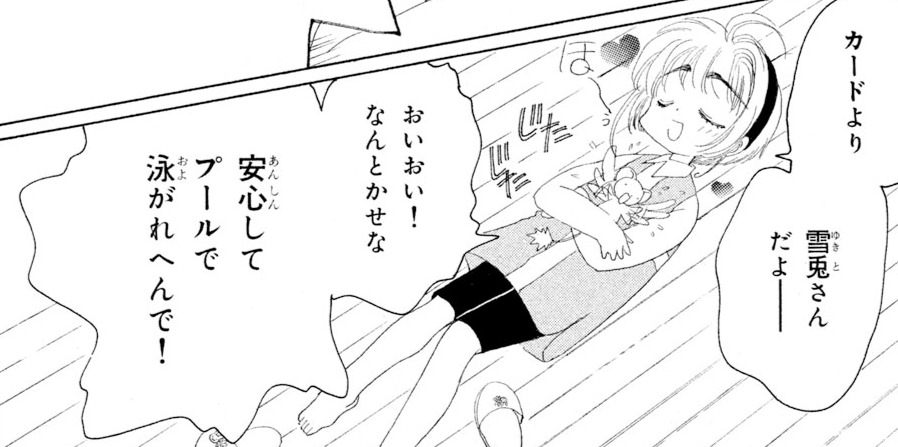
Sakura and Kero are supposed to discuss a Clow Card causing problems at the elementary school school. After taking her homemade pancakes to her brother and Yukito, Sakura’s happiness over making something for Yukito overtakes her concern of Clow Cards. Kero tries to get her back on track.
桜( さくら ) :「カードより雪兎( ゆきと ) だよーーー」
“Forget the cards, Yukito's way more important!”
ケロ:
「おいおい!なんとかせな」
“Hey hey! You've gotta do something about it!”
「安心( あんしん ) してプールで泳( およ ) がれへん で!」
“The pool can't be swam in safely!”
Challenge Yourself
Show translation
Challenge
What consequence does Kero warn about?
Clues
なんとかせな
they must do something about the problem
安心( あんしん ) してプールで泳( およ ) がれへんpeople will not be able to swim safely in the pool, in Kansai speech
What does the speaker mean?
People will not be able to swim in the pool without fear.
安心( あんしん ) して describes swimming at ease, and 泳( およ ) がれへん negates the ability to swim.
Sakura will permanently lose her ability to swim.
Kero is warning about the dangerous pool, not describing a lasting change in Sakura's swimming ability.
The Clow Card will become impossible to find outside the pool.
The stated consequence concerns safe swimming. The line does not discuss where the card can be found.
Everyone will have to swim before the pool closes.
泳( およ ) がれへん means they cannot swim, not that they are required to do so.
Yukito will be unable to visit the school.
Sakura mentions Yukito, but Kero's warning is about the pool and the unresolved danger there.
The pool will be safe as long as Sakura does nothing.
なんとかせな says action is necessary. Kero warns that the pool will remain unsafe without it.
Kero tells Sakura they must deal with the Clow Card trouble or nobody can swim at ease. 泳( およ ) がれへん is the Kansai equivalent of 泳( およ ) げない, which means cannot swim.
View Full Example
In this panel, 「泳( およ ) がれへん」 corresponds to standard 「泳( およ ) げない」, “can’t swim”. Both the potential form and its negative ending differ. The sentence-final で is the Kaisai counterpart to the standard よ.
Short Negatives
The short negative ん expresses the same basic denial as ない and appears alongside へん in Kansai speech.
Formation: 〜ない → 〜ん
This negative ん also occurs elsewhere in Japan.
Past Negatives
〜んかった says that something did not happen, corresponding to the past negative 〜なかった .
Formation: 〜なかった → 〜んかった
Polite Negatives
〜まへん is a regional counterpart of the polite negative 〜ません .
Formation: 〜ません → 〜まへん
Must Do
〜なあかん and 〜んとあかん express obligation , “must do” or “have to do”.
Formation:
〜なければならない → 〜なあかん
〜ないといけない → 〜んとあかん
あかん means “no good”, so these patterns say that leaving the action undone will not do. 「行( い ) かなあかん」 and 「行( い ) かんとあかん」 both mean “I have to go”.
あずまんが大王 »
Volume 2年生 » Page 122
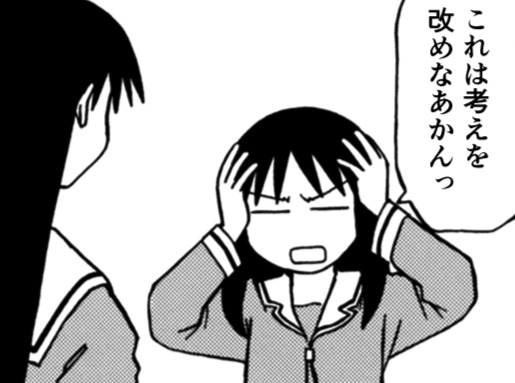
Ayumu says she’s never had matsutake mushrooms and asks Sakaki if they’re any different from shiitake mushrooms. Sakaki says they’re completely different, which throws off Ayumu’s belief that matsutake mushroom were an improved shiitake.
歩( あゆむ ) :「これは考( かんが ) えを攻( せ ) めなあかん っ」
“I have to challenge this whole notion!”
Challenge Yourself
Show translation
Challenge
What does Ayumu resolve to do after Sakaki corrects her?
Clues
これは
given this new information
考( かんが ) えを攻( せ ) めるattack or challenge an idea
〜なあかん
must do in Kansai speech
What does the speaker mean?
She decides she must challenge her previous idea about the mushrooms.
考( かんが ) え is the idea she held, and 攻( せ ) めなあかん says she must challenge it.
She decides she must criticize Sakaki's opinion.
The object of 攻( せ ) める is Ayumu's 考( かんが ) え, not Sakaki.
She says she must cook the mushrooms differently.
No cooking action appears in the line. Ayumu is revising an idea.
She insists her original belief was correct.
これは points to the correction as a reason to rethink, not defend, her assumption.
She says she is forbidden from thinking about mushrooms.
〜なあかん expresses necessity, not prohibition.
She plans to compare the price of the two mushrooms.
The line names her 考( かんが ) え as the target. It says nothing about price.
Sakaki’s correction makes Ayumu decide she must attack her own mistaken assumption. 〜なあかん is the Kansai equivalent of saying she has to do it.
View Full Example
Here, 「攻( せ ) めなあかん」 corresponds to 「攻( せ ) めなければならない」 or 「攻( せ ) めないといけない」.
Actions and States
These forms describe an action in progress, an existing state, or an action that ends up happening.
〜とる can describe the same ongoing action or state as 〜ている .
Formation: 〜ている → 〜とる
Being There
おる corresponds to いる when saying that a person or animal is present.
Formation: いる → おる
Ending Up Doing
〜てまう and its past forms describe completion or an action that ends up happening , sometimes with regret or surprise.
Formation:
〜てしまう → 〜てまう
〜てしまった → 〜てもうた・〜てもた
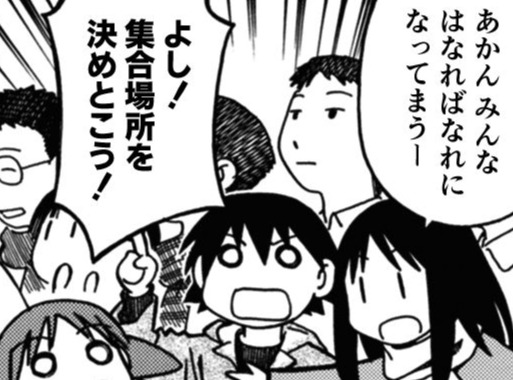
あずまんが大王 »
Volume 3年生 » Page 175
Chiyo and her friends from class to go a new year shrine visit together. Chiyo remarks on how crowded it is.
歩( あゆむ ) :「あかんみんなはなればなれになっ てまう ー」
“Oh no, everyone's going to end up separated!”
とも:
「よし!集合( しゅうごう ) 場所( ばしょ ) を決( き ) めとこう!」
“All right! Let's decide on a meeting spot!”
Challenge Yourself
Show translation
Challenge
What does Tomo propose before anyone gets separated?
Clues
はなればなれになってまう
will end up separated
集合( しゅうごう ) 場所( ばしょ ) meeting place
決( き ) めとこうlet's decide in advance
What does the speaker mean?
The group should choose a meeting place in advance.
集合( しゅうごう ) 場所( ばしょ ) names the meeting place, and 決( き ) めとこう proposes deciding it as preparation.
Everyone should split up and meet again at home.
Becoming separated is the problem they want to guard against, not Tomo's plan.
The group should leave the crowded shrine immediately.
Tomo proposes choosing a location. She does not tell the group to leave.
Chiyo should decide where each person stands in line.
The proposal is collective and concerns a fallback meeting place, not positions in a line.
They should wait until they are lost before choosing a place.
〜とこう marks preparation in advance, before the unwanted separation occurs.
Everyone should gather at the spot where they are standing now.
The line says to decide on a 集合( しゅうごう ) 場所( ばしょ ) ; it does not identify the current spot as that place.
Ayumu worries that the crowd will separate them. Tomo responds by proposing that they choose a meeting place ahead of time.
View Full Example
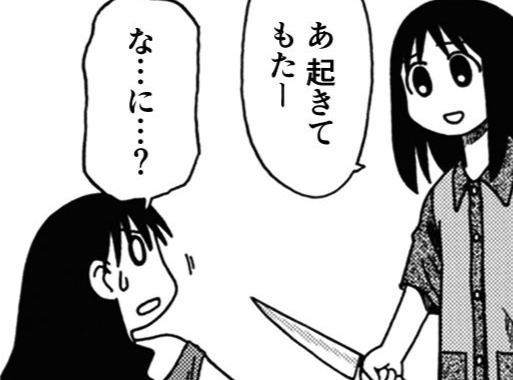
あずまんが大王 »
Volume 3年生 » Page 86
During a vacation trip with her teacher and friends from class, Ayumu plans to wake the teacher by banging a ladle against a frying pan. Since Ayumu is still half asleep herself, she doesn’t realize all she’s grabbed is a kitchen knife. She enters the teacher’s room only to find her sitting up already.
歩:
「あ 起( お ) きてもた ー」
“Oh, you're already awake!”
ゆかり:
「な…に…?」
“What...?”
Challenge Yourself
Show translation
Challenge
Why is Ayumu surprised when she enters Yukari's room?
Clues
起( お ) きるto wake up
〜てもた
Kansai form of 〜てしまった, marking an unexpected completed result
あ
an immediate reaction on noticing something
What does the speaker mean?
Yukari has already woken up before Ayumu can wake her.
起( お ) きてもた presents Yukari's waking as an already completed result that disrupts Ayumu's plan.
Ayumu has accidentally fallen asleep in Yukari's room.
The verb is 起( お ) きる, to wake up, not 寝( ね ) る, to sleep.
Yukari refuses to get out of bed.
起( お ) きてもた says the waking has already happened. It does not describe a refusal.
Ayumu realizes she has woken everyone in the building.
The line concerns the person Ayumu finds in the room. It does not mention everyone else.
Yukari asks Ayumu to wake her later.
Ayumu is reacting to a present result, not receiving a future request.
Ayumu is surprised that Yukari brought a kitchen knife.
Ayumu is the one holding the knife in the scene. Her line reacts to Yukari being awake.
Ayumu planned to wake Yukari herself, but 起( お ) きてもた shows that Yukari has already woken up. The Kansai form carries Ayumu’s sense that the result happened before she wanted it to.
View Full Example
「起( お ) きてもた」 corresponds to 「起( お ) きてしまった」. The shorter spelling てもた has the same basic role as てもうた.
Politeness
Polite grammar marks how a character addresses other people, and Kansai speakers can mix standard and regional forms.
Older Polite Endings
でっせ and まっせ combine regional polite forms with an emphatic ending directed at the listener.
Formation:
Questions and Reactions
These endings ask for an explanation, invite agreement, or react to what another character says.
Asking for an Explanation
Question-final ん asks about a situation, using the shortened form of explanatory の .
「どないしたん?」 means “What’s wrong?” or “What happened?” Question-final ん also appears in standard colloquial Japanese.
Formation:
〜の? → 〜ん?
どうしたの? → どないしたん?
Probably or Right
やろ and やろう express an assumption or ask for agreement, like だろう or でしょう .
Formation: だろう・だろ? → やろう・やろ?
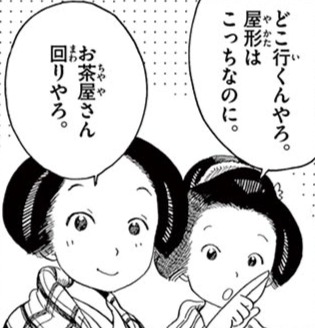
舞妓さんちのまかないさん »
Volume 4 » Page 18
A couple of maiko see Momohana leave a shop and head in the other direction.
まいこ1:
「どこ行( い ) くんやろ 。屋形( やかた ) はこっちなのに。」
“I wonder where she's going. The lodge is this way, though.”
まいこ2:
「お茶屋( ちゃや ) さん回( まわ ) りやろ 。」
“She's probably doing the teahouse rounds.”
Challenge Yourself
Show translation
Challenge
Where does the second maiko think Momohana is going?
Clues
屋形( やかた ) はこっちなのにMomohana is heading away even though the lodge is in this direction
お茶屋( ちゃや ) さん回( まわ ) りやろ
the second maiko guesses that she is making the teahouse rounds
What does the speaker mean?
Around to the teahouses she visits for work.
お茶屋さん回り names the rounds, and やろ presents that destination as the second maiko's likely explanation.
Back to the lodge in the direction the maiko points.
屋形はこっちなのに stresses that Momohana is walking away from the lodge, not toward it.
To an ordinary café to buy tea for the lodge.
In this setting, お茶屋さん refers to establishments that arrange maiko and geiko entertainment, not ordinary cafés.
To one teahouse where she plans to stay all day.
お茶屋さん回り describes going around to multiple teahouses rather than remaining at one.
Somewhere unknown that neither maiko can guess.
The first maiko wonders where she is going, but the second offers a specific likely answer.
Home because she has finished all of her visits.
The second maiko thinks Momohana is currently making her rounds, not heading home after completing them.
Momohana is walking away from the lodge, so the first maiko wonders where she is going. The second answers お茶屋さん回りやろ, guessing that Momohana is making her work-related rounds among the teahouses.
View Full Example
Standard Japanese would use 「行( い ) くんだろう 」 and 「回( まわ ) りだろう 」.
Pointing Something Out
やん and やんか draw attention to something or push for shared agreement, often like “see?” or “isn’t it?”.
Formation: 〜じゃん・〜じゃないか → 〜やん・〜やんか
For example, 「ええやん」 can mean “That’s good!” or “That’s fine, isn’t it?” The comparison with じゃん depends on context; the forms do not match in every use.
Wondering
かいな is a sentence-final particle made of か (question/doubt) plus いな (a softer emphatic particle, like よ). It can add doubt, surprise, skepticism, or mild exasperation to what’s said. It overlaps with かな .
Formation: 〜かな・〜のかな → 〜かいな
Comic Retorts
なんでやねん challenges an absurd statement or situation, often meaning “Why?!” or “How does that make sense?!”
Formation: なんでだよ → なんでやねん
It combines なんで with やねん. In comedy, it is a familiar retort.
Sentence Endings
Sentence-ending particles affect how a statement reaches the listener without changing the verb’s basic meaning.
Sentence-final で directs information, insistence, or a warning at the listener, much like よ .
Formation: よ → で
For example, 「行( い ) くで」 corresponds to 「行( い ) くよ」.
Shared Feelings
Sentence-final な and なあ can invite agreement or express reflection, overlapping with ね .
Formation: ね・ねえ → な・なあ
For example, 「そやな」 means “Yeah, that’s right”. Standard Japanese also uses な, so the particle alone does not identify a line as Kansai speech.
Personal Reactions
Sentence-final わ adds the speaker’s reaction or feeling, with its effect depending on context.
Kansai わ appears in speech by both men and women.
Formation: 行( い ) く・行( い ) くよ → 行( い ) くわ
Connecting Ideas
These forms give a reason or provide contrast to the rest of the sentence.
Even Though
やのに means “even though” after a noun or な-adjective, with や replacing standard な.
Formation: なのに → やのに
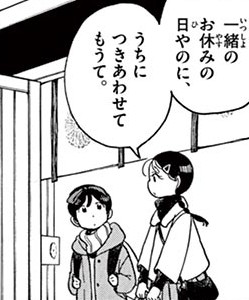
舞妓さんちのまかないさん »
Volume 14 » Page 114
Kiyo meets up with Sumire at the entrance to a local shrine.
すみれ:
「一緒( いっしょ ) のお休( やす ) みの日( ひ ) やのに 、うちにつきあわせてもうて。」
“Sorry for making you come along with me on our day off.”
Challenge Yourself
Show translation
Challenge
Why does Sumire sound apologetic?
Clues
一緒( いっしょ ) のお休( やす ) みの日( ひ ) a day they both have off
やのに
the Kansai equivalent of なのに, marking an 'even though' contrast
〜てもうて
the Kansai equivalent of 〜てしまって, adding regret here
What does the speaker mean?
She made Kiyo come along with her even though it was their shared day off.
一緒( いっしょ ) のお休( やす ) みの日( ひ ) says that both have the day off. うちに付( つ ) き合( あ ) わせる says Sumire made Kiyo accompany her, and 〜てもうて adds regret.
She forgot that Kiyo had to work while Sumire had the day off.
一緒( いっしょ ) の says that they share the day off. The line does not mention work.
Kiyo made Sumire come along when Sumire wanted to rest.
**うちに** means 'with me' here. Sumire leaves Kiyo unstated as the person she made come along.
She cannot accompany Kiyo because their days off are different.
The line has no negation, and 一緒( いっしょ ) の says that the day off is shared.
She is asking Kiyo to join her on their next day off.
〜てもうて looks back on what Sumire ended up doing. It is not a request about a future outing.
Sumire says that despite their shared day off, she ended up making Kiyo accompany her. やのに marks the mismatch, while 〜てもうて adds regret and leaves the apology unfinished.
View Full Example
Standard Japanese would use 「一緒( いっしょ ) のお休( やす ) みの日( ひ ) なのに 」. のに keeps its meaning; it is the preceding copula that changes.
Even
かて adds “even” or “also” after a noun<!–, as in 「寝言( ねごと ) かて関西弁( かんさいべん ) や」, “Even the sleep talking is in Kansai dialect”–.
Formation: 〜でも・〜だって → 〜かて
After a verb, 〜たかて can mean “even if” .
Because
さかい gives a reason or cause, like から or ので .
Formation: 〜から・〜ので → 〜さかい
ARIA The MASTERPIECE »
Volume 2 » Page 129
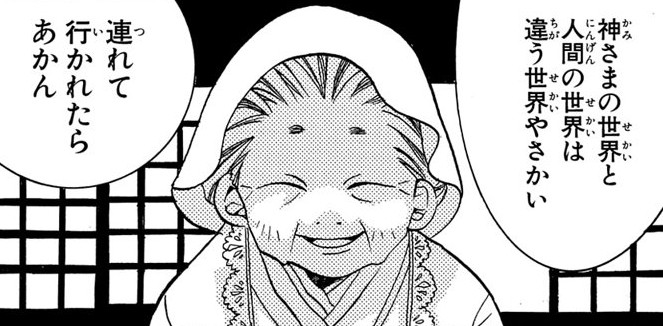
Alicia and Akari visit an island that’s modeled after part of Japan back on Earth. There, an elderly local woman tells the two of the fox spirits that visit the human world there. Akari is excited at the prospect of meeting one, but the old woman gives her a warning: on rare occasion, a fox will take a person back home with them.
おばあさん:
「神( かみ ) さまの世界( せかい ) と人間( にんげん ) の世界( せかい ) は違( ちが ) うやさかい 」
“Since the god world and the human world are different...”
「連( つ ) れて行( い ) かれたらあかん」
“...it is bad to follow along.”
View Full Example
や + さかい here is equivalent to だ + から in standard Japanese.
Sound Changes
Some written differences reflect regional pronunciation within otherwise familiar grammatical forms.
Verb Sound Changes
Some う-ending verbs use a long う sound where the standard past form uses a small っ.
Formation: 買( か ) った → 買( こ ) うた
カードキャプターさくら »
Volume 9 » Page 129
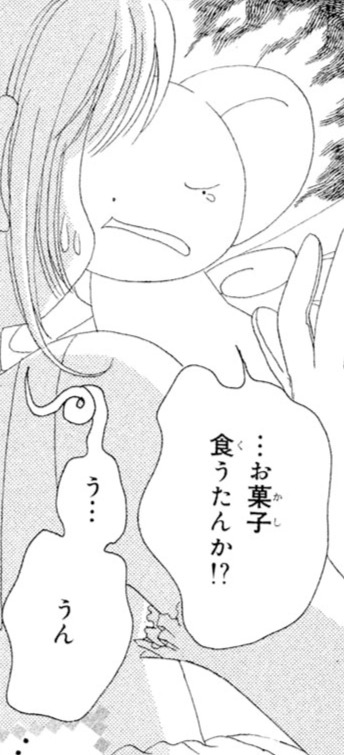
Kero joins Sakura at the spot where she sensed a Clow Card. Seeing Tomoyo and Li, Kero asks why Sakura called them first. Sakura explains she and Tomoyo had stopped by Li’s place, with Tomoyo adding that Sakura tried on a new outfit and they all had snacks.
ケロ:
「…お菓子( かし ) 食( く ) うたんか!?」
“…You ate snacks?!”
桜( さくら ) :「う… うん」
“Y... yeah.”
Challenge Yourself
Show translation
Challenge
What is Kero asking Sakura to confirm?
Clues
食( く ) うたthe Kansai past form of 食( く ) う, 'to eat'
んか
shortened のか, a question asking for confirmation or an explanation
What does the speaker mean?
That she and the others ate snacks.
食( く ) うた is past tense, and Sakura confirms the event with うん.
That she and the others did not eat any snacks.
The ん in んか is shortened explanatory の. It does not make 食( く ) うた negative.
That she and the others plan to eat snacks.
食( く ) うた describes eating that already happened. Kero is asking about a past event.
Kero asks in surprise whether Sakura and the others ate snacks. 食( く ) うた is the Kansai past form, and んか asks her to confirm what he has just heard. Her hesitant うん confirms it.
View Full Example
Adjective Sound Changes
Some adjective forms use a long う sound in places where standard Japanese has く.
Formation:
きつくて → きつうて
よく → よう
早( はや ) く → 早( はよ ) う
舞妓さんちのまかないさん »
Volume 10 » Page 86
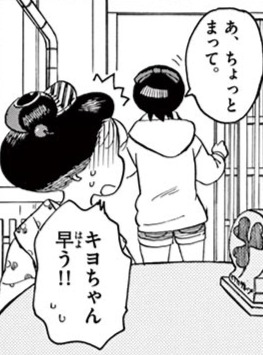
Kenta’s class visits Kyoto, and he takes the opportunity to stops by the place where Sumire and Kiyo are staying. He meets with Sumire, but Kiyo is out. When Sumire hears Kiyo in the kitchen later, she calls a cab for the two to rendezvous with Kenta.
キヨ:
「あ、ちょっとまって。」
“Ah, wait a moment.”
すみれ:
「キヨちゃん早( はよ ) う!!」
“Kiyo-chan, hurry up!!”
Challenge Yourself
Show translation
Challenge
What does Sumire want Kiyo to do?
Clues
早( はよ ) うthe Kansai counterpart of 早( はや ) く, 'quickly' or 'early'
What does the speaker mean?
Hurry up so they can leave.
早( はよ ) う urges Kiyo to get moving. Sumire is ready to leave and wants Kiyo to hurry.
Wait a moment before leaving.
ちょっとまって is Kiyo's request to wait. Sumire responds with 早( はよ ) う, urging her to hurry.
Arrive earlier next time.
早( はよ ) う can correspond to 'early', but Sumire is urging Kiyo to act now. She says nothing about a future visit.
Kiyo asks for a moment’s wait with ちょっとまって. Sumire calls her name and says 早( はよ ) う to urge her to hurry so they can leave.
View Full Example