Having someone do something with 〜てもらう
Grammar: Giving and Receiving » 〜てもらう
The grammar pattern Verb + てもらう describes receiving the benefit of someone doing an action. It often translates as “have someone do”, “get someone to do”, or simply as the action in passive-sounding English, depending on context.
Formation
View formation details
-
Verb て-form + もらう
- 助けてもらう
- "have someone help me"
-
Person + に + Verb て-form + もらう
- 先生に教えてもらう
- "have the teacher teach me"
- Note: に marks the person who does the action.
-
Verb て-form + もらえる
- 見せてもらえる?
- "can I have you show me?"
- Note: The potential form もらえる is common in requests.
Perspective
With 〜てもらう, the receiver is the center of the sentence.
- 私は友達に手伝ってもらった。
- I got my friend to help me.
The friend did the helping, but the sentence is organized around 私 receiving that help.
くれる Versus もらう
〜てくれる and 〜てもらう can describe similar real-world events, but the grammar points the camera differently.
- 友達が手伝ってくれた。 = My friend helped me.
- 友達に手伝ってもらった。 = I got my friend to help me.
In the first sentence, the friend is the subject and the action comes toward the speaker. In the second, the speaker is the receiver, and に marks the person who did the action.
Requests
The potential form 〜てもらえる is common for requests because it asks whether the speaker can receive the favor.
- 少し待ってもらえる? = Could I have you wait a little?
- 名前を書いてもらえますか? = Could you write your name?
This sounds less direct than commanding the action itself because the request is phrased around receiving help.
Related Grammar
-
Receiving kindness with 〜てくれる
- Also describes a helpful action coming toward the speaker's side.
-
Doing for someone with 〜てあげる
- Describes doing an action for someone else.
-
Wanting to do with 〜たい
- Can combine as 〜てもらいたい, meaning "want someone to do something for me".
Examples
Endure the tear gas for me with 〜てもらう
Grammar Explanation: Having someone do something with 〜てもらう
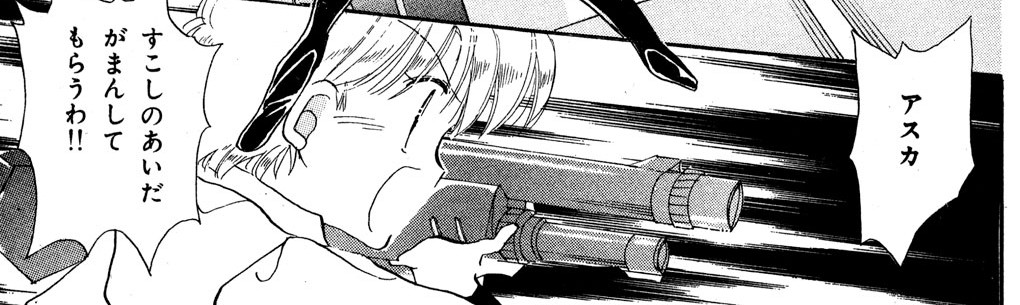
Saint Tail finds it rather easy to approach the historic dagger she’s out to steal. As she takes it, Asuka Jr. jumps out from his hiding place. Rina heads to the enclosed space where the two are and lifts a tear gas gun in their direction.
- リナ:
- 「アスカ すこしのあいだ がまんしてもらうわ!!」
- “Asuka, you'll have to put up with it for a bit!!”
Having you eat carrots for me with 〜てもらう
Grammar Explanation: Having someone do something with 〜てもらう
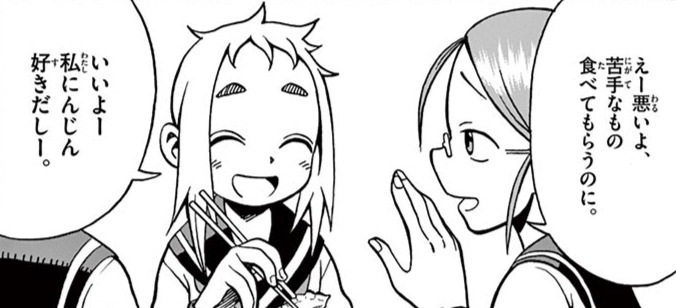
Yukari offers Mina the carrots from her lunch, as Yukari doesn’t like carrots. Mina gladly accepts them and offers Yukari one of her dumplings in return.
- ユカリ:
- 「えー悪いよ、苦手なもの食べてもらうのに。」
- “Eh~, I feel bad making you eat something I don't like.”
- ミナ:
- 「いいよー 私にんじん好きだしー。」
- “It's fine~ I like carrots anyway~.”
Your allowance of a rowing technique with 〜させてもらいます
Grammar Explanation: Having someone do something with 〜てもらう
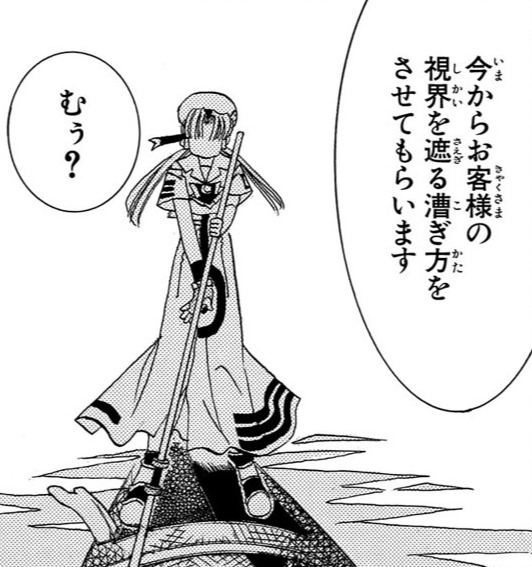
Akatsuki asks Akari for a gondola ride to his destination. Along the way, he asks whether he’ll make his deadline. Akari suggests Alicia should take over, but Akatsuki says he’s Akari’s customer (and paying the cheaper fare). Realizing her responsibility, Akari turns the gondola around so she can use her high-speed backward rowing. Alicia apologizes to Akatsuki for the turnaround.
- アリシア:
- 「今からお客様の視界を遮る漕ぎ方をさせてもらいます」
- “From now on, she'll be using a rowing technique that blocks your view.”
- 暁:
- 「むぅ?」
- “Mm?”
Supplemental Examples