These are not random slang. A handful of regular sound changes generate nearly all of them. Learn those changes and you can decode unfamiliar contractions.
Usage Notes
The everyday ones, roughly in order of how often they show up in a manga panel: 〜ている becomes 〜てる, 〜てしまう becomes 〜ちゃう, では becomes じゃ, のだ becomes んだ, and a ら-row sound before な becomes ん, as in 分かんない. Close behind are 〜ておく → 〜とく and 〜なければ → 〜なきゃ. Rougher speech adds ない → ねえ and という → つー.
Contractions can stack. 分からない becomes 分かんない, and rough speech can then turn ない into ねえ: 分かんねー. When a speech bubble stumps you, expand one change at a time until you reach the textbook form.
Formation
View formation details
〜らない → 〜んない
漢字が多すぎて分かんない
"There are too many kanji. I can't tell what's what."
〜ている → 〜てる
何見てるの?
"What are you looking at?"
〜るな → 〜んな
触んな!
"Don't touch it!"
〜のだ → 〜んだ
今から行くんだ
"I'm heading out right now, see."
〜てしまう → 〜ちゃう
全部食べちゃった
"I went and ate it all."
〜ておく → 〜とく
宿題は後でやっとく
"I'll take care of the homework later."
では → じゃ
そんなの無理じゃない?
"Isn't that impossible?"
〜ければ → 〜きゃ、〜ては → 〜ちゃ
もう行かなきゃ
"I've gotta go."
Note: なきゃ and なくちゃ both clip "must do" down to a single breath.
これは → こりゃ
こりゃ無理だ
"This is hopeless."
ない → ねえ
時間がねえ
"There's no time."
〜っていう → 〜っつー
早く寝ろっつーの
"Go to bed already, I said."
Stacked contractions
そんなの知らねーよ
"How should I know!"
Note: 知らない → 知らねえ → 知らねー. Undo one step at a time.
〜ている Becomes 〜てる
The い at the start of いる drops after a て-form, so 〜ている becomes 〜てる, and 〜でいる becomes 〜でる. Every form of いる shortens the same way, and so does いく.
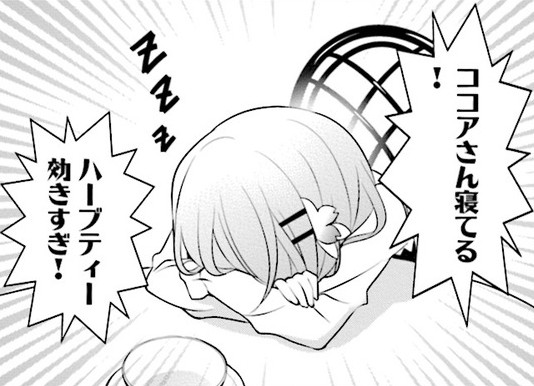
Syaro picked out a tea for each of her friends, based on what she thought would do them good. Cocoa’s worked a little too well: ココアさん寝てる!, “Cocoa’s asleep!” 寝てる is 寝ている without the い.
Example 2 of 20: Work uniform as casual outfit with 私服
Kumada stops by the library to read up on bears, in hope of finding a solution to the bear living in his apartment. As he skims through some books, the foreigner who works at the local convenience store notices him.
熊田:
「バイトのユニフォームを私服に使ってるのか…」
“She's using her part-time job uniform as her regular clothes, huh…”
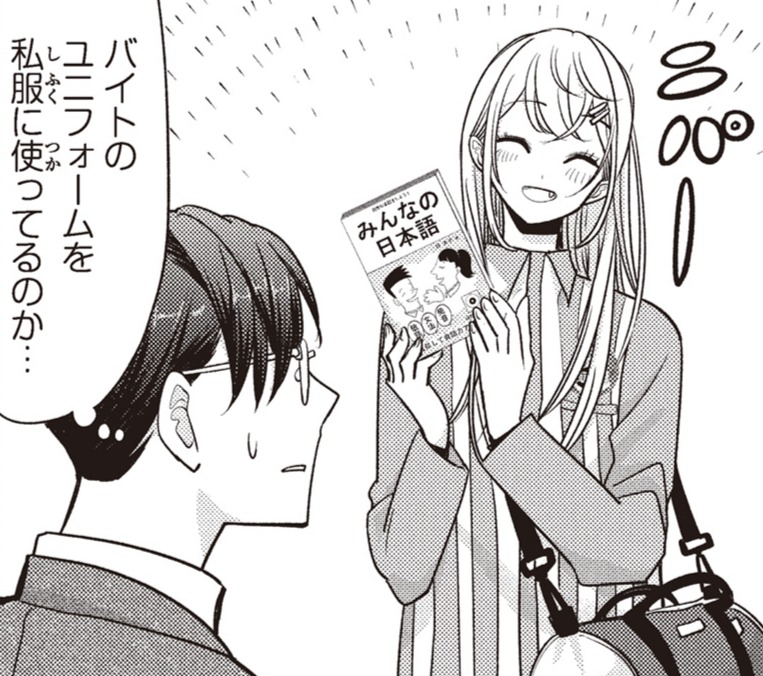
Kumada is reading up on bears at the library when the foreign clerk from his convenience store notices him. She’s out in her work uniform, and Kumada wonders whether she wears it as everyday clothes: 使ってるのか, from 使っているのか. ている describes a habit here, and the い still drops.
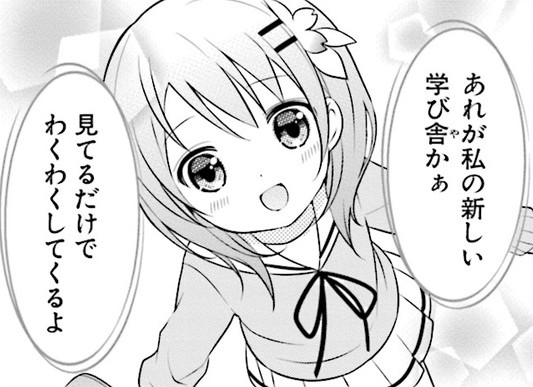
Example 3 of 20: That schoolhouse over there with あれ
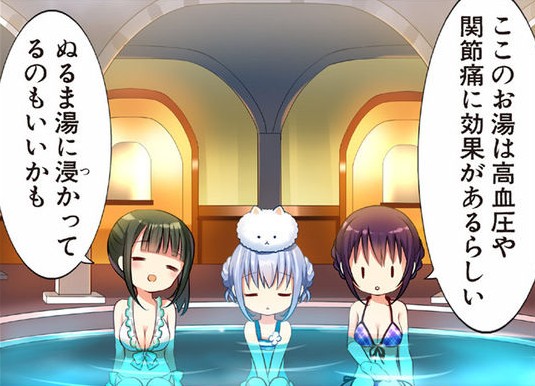
At an indoor hot spring, Rize reads out that the water is good for blood pressure and joint pain. Chiya is happy just to sit in the lukewarm bath: ぬるま湯に浸かってるのもいいかも, “soaking in lukewarm water might be nice too”. 浸かってる is 浸かっている.
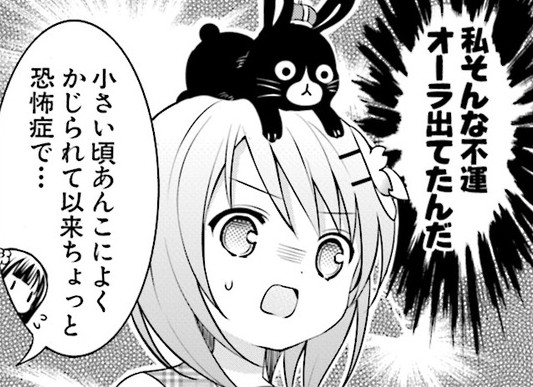
Cocoa has had a day of bad luck, and when Syaro tells her to keep away, Cocoa assumes it shows: 不運オーラ出てたんだ!, “was I giving off that much bad-luck energy?!” 出てた is 出ていた. The past ていた shortens to てた, just as ている shortens to てる. Chiya explains the real reason: Syaro has been scared of Anko the rabbit since he bit her as a child.
Example 6 of 20: Wanting to bake bread again with 〜たい
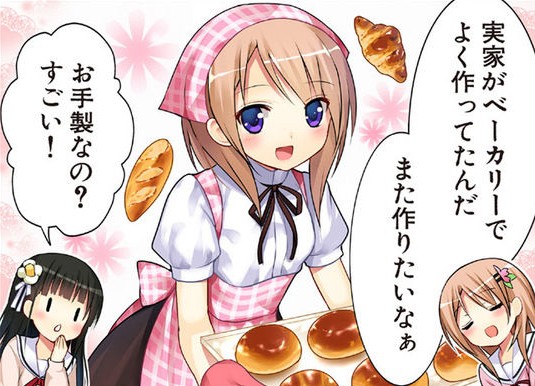
Cocoa stops in front of a bakery window. Her family runs a bakery, and she used to bake bread all the time: よく作ってたんだ. 作ってた is 作っていた, describing something she did regularly in the past. The んだ at the end is the explanatory のだ, another contraction on this page.
Example 7 of 20: Making a point of trying horror movies with 〜ようにしている
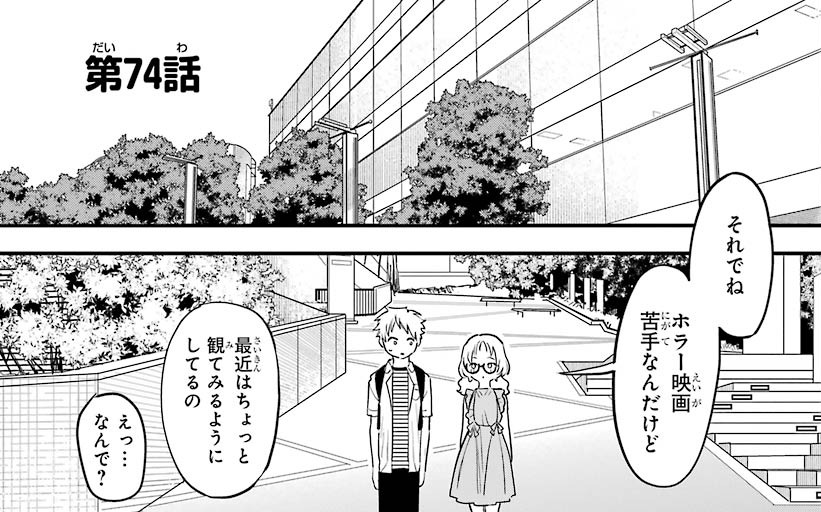
Mie tells Komura that although she’s no good with horror movies, she has been watching a little of them lately: 観てみるようにしてるの. ようにしてる is ようにしている with the い dropped, describing a practice she keeps up.
Example 8 of 20: Only arrived on the island last month with 〜たばかり
Kogoro has received a letter and a phone call from a man named Asou Keiji, who paid in advance and demanded he come to Tsukikage Island. Kogoro, Ran, and Conan take a boat to the island. At the village office, the clerk says nobody by that name lives there, and Kogoro insists he got a letter from him.
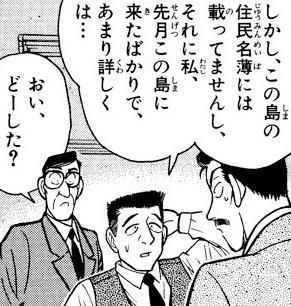
The village clerk tells Kogoro the man he’s looking for isn’t in the residents’ register: 載ってません, from 載っていません. The い drops in polite speech too, so a clerk talking to a visitor can still say てません.
Example 9 of 20: Left to waste away in the Room of Darkness with 〜ばかりだ
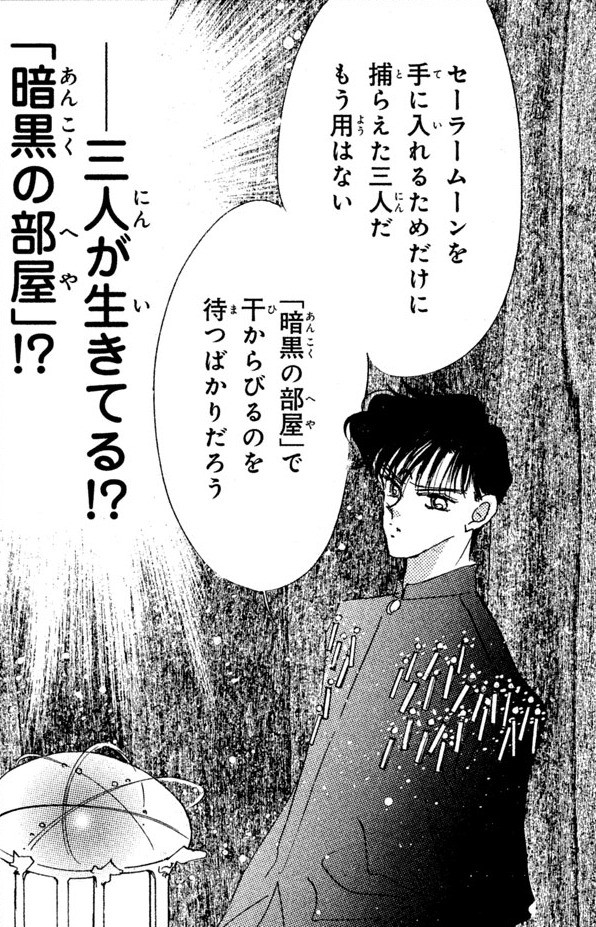
Sailormoon is searching the Black Moon clan’s maze-like castle for Mars, Mercury, and Jupiter, who were taken captive. She sensed them for an instant, then lost them. Weak and short of breath, she overhears Saphir talking with another member of the clan, who asks whether the three warriors are still alive.
サフィール:
「セーラームーンを手に入れるためだけに捕らえた三人だ もう用はない」
“We only took those three to get our hands on Sailormoon. We have no more use for them.”
「『暗黒の部屋』で干からびるのを待つばかりだろう」
“I expect all that's left for them is to wait in the 'Room of Darkness' until they shrivel up.”
うさぎ:
「三人が生きてる!? 『暗黒の部屋』!?」
“The three of them are alive!? The 'Room of Darkness'!?”
Sailormoon overhears that her three captured friends are being left to waste away, which means they’re still alive: 三人が生きてる!? 生きてる is 生きている with the い dropped, even in her own shocked thoughts.
Example 10 of 20: Even looking like a trap with 〜さえ
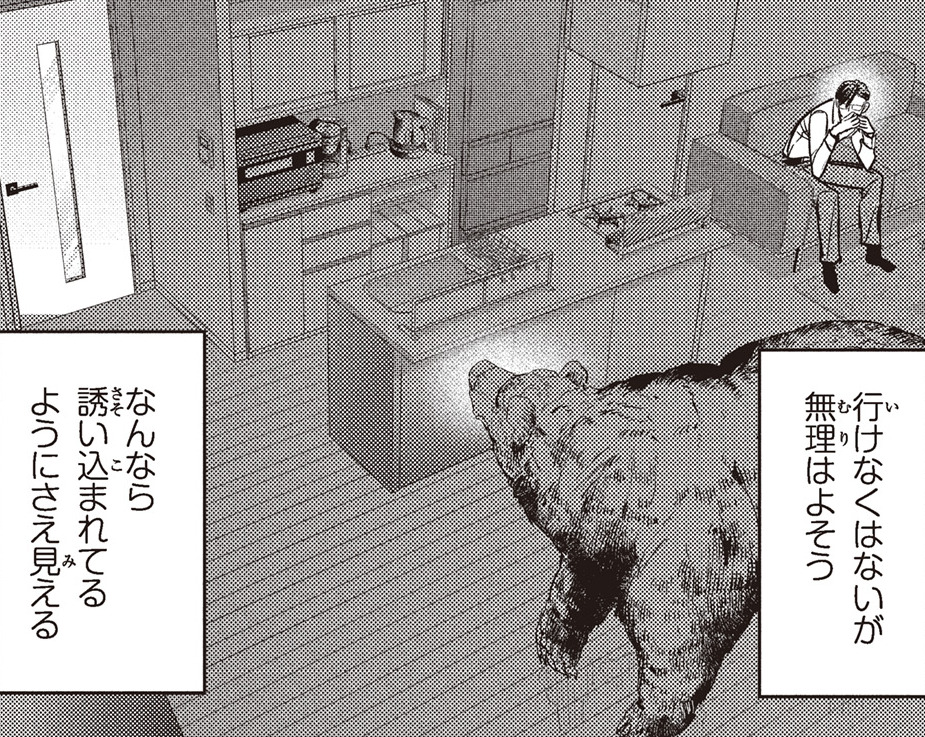
Kumada comes home from work to find a huge, very real bear in his apartment. A cup of coffee doesn’t calm him down. He tells himself to sort out the situation, admits he knows nothing about bears and has no physical strength to speak of, and resolves to raise his odds of survival. His first concern is an escape route.
熊田:
「行けなくはないが無理はよそう」
“I could make it, but let's not push my luck.”
「なんなら誘い込まれてるようにさえ見える」
“If anything, it even looks like I'm being lured in.”
Kumada sizes up the open path past the bear in his kitchen: 誘い込まれてるようにさえ見える, “it even looks like I’m being lured in”. 誘い込まれてる is 誘い込まれている. The い drops in his inner monologue just as it does in speech.
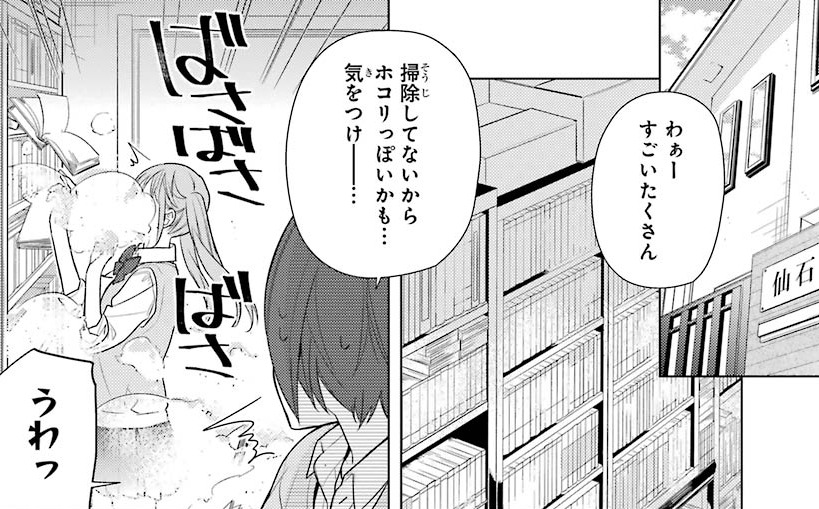
Sengoku has been lending books to his classmate Ayasaki. When he mentions that his parents’ books fill a whole room at home, she says she’d love to see it, and he invites her over.
綾崎:
「わぁー すごいたくさん」
“Wow, there are so many!”
仙石:
「掃除してないからホコリっぽいかも… 気をつけ——…」
“I haven't cleaned, so it might be dusty... Be care—...”
Sengoku shows a classmate the room where his parents keep their books. 掃除してない is 掃除していない, “haven’t cleaned”, with the い of いない dropped. The room is still uncleaned, so it might be dusty.
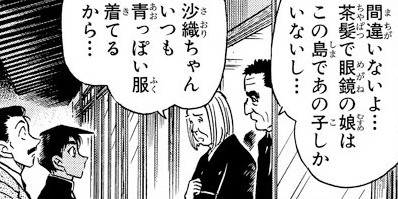
Naoko has been murdered during Sumi’s wake, and Kogoro tells the islanders that the killer took her Dugong Arrow, a sacred arrow from the island’s festival. Saori is missing, and she had also said she lost her arrow, so she may have been killed too. Then an elderly woman says she saw Saori near the Mermaid Falls on the morning of the festival, and other villagers say they spotted her there as well. Heiji asks whether it was really Saori.
お爺さん:
「間違いないよ… 茶髪で眼鏡の娘はこの島であの子しかいないし…」
“It was her, all right... She's the only girl on this island with brown hair and glasses...”
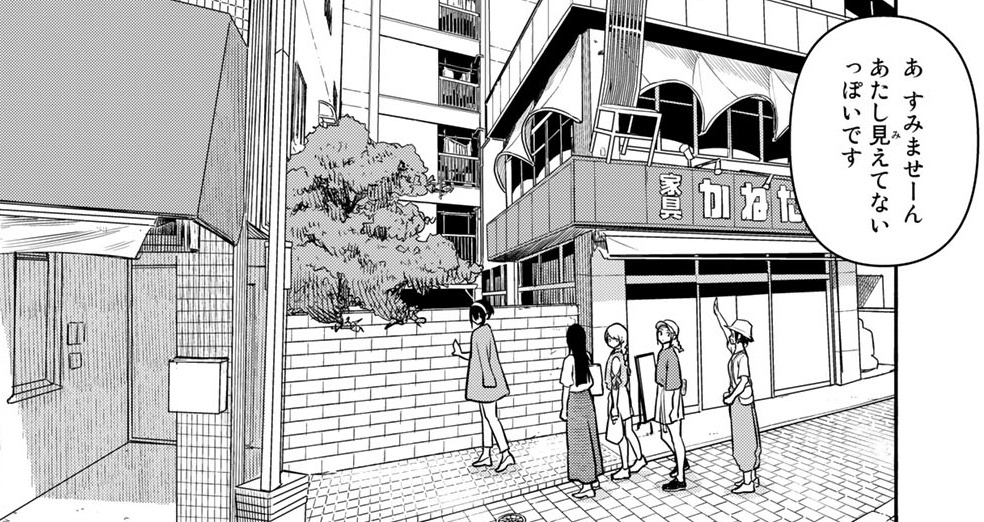
Tomoe Nibe, a witch who works with clothes, has brought Makoto and her friends to the fabric shop she runs in Sugamo. She tells them they’ve arrived and that the shop carries fabric from all over the world.
Nibe has brought Makoto and her friends to her fabric shop, but Yayoi sees only a wall. 見えてない is 見えていない, “can’t see it”, with the い dropped, even in a sentence that ends politely with です.
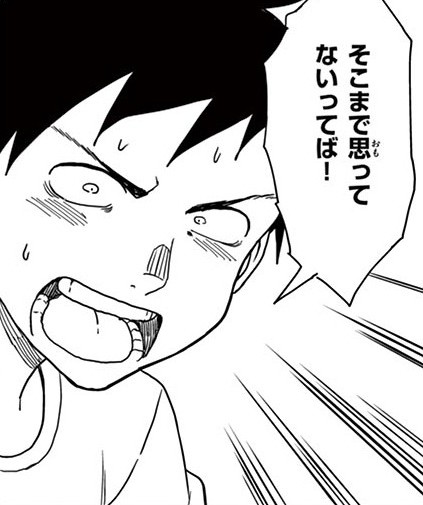
Nishikata and Takagi watch their daughter Chii play in the typhoon wind, pretending she’s the one making it blow. Takagi says it really looks like Chii is stirring up the wind. Nishikata nearly agrees, then catches himself. Takagi then puts his thoughts into words for him, guessing that he wonders whether this is a power only children have, and whether Chii has it because she’s his own child.
西片:
「そこまで思ってないってば!」
“I'm telling you, I don't think it goes that far!”
Takagi guesses that Nishikata thinks Chii has a special power because she’s his child. 思ってない is 思っていない, “not thinking”, with the い dropped, and ってば turns it into “I don’t think it goes that far!”
Example 15 of 20: Can't give up on Tanabata with あきらめきれない
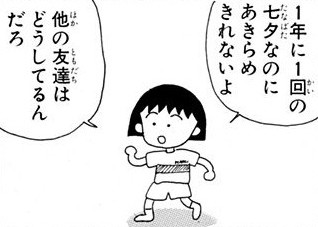
It’s the day before Tanabata, and Maruko needs a bamboo branch to hang her wishes on. Dad brought one home by chance last year but won’t find one this time, so she throws a tantrum. Mom tells her it makes no difference whether she has bamboo, and Dad says sometimes you can’t get what you want.
まる子:
「1年に1回の七夕なのにあきらめきれないよ」
“Tanabata only comes once a year. I can't just give up on it!”
Maruko can’t give up on finding bamboo for Tanabata and wonders how her friends got theirs. どうしてる is どうしている, “what are they doing”, with the い dropped.
Example 16 of 20: Sharpening the restaurant's knives with 包丁研ぎ
Hinata’s second-grade class is cooking curry on an overnight school trip. Midori has just noticed that the curry roux her team brought is medium-hot, and most of the children are sure it will be too spicy for them. While they argue, Hinata spots an apple among the ingredients and gets to work over a bowl. Midori asks her what she’s doing.
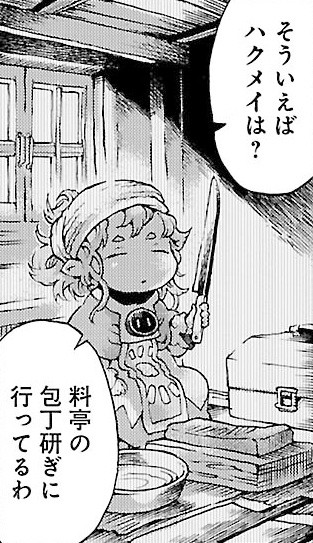
Mikochi wants to sell a jam-and-bread set at the festival, and she and Hakumei have cooked a big pot of raspberry jam through the night. Mikochi had Hakumei fetch a small pot for a test batch, added a splash of rum, then chopped basil leaves fine and put them into the jam.
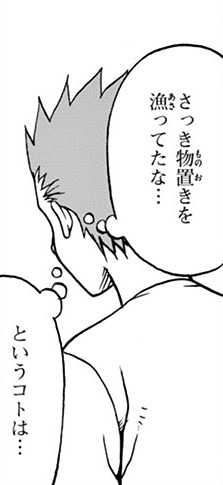
Kenji found Kyoko alone in the house’s storage room, and she wouldn’t tell him what she was doing there. Since then she has insisted nothing is wrong, yet she keeps her back turned away from him. After she drives him out of the room at lunch, Kenji can’t stop wondering what is bothering her.
ケンジ:
「さっき物置きを漁ってたな…」
“She was rummaging through the storage room earlier...”
Kenji thinks back to finding Kyoko in the storage room. 漁ってた is 漁っていた with the い dropped, the same contraction in the past: she was rummaging through it.
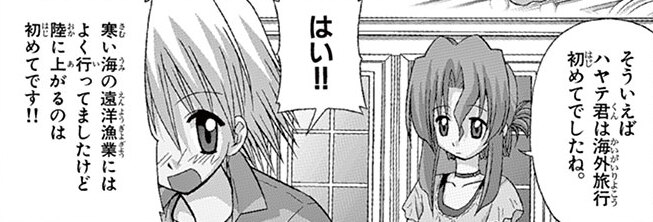
Over Golden Week, Hayate, Nagi, and Maria have come to the Aegean Sea on vacation. Hayate leans over the balcony railing, thrilled at the view. He has worked jobs among adults since he was a small child.
マリア:
「そういえばハヤテ君は海外旅行初めてでしたね。」
“Come to think of it, Hayate, this is your first trip abroad, isn't it?”
ハヤテ:
「はい!!」
“Yes!!”
「寒い海の遠洋漁業にはよく行ってましたけど陸に上がるのは初めてです!!」
“I used to go out on deep-sea fishing trips in cold waters all the time, but this is my first time going ashore!!”
In casual speech, てしま runs together into ちゃ, and でしま into じゃ. So 〜てしまう becomes 〜ちゃう, and 〜でしまう becomes 〜じゃう. The meaning doesn’t change: the action is done completely, or it happened when it shouldn’t have.
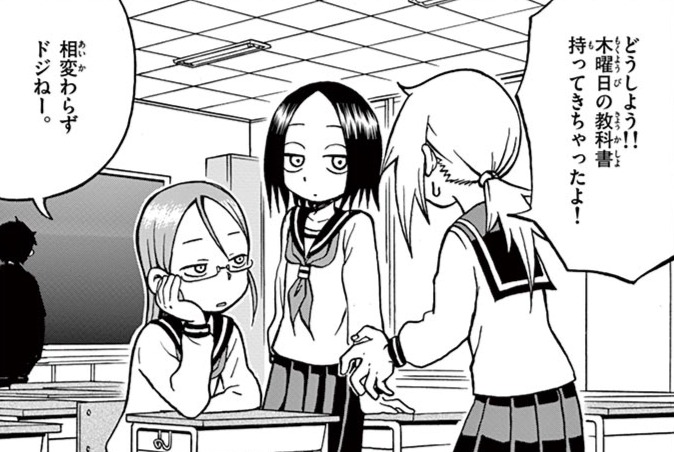
Mina has just found out that today is Friday, not Thursday. 持ってきちゃった is 持ってきてしまった: she brought Thursday’s textbook by mistake. The ちゃった carries the “oops”.
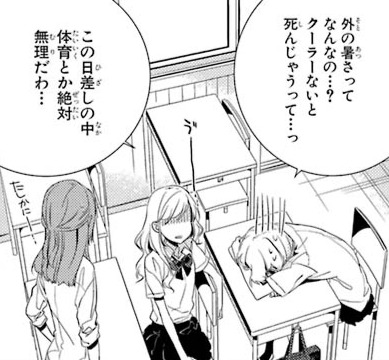
Example 2 of 4: I'd totally die in the heat with 〜じゃう
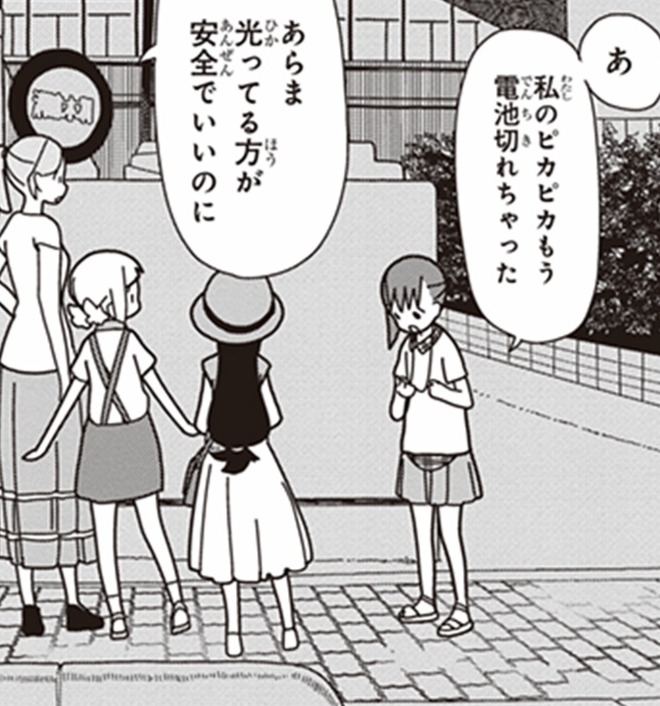
At a night festival, Yui’s glowing star necklace has gone dark: 電池切れちゃった, “the battery died”. 切れちゃった is 切れてしまった. Sacchan’s mother answers with another contraction, 光ってる, from 光っている.
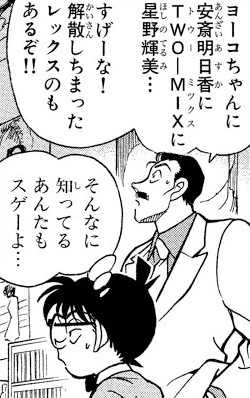
Detective Kogoro gives a young woman a ride home in exchange for concert tickets. While waiting for her to get the tickets, Kogoro notices the livingroom is filled with pop star posters.
小五郎:
「ヨーコちゃんに安斎明日香にTWO―MIXに星野輝美…」
“There's Yoko, and Asuka Anzai, and Two-Mix, and Terumi Hoshino...”
「すげーな!解散しちまったレックスのもあるぞ!!」
“Amazing! There's even the disbanded group Lex!”
コナン:
「そんなに知ってるあんたもスゲーよ…」
“It's also amazing that you know that much about them...”
Kogoro is waiting in a young fan’s living room, which is covered in pop star posters. He even spots the group Lex, which has broken up: 解散しちまった. ちまった is the rougher version of ちゃった, from してしまった. His first word is rough too: すげー is すごい.
〜ておく Becomes 〜とく
The て and the お of ておく run together, so 〜ておく becomes 〜とく, and 〜でおく becomes 〜どく. Every form of おく contracts the same way.
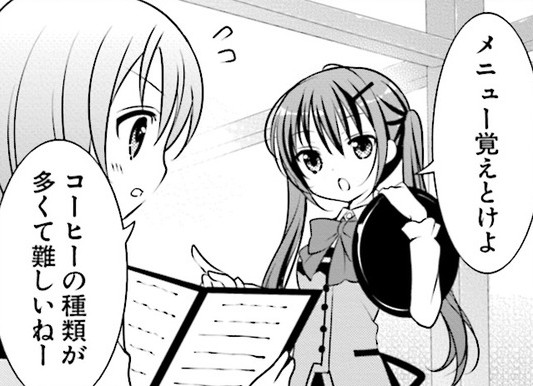
Rize is training Cocoa at the café. 覚えとけよ is 覚えておけよ, “memorize (the menu) ahead of time”. The command form おけ becomes とけ. Cocoa answers that there are a lot of coffees to learn.
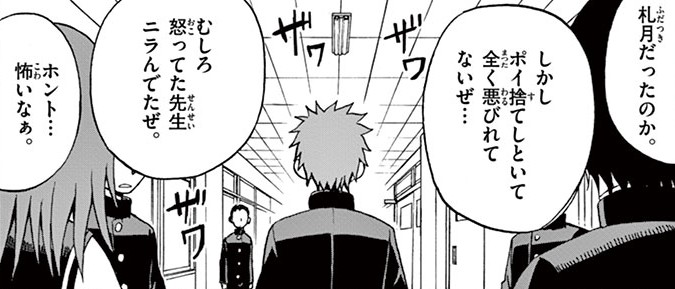
As Kenji Fudazuki ponders ways to increase his image as a delinquent, he hears a teacher asking who littered an empty soft drink can. Seeing an opportunity, Kenji takes credit for the misdeed. With this revelation, the teacher backs off and leaves quietly.
Fudazuki has taken the blame for a littered can to look like a delinquent, and his classmates are impressed. ポイ捨てしといて is ポイ捨てしておいて, and here 〜ておいて means “even after doing”: he littered, and he isn’t the least bit sorry. The next line has two ていた forms: 怒ってた and ニラんでた.
Example 4 of 4: Cooking rice for whoever comes home with ご飯を炊く
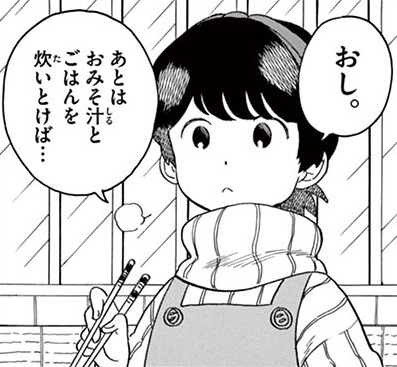
During the spring dance performances, everyone at the house keeps a different schedule, so they each eat when they can. Kiyo comes home from shopping, sees that the rice balls she left out have been eaten, and makes a set of side dishes that taste fine even cold.
キヨ:
「おし。」
“All right.”
「あとはおみそ汁とごはんを炊いとけば...」
“Now if I just make the miso soup and cook the rice...”
Kiyo is working out the last steps of dinner. 炊いとけば is 炊いておけば. The ば form おけば contracts to とけば, just as おけ becomes とけ.
行っておいで Becomes 行っといで
行っておいで, “off you go”, contracts the same way: て + お becomes と, giving 行っといで. But this おいで isn’t おく. It’s a gentle “come”, so 行っておいで is literally “go and come back”. People say it to send someone off, the way a parent sends a child to school.
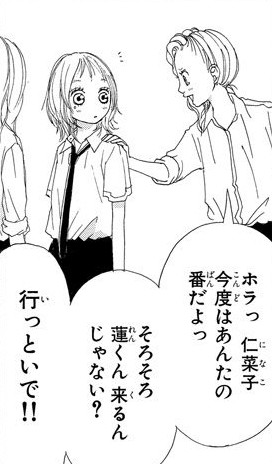
Ninako confessed her feelings to Ren, even knowing he already has a girlfriend and would turn her down. After not seeing Ren during summer break, Ninako wonders if she’ll still be able to greet him normally. After a boy she turned down greets her normally, Ninako feels more confident.
Ninako is nervous about greeting Ren after the summer break, and her friend Tsukasa pushes her to go. 行っといで!! is 行っておいで, “go for it!” Tsukasa’s line before it has two more contractions: 来るんじゃない is 来るのではない, with の → ん and では → じゃ.
〜ては Becomes 〜ちゃ, では Becomes じゃ
ては runs together into ちゃ, and では into じゃ. The most common place to hear 〜ちゃ is in rules: 〜ちゃだめ and 〜ちゃいけない, “you mustn’t”.
では on its own becomes じゃ too. ではない becomes じゃない, 自分では, “by myself”, becomes 自分じゃ, and the conjunction では, “well then”, becomes じゃ or じゃあ. じゃない is so common that it sounds neutral, and polite speech uses じゃありません and じゃないです.
Example 1 of 8: Don't leave your vegetables 〜てはだめだ
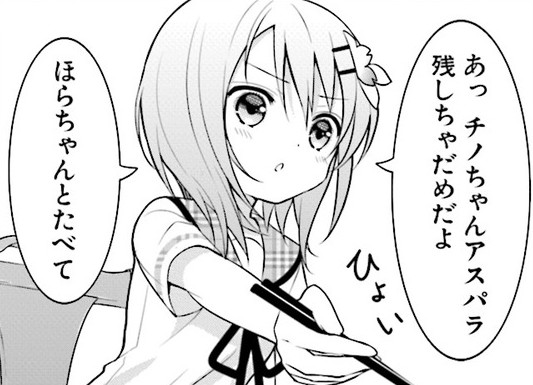
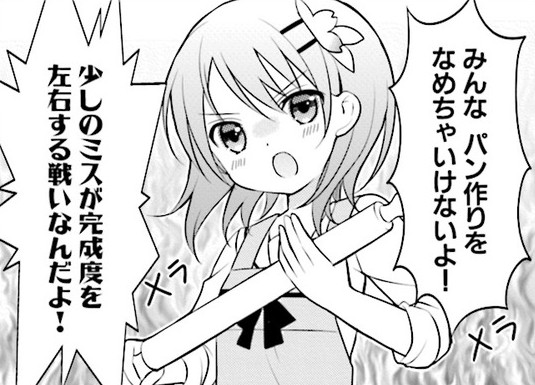
Cocoa is about to teach her friends to bake bread, and she’s serious about it. なめちゃいけないよ is なめてはいけないよ, “don’t underestimate it”. A small mistake, she says, can decide the result.
Example 3 of 8: Taking too much caffeine with 〜すぎる
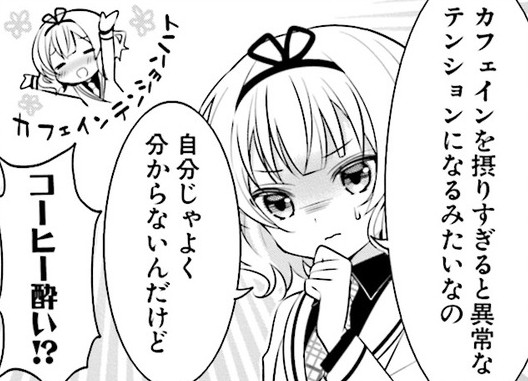
Syaro explains that she avoids coffee because caffeine makes her strangely hyper, though she can’t tell herself: 自分じゃよく分からないんだけど. 自分じゃ is 自分では, “by myself”, with では shortened to じゃ.
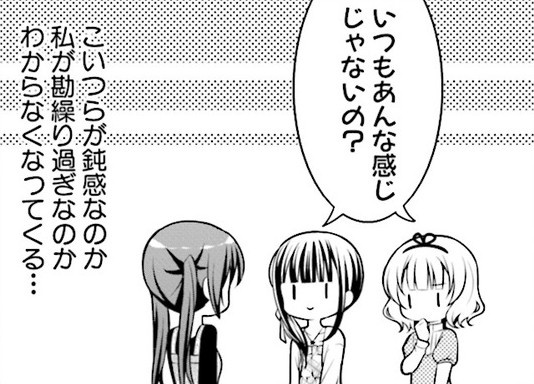
Rize wonders aloud whether Chino and Cocoa have gotten over their fight. Syaro and Chiya see nothing unusual: いつもあんな感じじゃないの?, “aren’t they always like that?” じゃない is ではない, and it’s how most people say it in conversation.
Example 5 of 8: Thanks for the boxed lunch with サンキュ
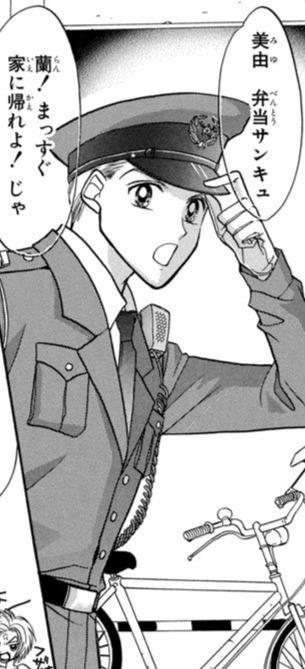
Miyu visits Yamato at his police box workplace to bring him a packed lunch. She sees her friend, Yamato’s sister Ran, there and stops by to see her next. A call comes in, and Yamato heads to help provide backup.
Yamato gets a call at his police box, and he heads out with a word to his sister: 蘭!まっすぐ家に帰れよ!じゃ. This じゃ is the conjunction では, “well then”, cut down to a quick “bye”. His thanks to Miyu is clipped too: サンキュ, from English “thank you”.
Example 6 of 8: Short-handed student council with 〜たばかり
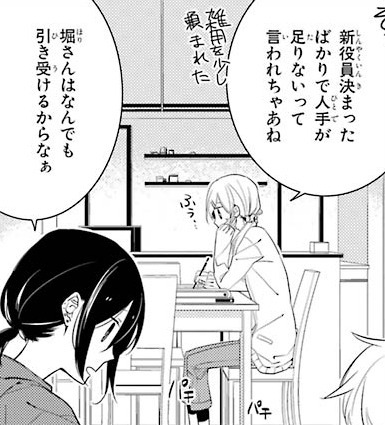
At Hori’s house, Miyamura is playing a board game with her little brother Souta while Hori works through a stack of papers at the kitchen table. Miyamura asks whether she’s helping out the student council.
堀:
「新役員決まったばかりで人手が足りないって言われちゃあね」
“When they tell me the new officers were only just chosen and they're short on help, what can I do?”
Hori explains why she agreed to help the short-handed student council. 言われちゃあね is 言われてはね, “when they put it like that”, with ては shortened to ちゃ and drawn out. She leaves off the rest: she couldn’t say no.
Example 7 of 8: Too much to carry alone with 〜きれない
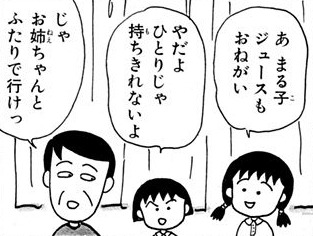
Maruko’s sister adds a juice to Dad’s beer order. Maruko refuses with ひとりじゃ持ちきれない, “I can’t carry it all by myself”. ひとりじゃ is ひとりでは, “if it’s just me”.
Example 8 of 8: Whisking eggs and honey for waffles with 泡立てる
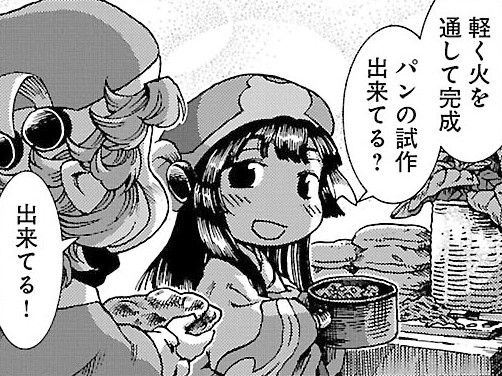
Konju drops by Hakumei and Mikochi’s new house and finds Mikochi testing a new product, honey waffles. Konju has just learned that Mikochi makes the cookies and tea she loves. She doesn’t want to be in Mikochi’s debt, so she begs to help, and Mikochi gives in.
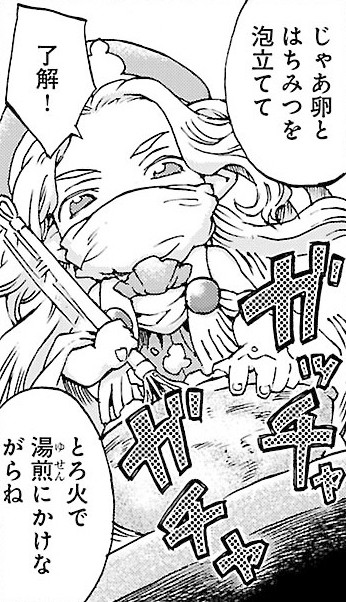
Mikochi has just agreed to let Konju help with the honey waffles. じゃあ卵とはちみつを泡立てて is “okay, then whisk the eggs and honey”. じゃあ is the conjunction では, “well then”, and it moves the talk on to Konju’s first job.
れば and れは Become りゃ
When れ is followed by ば or by the particle は, the two sounds run together into りゃ. それは becomes そりゃ, これは becomes こりゃ, and あれは becomes ありゃ. In a conditional, すれば becomes すりゃ, and なければ becomes なけりゃ, then なきゃ.
そりゃ often starts a reply that the speaker thinks is obvious: そりゃそうだ, “well, of course”.
Example 1 of 7: Replacing the bathroom lock with 交換
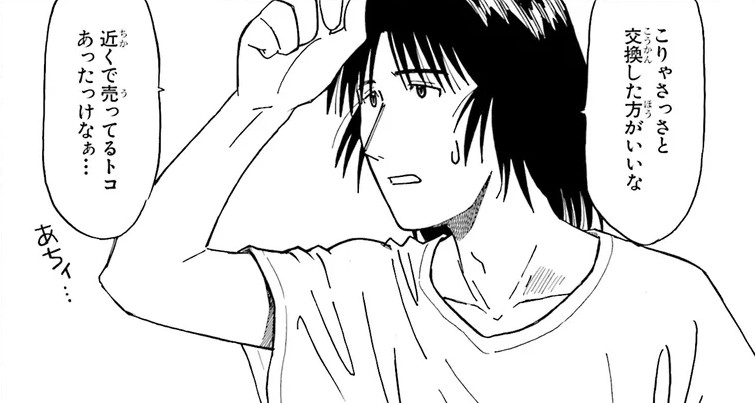
The bathroom lock broke and trapped the door shut, and Yousuke has just gotten it open. こりゃさっさと交換した方がいいな is これは: “I’d better replace this right away.” His next line, 売ってるトコ, has two more: 売っている → 売ってる, and ところ → とこ.
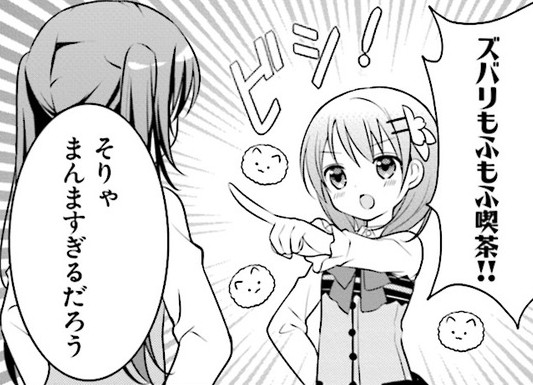
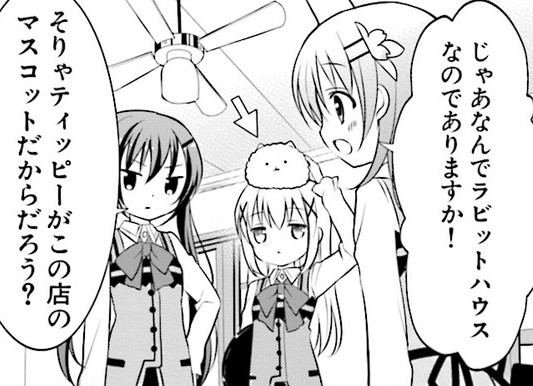
Cocoa demands to know why the café is called Rabbit House. To Rize the answer is obvious: そりゃティッピーがこの店のマスコットだからだろう?, “well, because Tippy is the shop’s mascot, obviously”. Cocoa’s question starts with じゃあ, the casual では, “then”.
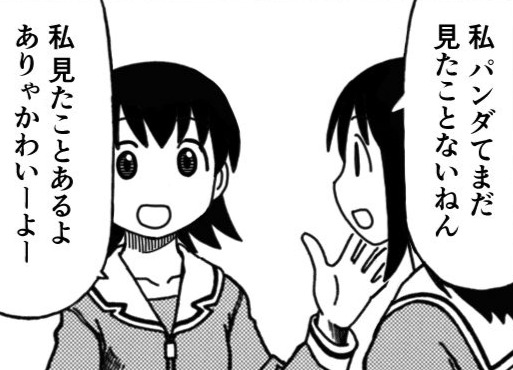
Chiyo is showing her friends a panda picture book, and Ayumu admits she’s never seen a panda. Tomo has: ありゃかわいーよー, “they’re cute!” ありゃ is あれは, and かわいー stretches かわいい.
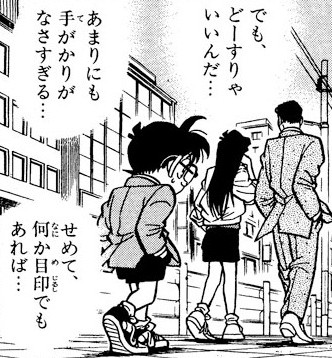
Masami Hirota’s father has been found hanged in his apartment, and the police say it was murder. Masami is missing, and her glasses turned up near the scene. Ran is crushed, and Conan resolves to find Masami before it’s too late.
コナン:
「でも、どーすりゃいいんだ…」
“But what am I supposed to do...”
「あまりにも手がかりがなさすぎる…」
“There are way too few clues...”
「せめて、何か目印でもあれば…」
“If only there were some kind of marker, at least...”
Masami Hirota has gone missing after her father’s murder, and Conan wants to find her before it’s too late. In どーすりゃいいんだ, すりゃ is すれば: “what am I supposed to do?” どー is a casual spelling of どう.
Example 6 of 7: Buying finches instead of waiting with 〜きれずに
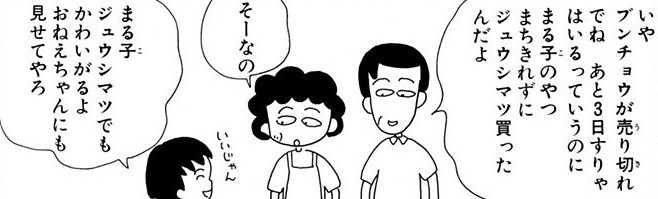
Dad agreed to buy Maruko a Java sparrow chick, and she went with him to the pet shop. They come home with a pair of society finches instead, and Mom asks why they aren’t Java sparrows.
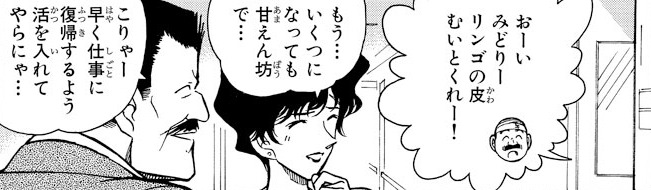
Inspector Megure is in the hospital after an old head wound reopened during a case. Superintendent Matsumoto has just told Kogoro and the others how Megure got the scar twenty years ago. Now Megure’s wife, Midori, has stepped out of his room to greet the visitors.
目暮:
「おーい みどりー リンゴの皮むいとくれー!」
“Heeey, Midori! Peel an apple for me!”
みどり:
「もう… いくつになっても甘えん坊で…」
“Honestly... He's such a baby, no matter how old he gets...”
松本:
「こりゃー早く仕事に復帰するよう活を入れてやらにゃ…」
“Looks like I'll have to light a fire under him so he gets back to work soon...”
Inspector Megure is in the hospital, calling for his wife to peel him an apple, and his boss decides Megure needs a push back to work. こりゃー is これは: “this calls for…”. The line ends with the same squeeze in a conditional: やらにゃ is やらねば, “I’ll have to”.
Must Do with 〜なきゃ and 〜なくちゃ
〜なければならない, “must”, is long, so casual speech shortens both halves. なければ becomes なけりゃ and then なきゃ. なくては becomes なくちゃ, by the same ては → ちゃ change as 〜ちゃだめ. The ならない or いけない at the end is usually dropped, so 行かなきゃ alone means “I have to go”.
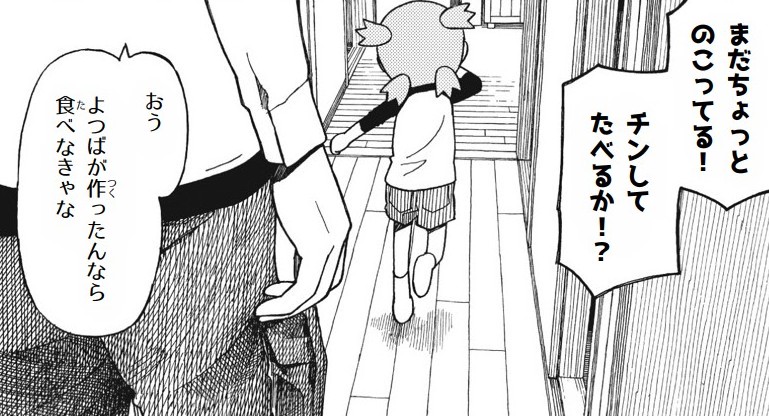
Yotsuba made pancakes earlier and offers to heat up the leftovers for Jumbo. He’s happy to eat them: よつばが作ったんなら食べなきゃな, “if you made them, I’ve got to have some”. 食べなきゃ is 食べなければ with ならない dropped. 作ったんなら has an の → ん change: 作ったのなら.
Example 2 of 6: Working hard so as to satisfy customers with 〜ように
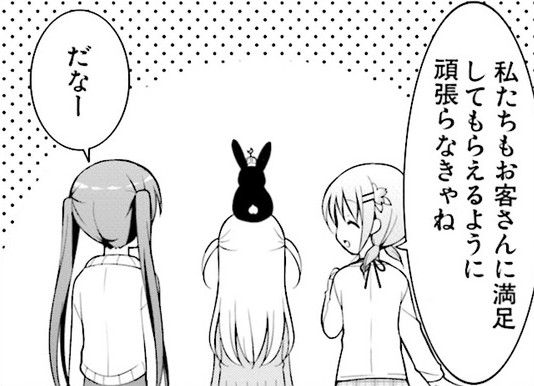
After visiting Chiya’s family’s café, Cocoa is fired up about her own job. 頑張らなきゃね is 頑張らなければね: “we have to work hard too, so customers are satisfied”.
Example 3 of 6: Correcting a case of mistaken identity with 訂正
While Sana is away with her other friends for a moment, Ayumu leaves to use the restroom. Shun takes off his glasses to rub something from his eye, only for Sana to return and mistake him for Ayumu. He doesn’t correct her, but when Sana asks where Shun is, Shun says the restroom, and goes that way himself to wash his eye. In the restroom, Shun finds Ayumu and is about to explain what happened, but stops himself. Ayumu says it’s better not to hold back, and that Shun can say anything to him. Shun finally explains that Sana mistook him for Ayumu.
駿:
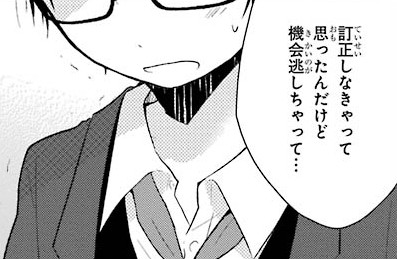
「訂正しなきゃって思ったんだけど機会逃しちゃって…」
“I thought I should correct it, but I missed the chance…”
Sana mistook Shun for Ayumu, and Shun didn’t set her straight. 訂正しなきゃって思った is “I thought I had to correct it”, with って quoting the thought. Then he missed his chance: 逃しちゃって, from 逃してしまって.
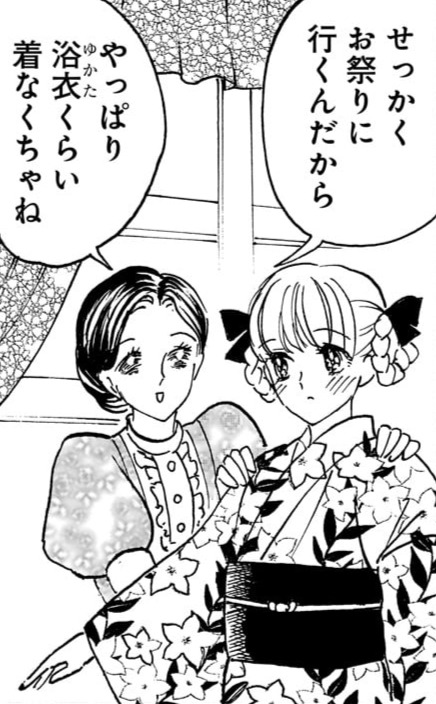
Lulu is going to a local festival with friends, and her mother helps her dress. 浴衣くらい着なくちゃね is 着なくてはね: “you should wear a yukata at least”. なくちゃ and なきゃ mean the same thing.
Example 5 of 6: Singing one song after another with 連続
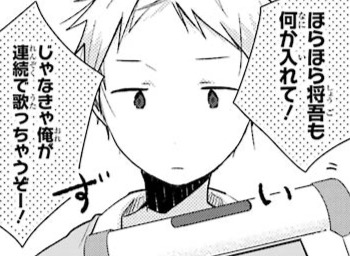
Hase has dragged Shougo to karaoke and wants him to pick a song. じゃなきゃ is でなければ, “otherwise”. Casual speech says じゃ where careful speech says で or では, and なければ becomes なきゃ. Otherwise, Hase says, he’ll keep singing back to back: 歌っちゃうぞ, from 歌ってしまうぞ.
Example 6 of 6: Making sure not to be found out with 〜ないようにする
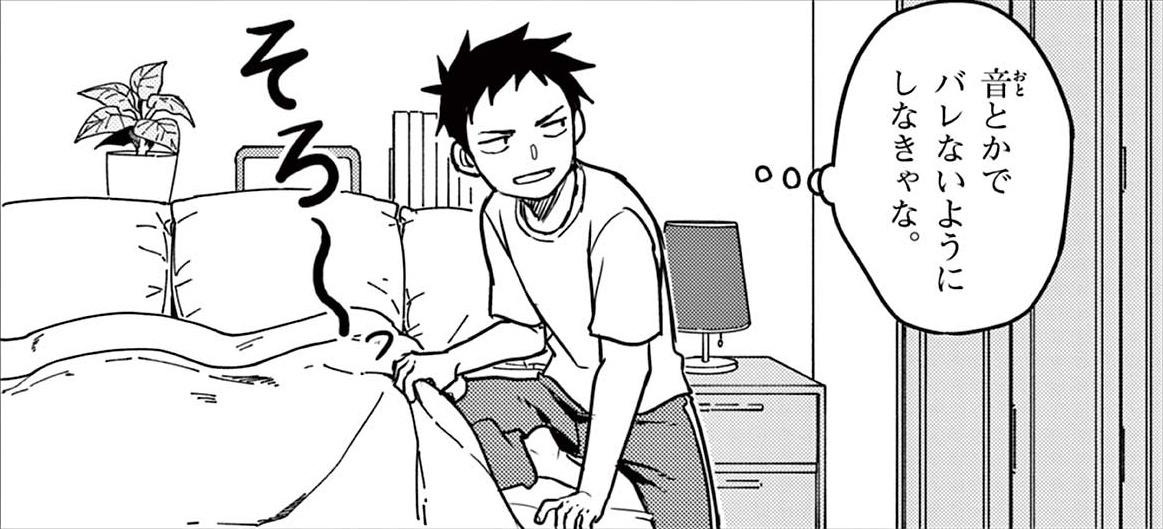
Nishikata is sleepy on his day off, but Chii keeps begging him to play. Takagi suggests hide-and-seek, and Nishikata agrees on the condition that Chii is the seeker. Once the game starts, he grins to himself that this is easy. He can sleep while he hides, under the covers of his bed.
西片:
「音とかでバレないようにしなきゃな。」
“I've gotta make sure I don't give myself away with noise or anything.”
Nishikata plans to nap under the covers while Chii looks for him in a game of hide-and-seek. ようにしなきゃな is ようにしなければな with ならない dropped: “I’ve gotta make sure no noise gives me away”.
ら-Row Sounds Become ん
Before a sound that starts with n, ら, る, or れ often turns into ん. The tongue is already in place for the n, so the r drops out. 分からない becomes 分かんない, するな becomes すんな, いるの becomes いんの, and かもしれない becomes かもしんない.
Example 1 of 2: Letting daikon syrup sit in the fridge with 寝かせる
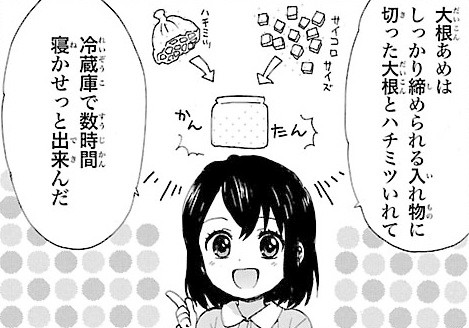
Moka has a sore throat. Hinata scolds her so harshly that Moka cries, then makes up for it with a jar of daikon syrup. Moka tastes it and is surprised that it’s sweet and nothing like daikon.
日向:
「大根あめはしっかり締められる入れ物に切った大根とハチミツいれて」
“For daikon syrup, you put cut daikon and honey in a container that seals tight...”
「冷蔵庫で数時間寝かせっと出来んだ」
“...and once you let it sit in the fridge for a few hours, it's ready.”
Moka has a sore throat, and Hinata gives her a jar of daikon syrup. She explains that it’s ready after a few hours in the fridge. 出来んだ is 出来るんだ, with る turned into ん before the ん of んだ. In the same line, 寝かせっと is 寝かせると, with る shrunk to a small っ before と.
Example 2 of 2: An invitation to go smelt fishing with ワカサギ釣り
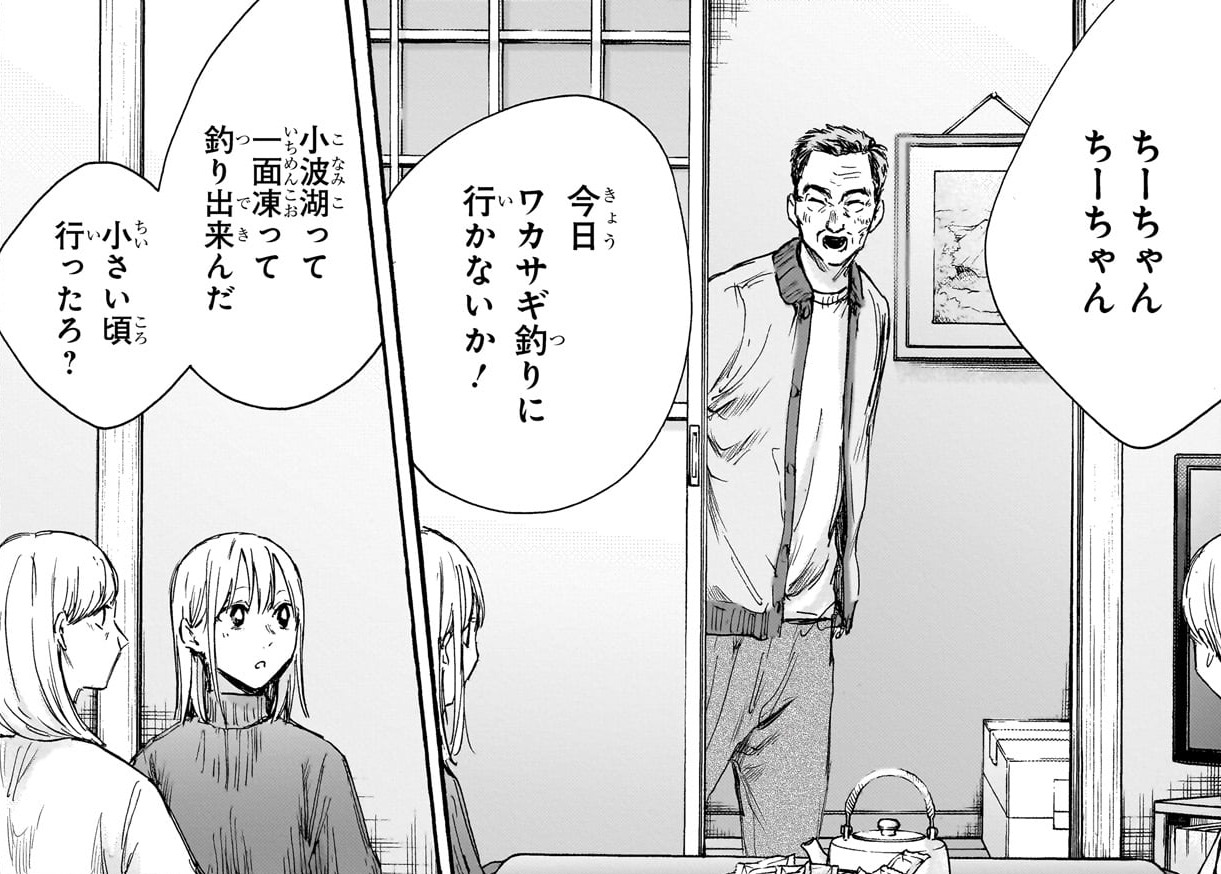
Chinatsu is spending the New Year holidays at her grandparents’ house in Nagano. One morning she sits at the kotatsu with her mother, who tells her they’ll head home on the sixth and can take it easy until then. Then her grandfather calls to her from the doorway.
おじいちゃん:
「ちーちゃん ちーちゃん」
“Chii, Chii!”
「今日ワカサギ釣りに行かないか!」
“Want to go smelt fishing today?”
「小波湖って一面凍って釣り出来んだ」
“Konami Lake freezes over end to end, so you can fish right on it.”
Chinatsu’s grandfather wants to take her ice fishing on a frozen lake. 釣り出来んだ is 釣りが出来るんだ, “you can fish there”. る turns into ん before んだ, and the が is dropped too.
〜らない Becomes 〜んない
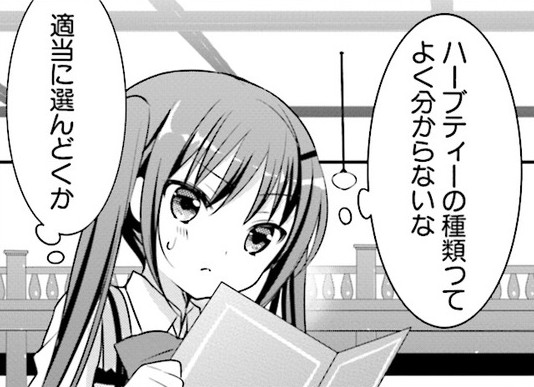
The ら of a negative ending turns into ん: 分からない becomes 分かんない, つまらない becomes つまんない, and ならない becomes なんない. Rough speech can go one step further and turn ない into ねえ: 分かんねえ.
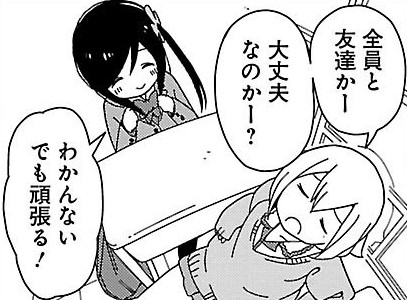
Bocchi needs to become friends with everyone in her class, and Nako asks if she’ll be okay. わかんない is わからない, “I don’t know”, and Bocchi follows it with でも頑張る, “but I’ll try my best”.
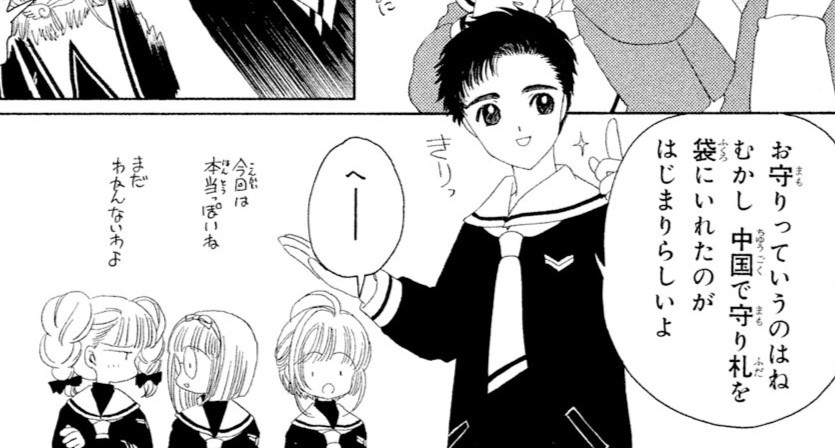
Example 2 of 4: Chinese history lesson on talismans with 中国
Sakura had to take a detour to get to class. She tells her friends at school about the shrine she saw along the way. Naoko says the talismans from there are popular, as they can grant wishes for things such as exams and romance.
山崎:
「お守りっていうのはね むかし 中国で守り札を袋にいれたのがはじまりらしいよ」
“You know, apparently good-luck charms began long ago in China, when people put protective talismans into bags.”
Yamazaki claims that good-luck charms began in ancient China. Naoko thinks that this time his story sounds true, but Chiharu, who has heard plenty of his made-up stories, isn’t convinced: まだわかんないわよ, “we don’t know that yet”. わかんない is わからない.
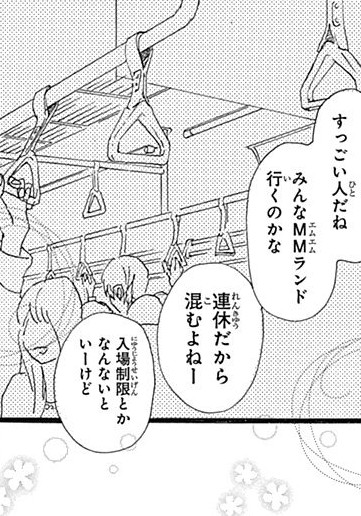
Example 3 of 4: Limited amusement park admission with 入場制限
Takeo and his friends are on a crowded train to an amusement park during a long weekend. Ai hopes the park won’t limit admission: 入場制限とかなんないといーけど. なんない is ならない, “doesn’t become”, and いー stretches いい.
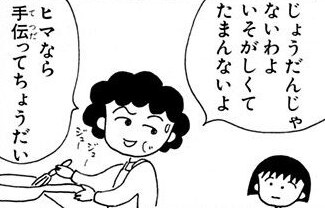
Example 4 of 4: Help me if you're bored with 〜てちょうだい
Maruko wakes up early for once, because she fell asleep in the kotatsu the night before. Her mother is busy making breakfast in the kitchen. Maruko wanders in and complains that six in the morning is boring, with nothing good on TV.
Maruko calls the early morning boring, and her mother, busy making breakfast, disagrees: いそがしくてたまんないよ, “I’m so busy I can’t stand it”. たまんない is たまらない, “unbearable”.
〜るな Becomes 〜んな
The prohibitive な, “don’t”, follows the dictionary form, and a final る before it turns into ん. するな becomes すんな, 触るな becomes 触んな, and 来るな becomes 来んな. The result sounds rougher than the full form. The prohibitive な covers the meaning.
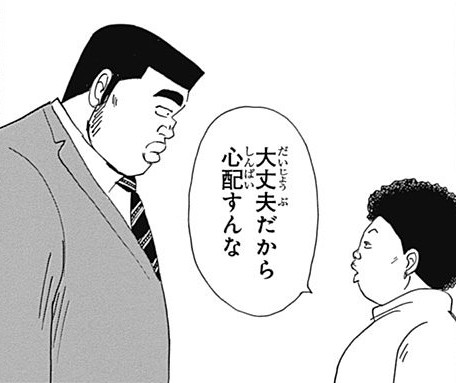
Takeo takes his pregnant mother to the hospital, as she’s getting close to delivery. Once there, she gives Takeo and his friend Suna a list of things to take care of during her stay.
Takeo has brought his pregnant mother to the hospital, and she hands him a list of things to take care of while she’s there. 大丈夫だから心配すんな is 心配するな: “I’ll be fine, so don’t worry.” From a mother to her son, the rough すんな sounds warm and direct.
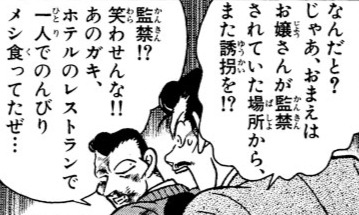
Ran and Kogoro find the kidnapped Akiko and they apprehend the kidnapper. Believing the butler to have arranged the kidnapping, Kogoro accuses the kidnapper being an accomplice. The kidnapper denies working with someone, saying he encountered the child in the hotel by chance.
小五郎:
「なんだと?じゃあ、おまえはお嬢さんが監禁されていた場所から、また誘拐を!?」
“What?! So you kidnapped her all over again, from the very place where the young lady was being held captive!?”
誘拐犯:
「監禁!?笑わせんな!!あのガキ、ホテルのレストランで一人でのんびりメシ食ってたぜ…」
“Held captive?! Don't make me laugh!! That brat was eating a leisurely meal all by herself in the hotel restaurant...”
Kogoro accuses the man who kidnapped Akiko of taking her from the place where she was being held captive. The kidnapper scoffs: 笑わせんな!!, “don’t make me laugh!” It’s 笑わせるな with the る turned to ん. By his account, the girl was eating alone in a hotel restaurant.
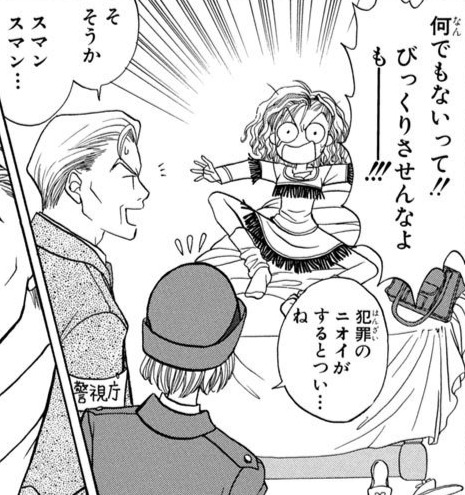
A classmate shows off her new satchel from Meisho Daichi High School. Ran wants one for herself, so she heads down to Shibuya in search of a Meisho Daichi student who’ll give her one. She accidentally steals one, which she later ruminates on in her room. As she talks to herself about how her pride cannot abide stealing, her police officer parents burst into her room, asking what was stolen and who the suspect is.
蘭:
「何でもないって!! びっくりさせんなよ もーーーー!」
“It's nothing!! Don't scare me like that! Seriously!!”
泰三:
「そ そうか スマン スマン…」
“Oh... okay. Sorry, sorry...”
清香:
「犯罪のニオイがするとつい…ね」
“When I smell a crime, I just can't help myself...”
Ran is muttering to herself about the satchel she accidentally took when her parents, both police officers, burst in asking what was stolen. びっくりさせんなよ is びっくりさせるなよ, “don’t scare me like that!”
〜るの Becomes 〜んの
The same change happens before the explanatory の. いるの becomes いんの, and するの becomes すんの. In questions, 〜んの sounds casual and a little pushy: どこにいんの?, “where are you?”
Azu is with her friends, waiting for Suwa. They call him to find what’s keeping him, and while Azu talks with Suwa by phone, she hears an echo of his voice in the distance.
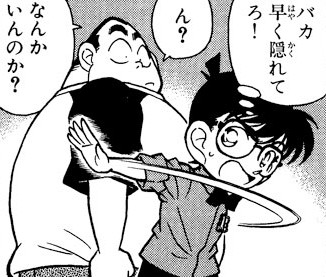
In a game of hide-and-seek, Conan and Ayumi find they’re hiding on the same bench. Their conversation attracts the seeker, Genta, leading him to find Conan. As Ayumi sneaks away unseen, she signals an apology to Conan.
During hide-and-seek, Conan and Ayumi end up hiding on the same bench, and their whispering draws Genta, the seeker. なんかいんのか? is なにかいるのか, “is something there?” なにか has shortened to なんか, too.
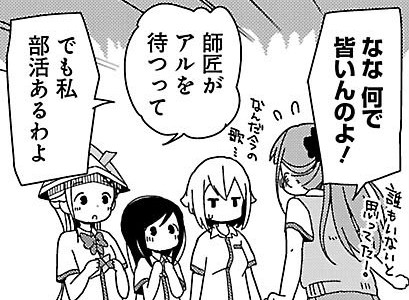
Aru returns to her classroom after club. Expecting the classroom to be empty, she’s singing a song about herself as she enters the room. There, she finds her friends idling away the time.
アル:
「なな 何で皆いんのよ!(誰もいないと思ってた!)」
“Wh- why is it that you all are here?! (I was thinking no one was here!)”
Aru walks back into her classroom after club, singing a song about herself, and finds her friends still there. 何で皆いんのよ! is 何で皆いるのよ, “why are you all here?!” Sotoka answers with a casual quote: 待つって, “(she) said she’d wait”.
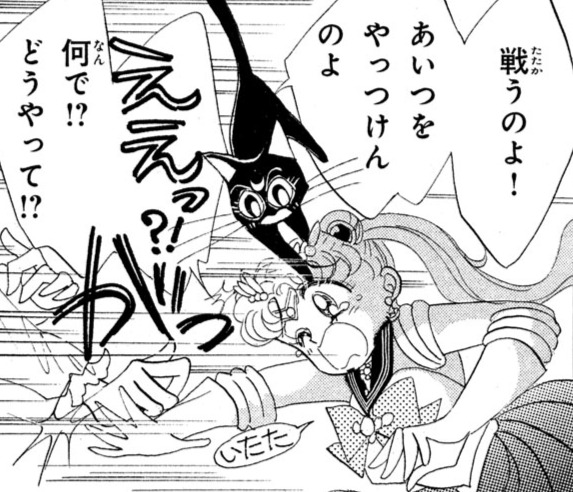
Luna explains that Usagi must become Sailormoon to fight against enemies. Upon transforming, Sailormoon discovers the opponent has targeted her friend Naru. When Sailormoon arrives to help, the enemy sends mind-controlled people to attack and harm her.
Usagi has just transformed into Sailormoon, and Luna tells her what to do. あいつをやっつけんのよ is やっつけるのよ, “take that one down!” The の with よ gives an order, and る turns into ん before it.
Example 5 of 7: Not letting anyone find out with 〜ないようにしろ
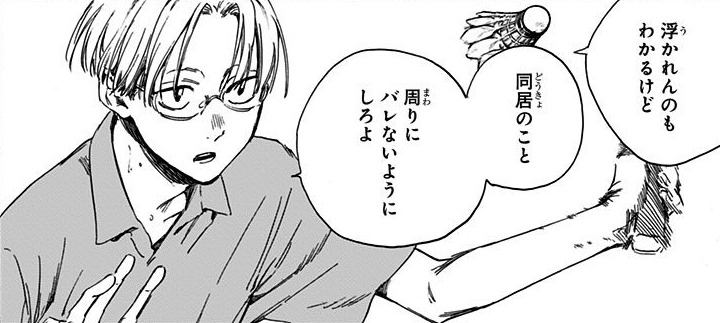
Chinatsu has moved into Taiki’s family’s house. At badminton practice the next day, he’s in high spirits. His friend Kyou is aware of the living arrangement.
匡:
「浮かれんのもわかるけど」
“I get why you're walking on air, but...”
「同居のこと周りにバレないようにしろよ」
“...make sure nobody around here finds out you two live together.”
Taiki is thrilled that Chinatsu now lives at his house, and his friend Kyou has noticed. 浮かれんのもわかるけど is 浮かれるのもわかるけど, “I get why you’re giddy, but”. This の turns the verb into a noun, “being giddy”, and る still becomes ん before it.
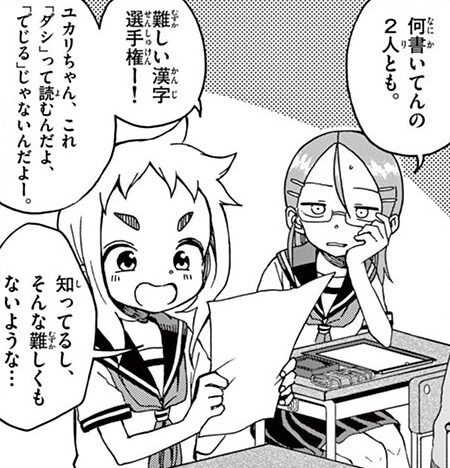
Example 6 of 7: A hard kanji championship with 選手権
In calligraphy class, the teacher tells everyone to write a word they like and hand it in by the end of class. Yukari settles on something plain. Then Mina shouts that she’s done, and she and Sanae hold up their sheets. Mina’s reads 出汁 and Sanae’s reads 韋駄天.
Yukari asks her friends what they’re writing in calligraphy class. 書いてんの stacks two changes on 書いているの: ている shrinks to てる, and that る becomes ん before の.
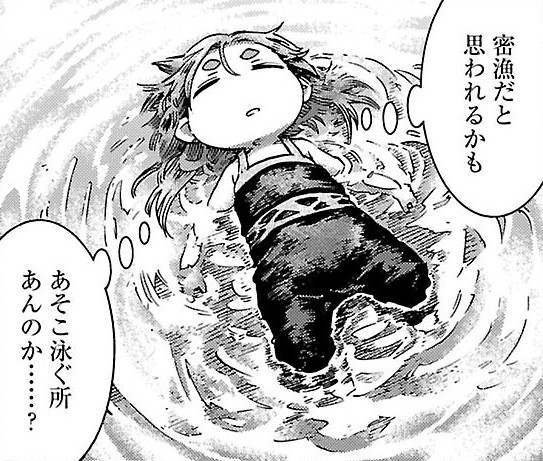
Hakumei can’t swim, so Mimari is teaching her. Hakumei tenses up in the water because she pictures herself drowning, so Mikochi tells her to think about something else, like where she’d go once she can swim. Floating on her back, Hakumei decides she might visit the sea at Arabi with Mikochi. Arabi is a port town known for its seafood.
Hakumei pictures herself swimming in the sea at the port town of Arabi, then starts to doubt the plan. あんのか is あるのか, “is there?”, with る turned into ん. She’s wondering whether Arabi has any 泳ぐ所, place to swim.
の Becomes ん
The の of explanatory のだ shortens to ん, so のだ becomes んだ and のです becomes んです. In conversation, んだ is the normal form, and のだ sounds bookish. Reasoning with 〜のだ covers the meaning.
Other の words shorten the same way. もの, “thing”, becomes もん, and ◯◯のうち, “◯◯’s house”, becomes ◯◯んち. See One’s house with 〜んち.
Example 1 of 4: Getting on one's nerves with 気に食わない
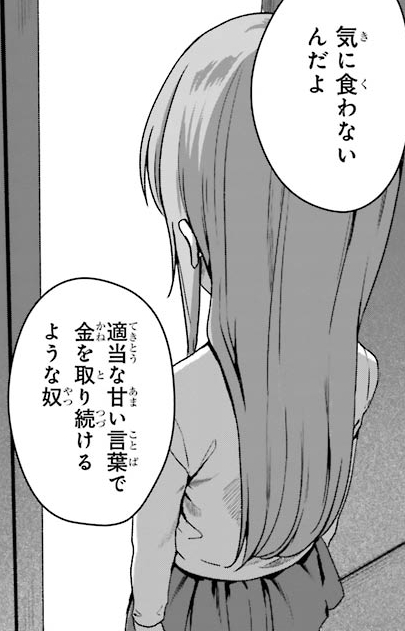
Following the death of their parents, Kanami’s big brother Kazutaka became secluded and abusive. Kanami begins to spend time with Makoto, a “rental big brother” whose advice gives her hope in restoring her brother’s former kindness. Kazutaka rebukes her attempts, suggesting that Makoto’s filling her with nonsense ideas.
一敬:
「気に食わないんだよ」
“He gets on my nerves.”
「適当な甘い言葉で金を取り続けるような奴」
“He's the kind of guy who keeps taking (rental) money while spouting alluring words.”
Kanami’s brother Kazutaka has turned cold since their parents died, and he wants her to stop seeing Makoto, the “rental big brother”. 気に食わないんだよ is 気に食わないのだよ, “he gets on my nerves”. Spoken Japanese almost always says んだ here.
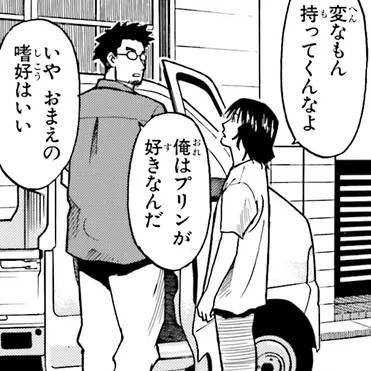
After Yousuke finishes moving his belongings into his new home with the help of his friend Jumbo, Jumbo offers to pick up some gifts for Yousuke to give his new neighbors when he goes around the neighborhood to introduce himself.
Jumbo offers to pick up gifts for Yousuke to give his new neighbors. 変なもん持ってくんなよ is 変なもの持ってくるなよ, “don’t bring back anything weird”, with two changes: もの → もん, and くるな → くんな. Jumbo’s reply has a third: 好きなんだ is 好きなのだ, “I like pudding, you know”.
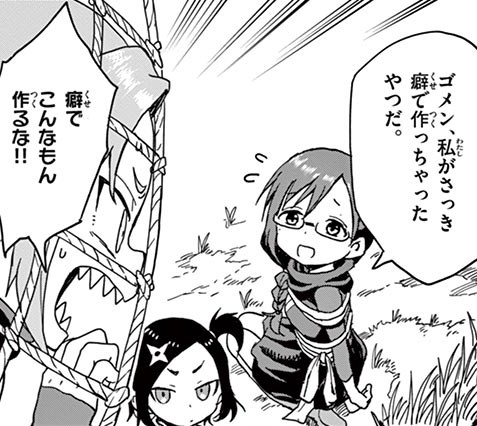
During a competition, Touwata and Mizubashou confront Tsubaki’s group to ask for help. While Touwata lays out her request, Sazanka and Asagao tie the two with ropes, believing their plea to be a trick. Figuring they’ve won, Sazanka and Asagao let down their guard and fall into a trap.
Mizubashou admits she made the trap out of habit, and Sazanka snaps: 癖でこんなもん作るな!!, “don’t make things like this out of habit!” こんなもん is こんなもの. Mizubashou’s apology has a contraction too: 作っちゃった is 作ってしまった.
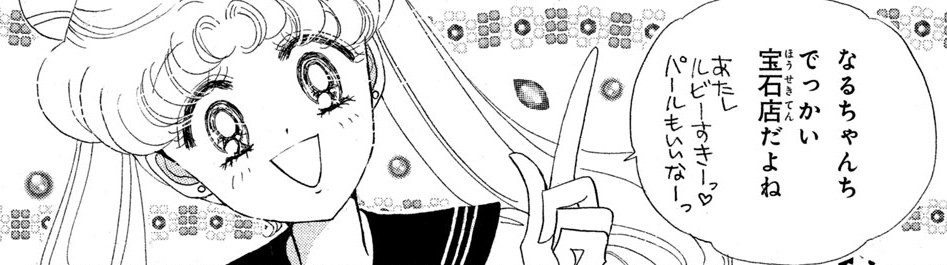
Usagi and her friends are talking about jewelry over lunch, and Naru’s family owns a jewelry store. なるちゃんち is なるちゃんのうち, “Naru’s house”. ちゃん already ends in ん, so のうち shrinks to just ち.
〜ているのだ Becomes 〜てんだ
Some contractions stack. 何をしているのだ, “what are you doing?”, goes through three changes on the way to rough speech:
ている becomes てる, and を drops: 何してるのだ
の becomes ん: 何してるんだ
る becomes ん before the ん: 何してんだ
The same steps turn 〜ているの into 〜てんの. 〜てんだ sounds rougher than 〜てんの, and it’s common in angry or excited speech.
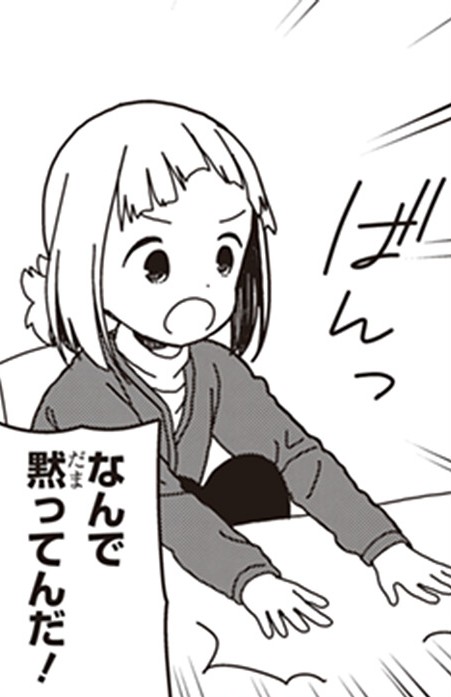
Being the first to arrive at the clubhouse after school, Yui decides to change her hairstyle and see how long it takes the others to notice when they arrive. Sacchan arrives next and starts up a conversation. Yui simply sits there without saying anything.
Yui changed her hairstyle to see how long her friends would take to notice, and she sits waiting without a word. Sacchan arrives and gets no answer: なんで黙ってんだ!, “why aren’t you saying anything?!” 黙ってんだ is 黙っているんだ.
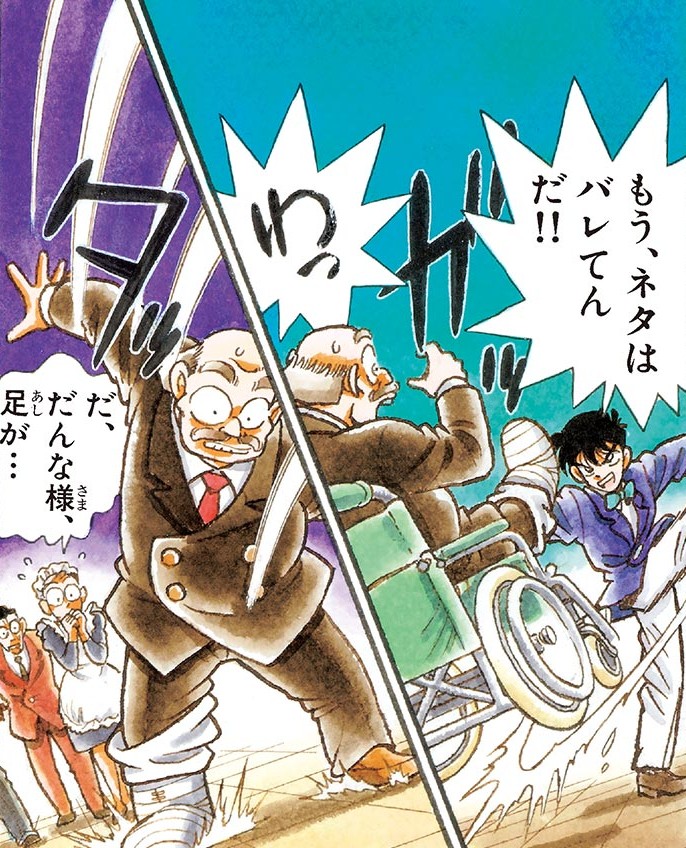
Shin’ichi reveals that the murderer escaped out the window and onto the roof, naming the wheelchair-bound husband as the culprit. The husband points his cast-covered leg, but Shin-ichi knows better.
Shin’ichi has worked out that the murderer escaped through the window and over the roof, and he names the husband in the wheelchair. ネタはバレてんだ!! is バレているんだ, “your trick has been exposed!” The ている describes the resulting state: the trick is now known.
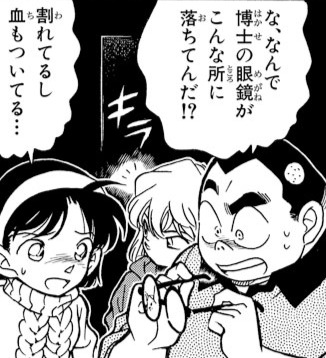
Professor Agasa and the Detective Boys stay overnight in a large villa in the woods after getting lost on a camping trip. Conan and Agasa go missing, leaving the rest of the kids to sneak around at night to search the property for them. After entering a secret passage, Haibara finds spots of blood on the ground, and then Genta finds Agasa’s glasses.
元太:
「な、なんで博士の眼鏡がこんな所に落ちてんだ!?」
“W-what the heck? Why are the professor's glasses lying here!?”
The Detective Boys are searching a villa at night for Conan and Professor Agasa, and Genta finds the professor’s glasses in a secret passage. 落ちてんだ is 落ちているんだ: “why are they lying here?” Ayumi notices they’re broken: 割れてる, from 割れている.
Example 4 of 5: Testing one's detective ability with 能力
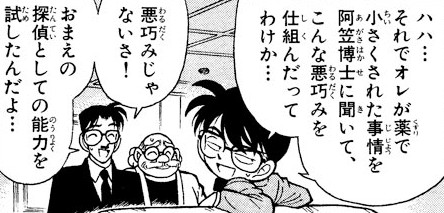
Conan has discovered that the dangerous pair holding him are his own parents in disguise. His father insists it isn’t an evil scheme: 能力を試してんだよ, “I’m testing your ability (as a detective)”. 試してんだ is 試しているんだ, and 悪巧みじゃない uses じゃ for では.
One morning, Miyamura and his classmates are wearing the black, high-collared jackets of the winter uniform. Shindou walks into the classroom in a white summer shirt.
進藤:
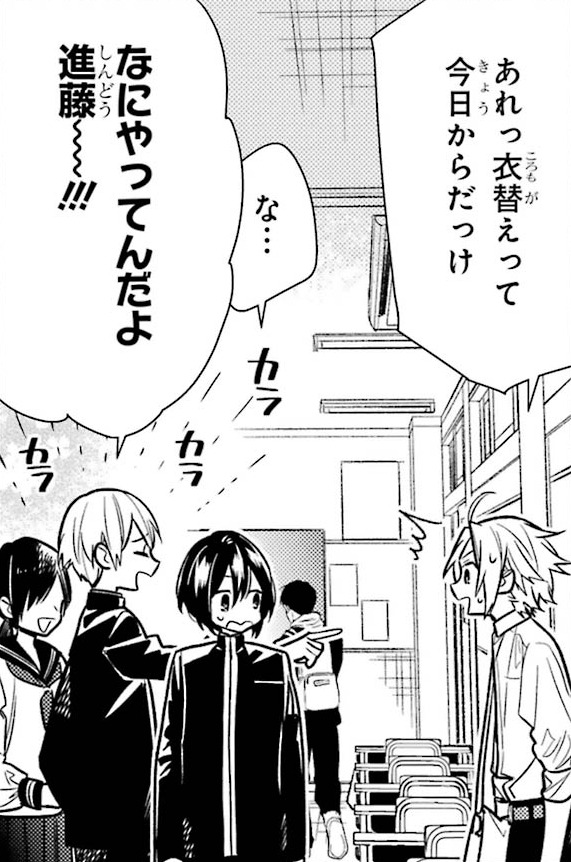
「あれっ 衣替えって今日からだっけ」
“Huh? Was the uniform change supposed to start today?”
Everyone else has switched to winter jackets, and Shindou shows up in his summer shirt. A laughing classmate calls out, なにやってんだよ進藤!, “what are you doing, Shindou?!” やってんだ is やっているんだ.
〜と言う Becomes 〜って and 〜つー
The quoting particle と becomes って in casual speech, and という becomes っていう. 行くと言った becomes 行くって言った, and バドミントンというのは becomes バドミントンっていうのは. Quoting and reporting with と and って covers the meanings.
Rough speech squeezes the same words further, until 言う disappears into the quote:
Full form
Light casual form
Rough form
という
っていう
つー・っつー
と言って
って言って
つって・っつって
と言った
って言った
つった・っつった
何と言った
何て言った
なんつった
When a bubble gives you つった, don’t look for a new verb. Put 言う back in first.
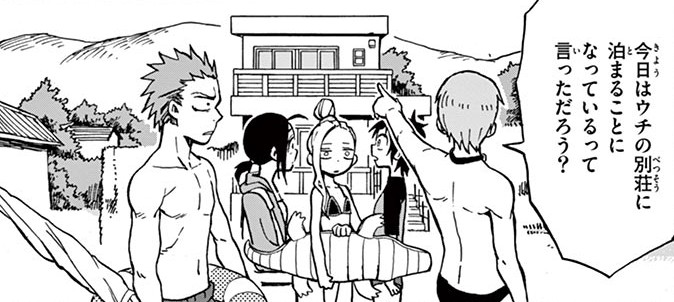
After a day at the beach, Hikari asks when someone is coming to pick them up. Shindou reminds her that they’re staying the night at his villa: 泊まることになっているって言っただろう?, “didn’t I tell you?” This is the light casual って言った, from と言った. Rougher speech could squeeze it to っつっただろ.
Calling Something by Name
XっていうY means “a Y called X”. The rough XっつーY means the same thing in a rougher voice. っていうのは, “the thing called”, also sets up a topic to explain.
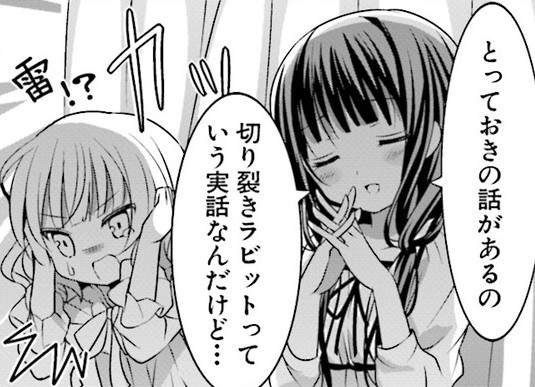
At a sleepover at Chino’s, the friends are telling scary stories late at night, and Chiya has one saved up. 切り裂きラビットっていう実話 is “a true story called The Slasher Rabbit”.
Example 2 of 2: Dueling like in Ancient Rome with 古代
Li seems fired up over something with Sakura. Yamazaki suggests whatever the issue is be settled when they play badminton during that day’s physical education class. Li asks why things have to be settled via badminton.
山崎:
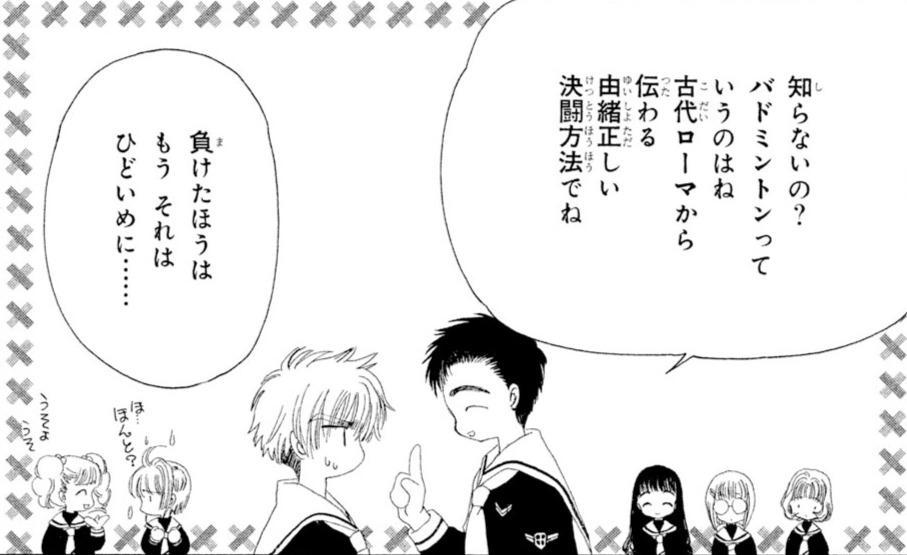
「知らないの?バドミントンっていうのはね 古代ローマから伝わる由緒正しい決闘方法でね」
“You don't know? Badminton is a time-honored method of dueling that has been passed down since ancient Rome.”
Li is fired up about something with Sakura, and Yamazaki suggests they settle it with badminton in PE. Asked why badminton, he explains: バドミントンっていうのはね, “badminton, you see”, is a time-honored way of dueling from ancient Rome.
Summarizing What Someone Said
っていう can also report what someone means or said: “you’re saying that…” or “they said that…”. Rough っつー keeps the same job, as in 〜っつーんだ and 〜っつーから.
Example 1 of 2: They'll target not just me with 〜だけじゃなく〜も
After Shin’ichi was forced to take a deadly drug that instead shrank him back to a child, he took on the undercover name Conan and went to stay with his childhood friend Ran and her detective father in the hope of a lead to the black-clad men who drugged him. He later discusses with Professor Agasa about how useless Detective Mouri is. The professor reminds Conan that the poison was supposed to have killed him, so he can’t rush and let others know his true identity.
コナン:
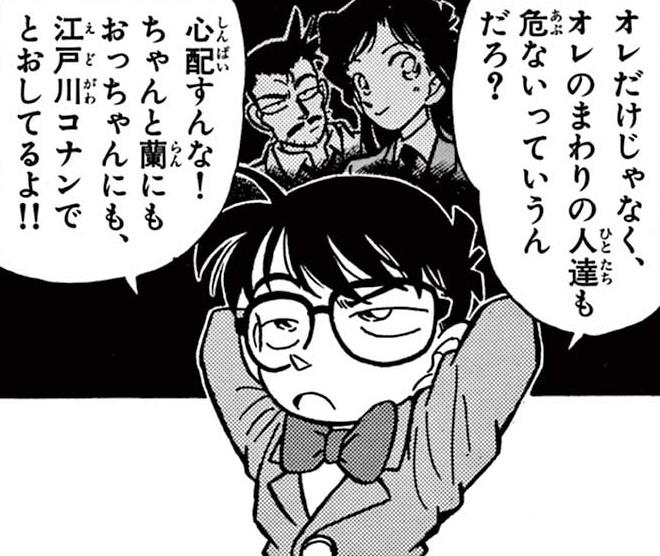
「オレだけじゃなく、オレのまわりの人達も危ないっていうんだろ?」
“You're saying it won't be just me, but the people around me will be in danger too, right?”
「心配すんな!ちゃんと蘭にもおっちゃんにも、江戸川コナンでとおしてるよ!!」
“Don't worry! I'm keeping up the Conan Edogawa act with Ran and the old man, too!!”
Professor Agasa warns Conan not to reveal who he is, since the men in black meant for the poison to kill him. Conan sums up the warning: 危ないっていうんだろ?, “you’re saying the people around me will be in danger too, right?” Then he tells the professor not to worry: 心配すんな, from するな.
Example 2 of 2: Additionally, I'm happier having girls here with それに〜
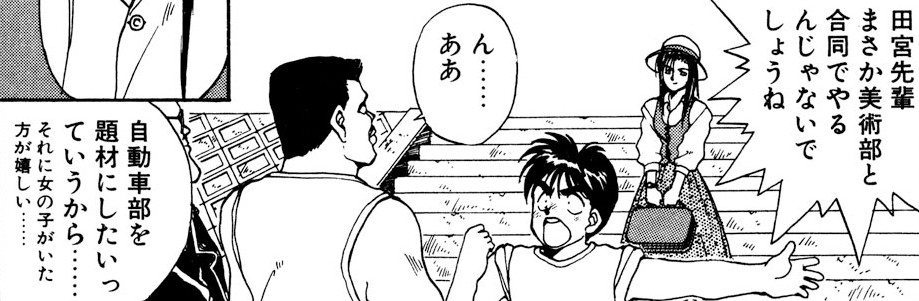
Kei’ichi is excited to spend four days at the beach with his university automobile club and Belldandy. His mood changes when he hears Sayoko call out to him.
螢一:
「田宮先輩まさか美術部と合同でやるんじゃないでしょうね」
“Tamiya, don't tell me we're doing this with the art club!”
田宮:
「ん……ああ。自動車部を題材にしたいっていうから…… それに女の子がいた方が嬉しい…」
“It's because they said they wanted to use the automobile club as a subject... Additionally, I'm happier having girls here.”
Kei’ichi is dismayed to learn the art club is joining the automobile club’s beach trip. Tamiya explains: 題材にしたいっていうから, “because they said they want to use (our club) as a subject”. Here っていう reports what the art club said.
Rough つー, つって, and つった
In rough speech, っていう becomes つー or っつー, って言って becomes つって, and って言った becomes つった. Two uses come up again and again:
Sentence-final っつーの, from っていうの, insists on something the listener should already know: バレバレだっつーの, “it’s totally obvious, I’m telling you”.
なんつったっけ is 何て言ったっけ, “what was it called again?” The っけ at the end is the “what was it?” particle.
Rough speech fuses the vowels “ai” into “ee”. ない becomes ねえ, also written ねー or ねぇ, so 知らない becomes 知らねえ. Other words that end in “ai” or “oi” change the same way: すごい becomes すげえ, うるさい becomes うるせえ, and the たい of “want to” becomes てえ, as in 食いてえ. おまえ becomes おめえ.
This is mostly masculine speech, from tough guys, boys horsing around, and anyone being blunt. “ui” can fuse too: 暑い becomes あちい, and 寒い becomes さみい. Negation with 〜ない has more about ねえ.
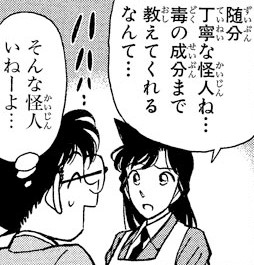
A client tells Detective Mouri about the condition in which she found her deceased husband. Hearing the details, Conan identifies the likely poison, including the composition, the dosage required to kill, and the internal effects it has on a person. When Ran asks how he knows all this, Conan covers by saying the monster villain on the kid’s TV show he watched explained it.
蘭:
「随分 丁寧な怪人ね… 毒の成分まで教えてくれるなんて…」
“What a polite villain... Going so far as to tell the poison's composition...”
Conan explains a poison in a little too much detail, and when Ran asks how he knows, he claims a villain on a kids’ TV show explained it. Ran marvels at such a polite villain, and Conan thinks: そんな怪人いねーよ…, “no villain like that exists”. いねー is いない.
Example 2 of 9: Drawing a conclusion about a murder with 結論
Conan and Heiji end up staying at the same mansion when a murder occurs. They decide to put their heads together to try and determine who the culprit is.
コナン:
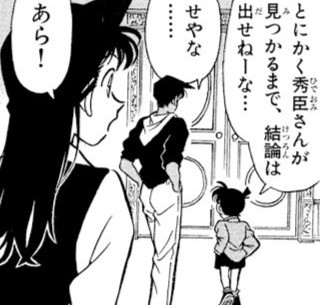
「とにかく秀臣さんが見つかるまで、結論は出せねーな…」
“Anyway, I guess we can't come to a conclusion until we find Hideomi...”
Conan and Heiji are working out who committed the murder at the mansion. 結論は出せねーな is 出せないな: “we can’t reach a conclusion (until we find Hideomi)”. Heiji agrees in Kansai speech: せやな, “that’s right”.
Example 3 of 9: It's not like you're a foreigner with 〜じゃあるまいし
Shin’ichi’s teenage friend Ran enters Professor Agasa’s house looking for him, unaware that he was forced to take a poison that inadvertently turned the teenager into a young child. When Ran sees the boy and asks his name, Shin’ichi recalls Agasa’s suggestion to not reveal who he is. Panicking, he gives the name “Conan”, explaining the oddness of it by saying his father is a fan of author Arthur Conan Doyle.
蘭:
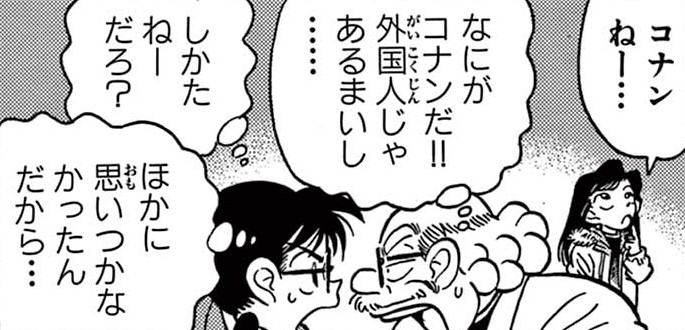
「コナンねー…」
“Conan, huh?”
阿笠:
「なにがコナンだ!! 外国人じゃあるまいし」
“What's with 'Conan'!? It's not like you're a foreigner...”
コナン:
「しかたねーだろ? ほかに思いつかなかったんだから…」
“It couldn't be helped, all right? I couldn't think up anything else...”
Shin’ichi, shrunk to a child, panicked and told Ran his name was Conan. Professor Agasa scolds him for picking such an odd name, and Conan grumbles back: しかたねーだろ?, “what else could I do?” しかたねー is しかたない.
Simon and Nicola stop at a pub for dinner. Their dinner conversation turns to Simon explaining the various temperaments of different tribes in the demon world.
サイモン:
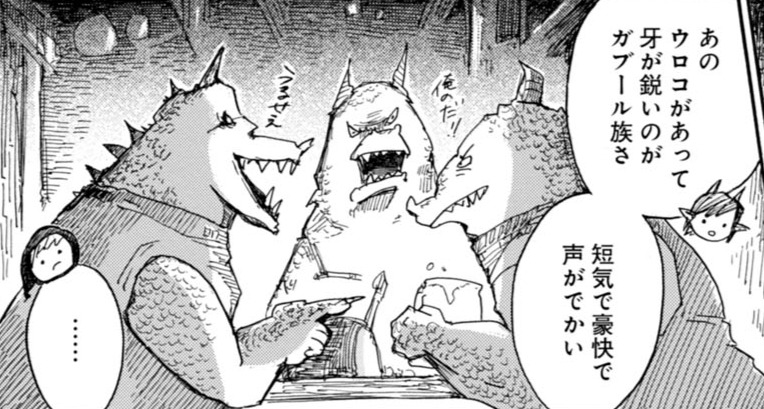
「あのウロコがあって牙が鋭いのがガブール族さ」
“Those ones with scales and sharp fangs are the Gabool tribe.”
Simon is telling Nicola about the tribes of the demon world, starting with the short-tempered, loud Gabool. Right on cue, two of them start squabbling. うるせえ is うるさい, “shut up”, with “ai” fused into “ee”.
Example 5 of 9: Seeing a comet with the naked eye with 肉眼
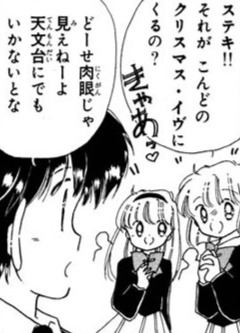
Asuka Jr. mentions a comet that passes Earth once every fifty years, and Ryouko is thrilled it’s coming on Christmas Eve. He’s less romantic: どーせ肉眼じゃ見えねーよ, “you won’t see it with the naked eye anyway”. 見えねー is 見えない, and 肉眼じゃ is 肉眼では.
Example 6 of 9: Unsuitable conditions for live-in work with 住み込み
Sami answers a phone call from her uncle. He thinks his friend’s son Nishi would be a good assistant for Sami’s father. Since her father’s busy trying to meet a deadline, Sami accepts on her father’s behalf. When the assistant arrives, he’s completely unwilling to adjust to Sami’s father’s workstyle, then he stays overnight in their bed and wears Sami’s father’s clothes. After all this, Sami’s father is still willing to take Nishi on, but not as a live-in assistant.
西:
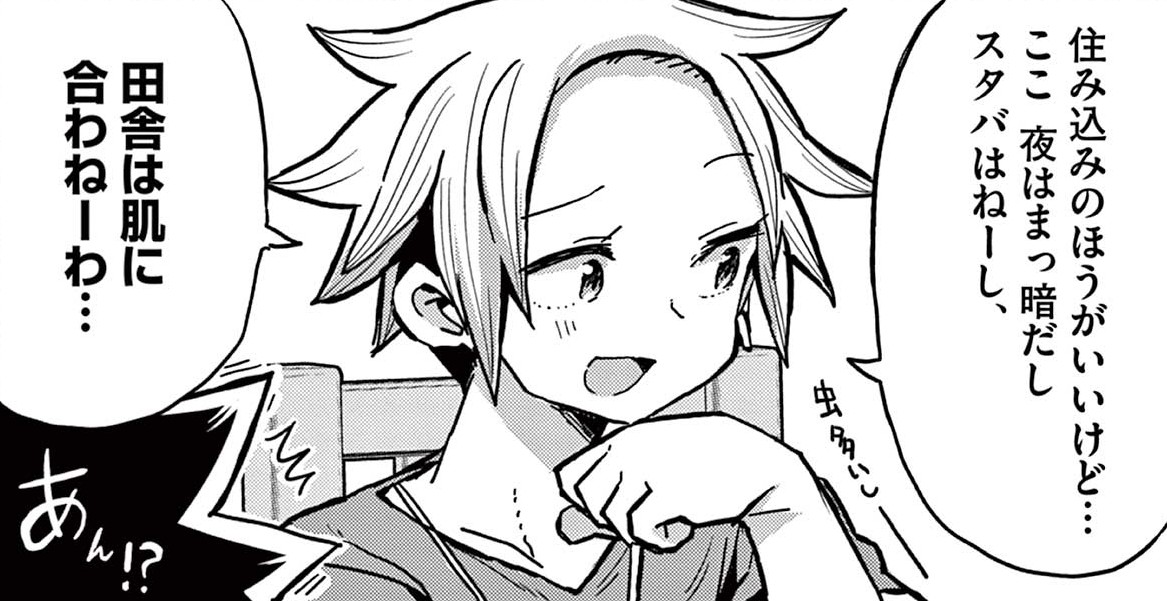
「住み込みのほうがいいけど… ここ 夜はまっ暗だしスタバはねーし、(虫多いしーーー)」
“A live-in arrangement would be better, but... it gets pitch dark here at night, there's no Starbucks, and there are tons of bugs...”
Nishi has come to work as Sami’s father’s assistant, and he complains about the countryside: it’s pitch dark at night, and スタバはねーし, “there’s no Starbucks”. 合わねーわ, “(country life) doesn’t suit me”, fuses ない the same way.
Example 7 of 9: Not quite a movie buff with ってほどでもない
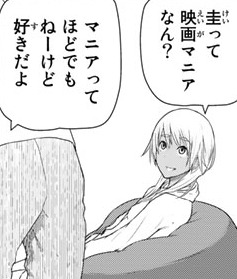
Akane asks her cousin Kei whether he’s a movie buff. He plays it down: マニアってほどでもねーけど好きだよ, “I wouldn’t go as far as ‘buff’, but I like them”. でもねー is でもない.
Moka has a sore throat. Hinata brings her chopped daikon that was left to steep in honey in a sealed jar. Moka tastes it and is surprised that it’s sweet.
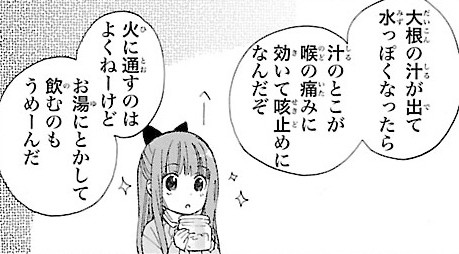
日向:
「大根の汁が出て水っぽくなったら 汁のとこが喉の痛みに効いて咳止めになんだぞ」
“Once the daikon juice comes out and it gets watery, the juice is good for a sore throat and works as cough medicine.”
「火に通すのはよくねーけど お湯にとかして飲むのもうめーんだ」
“Heating it's no good, but it's tasty stirred into hot water, too.”
Hinata, a five-year-old who talks like an old country grandmother, explains daikon syrup to her friend Moka. 火に通すのはよくねー is よくない, “heating it is no good”. うめー in the same line is うまい, “tasty”, with “ai” fused the same way.
Example 9 of 9: Curiosity I can't hold back with 〜きれねー
Conan, Professor Agasa, and the Detective Boys are exploring the empty villa of Agasa’s late uncle. Conan has found signs that a skilled old man secretly lived there, and the children have found rows of strange figures that Conan recognizes as a code, like the one in Sherlock Holmes’s “The Adventure of the Dancing Men”. Agasa notices how pleased he looks and asks whether he can read it. Conan admits he can’t make sense of any of it yet.
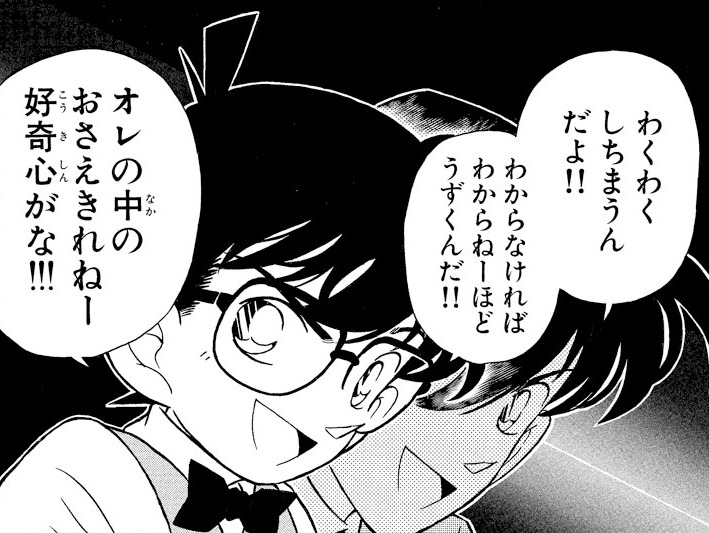
コナン:
「わくわくしちまうんだよ!!」
“That's what gets me so excited!!”
「わからなければわからねーほどうずくんだ!!」
“The less I understand, the more it itches!!”
「オレの中のおさえきれねー好奇心がな!!!」
“This curiosity inside me that I can't hold back!!!”
Conan can’t read the code he’s found yet, and it thrills him. わからねー and きれねー are rough forms of わからない and きれない, and they suit his excited, boyish tone.
Clipped Words
Some common words simply lose their ending in casual speech. ところ, “place”, becomes とこ. やはり becomes やっぱり and then やっぱ, “after all” or “as expected”. 何も becomes なんも, and 面倒くさい becomes めんどくさい.
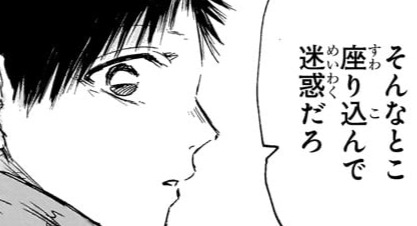
The Winter Cup basketball tournament has arrived, and Taiki is there to cheer on Chinatsu in the competition. He’s feeling so nervous that his legs give out and he falls into a crouch on the ground outside the event. In this state, he doesn’t see his upperclassman from the badminton club approaching.
Taiki has come to cheer for Chinatsu at the Winter Cup, but his nerves give out and he crouches down outside the venue. His senpai from the badminton club finds him: そんなとこ座り込んで迷惑だろ, “squatting in a spot like that, you’re in the way”. そんなとこ is そんなところ.
Example 2 of 7: Feeling running is better after all with 〜気がする
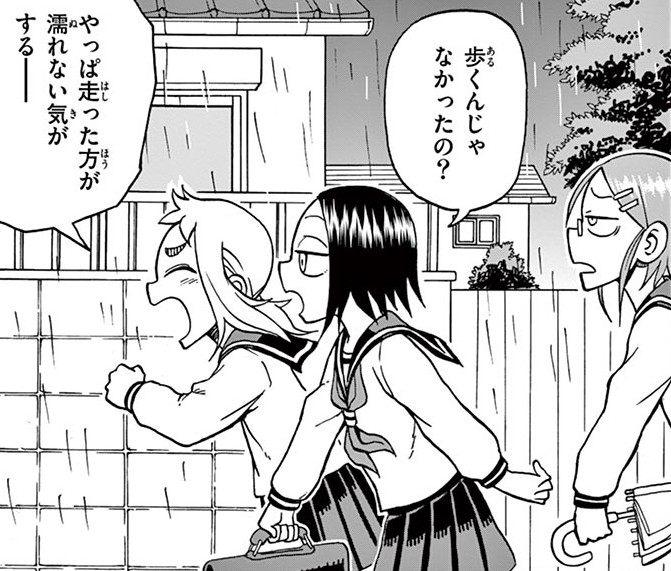
Mina proclaims she knows a shocking fact about being caught in the rain: it doesn’t matter whether you walk or run because you’ll get wet the same amount either way. Sanae says she heard running is better to avoid getting as wet. Mina says if it starts raining, she’ll walk, and Sanae has to run.
サナエ:
「歩くんじゃなかったの?」
“Weren't you going to walk?”
ミナ:
「やっぱ走った方が濡れない気がするーーー」
“I feel like I'll get less wet if I run after all!”
Mina claimed you get just as wet walking or running in the rain, and said she’d walk. Now that it’s raining, she runs anyway: やっぱ走った方が濡れない気がする, “on second thought, I feel like running keeps you drier”. やっぱ is やっぱり, which is やはり.
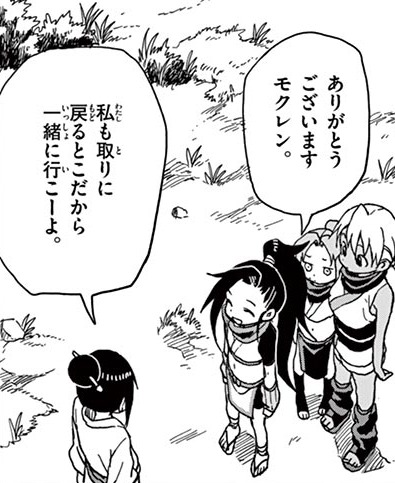
After lunch, Tsubaki is lost in thought when Mokuren calls her over. Mokuren tells her that today’s class will use the second scroll instead of the first.
ツバキ:
「ありがとうございますモクレン。」
“Thank you, Mokuren.”
モクレン:
「私も取りに戻るとこだから一緒に行こーよ。」
“I'm just about to go back for mine too, so let's go together.”
Mokuren is chatting with her friend Tsubaki about the day’s class. 取りに戻るとこだ is 取りに戻るところだ, “I’m about to go back for it”. Here ところ marks a point in time rather than a place, but it clips to とこ all the same.
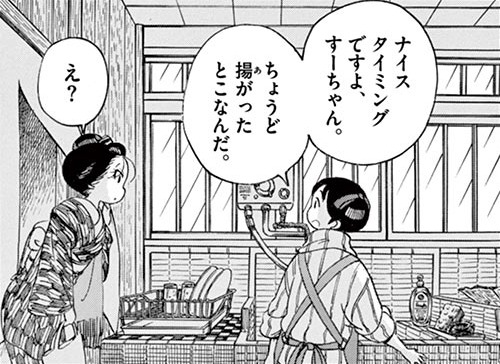
Kenta, a friend from back home, has told Sumire that he’s taking a job in Kyoto and staying. Sumire is thrilled, then scolds herself for it, since he must have made some hard choices. She comes home worn out from holding back a grin, and Kiyo leans out to welcome her back.
Kiyo greets Sumire in the kitchen with a fresh batch of fried snacks. ちょうど揚がったとこなんだ is ちょうど揚がったところなんだ, “it’s just come out of the fryer”. The clipped とこ keeps the line casual.
Example 5 of 7: Leaving right after a drink with 〜たばっか
Fujimiya’s mother has asked Hase to meet her at the park on Sunday, and he’s anxious about what she wants. On Saturday he calls Kiryuu out to the same park to talk it over. Kiryuu, thirsty and without his wallet, gets Hase to buy him a drink. Hase admits he could have just phoned, but he wanted Kiryuu to set him straight in person.
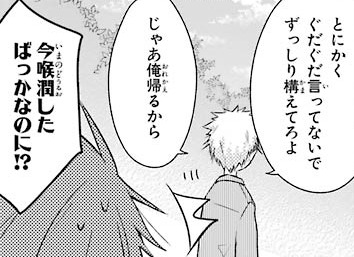
桐生:
「とにかく ぐだぐだ言ってないで ずっしり構えてろよ」
“Anyway, quit whining and hold steady.”
「じゃあ俺帰るから」
“Okay, I'm heading home.”
長谷:
「今喉潤したばっかなのに!?」
“You only just wet your whistle, and you're leaving?!”
Kiryuu is leaving the moment he finishes the drink Hase bought him. ばかり clips the same way やはり does: ばかり becomes ばっかり, then ばっか. 潤したばっかなのに is 潤したばかりなのに, “even though you only just had a drink”.
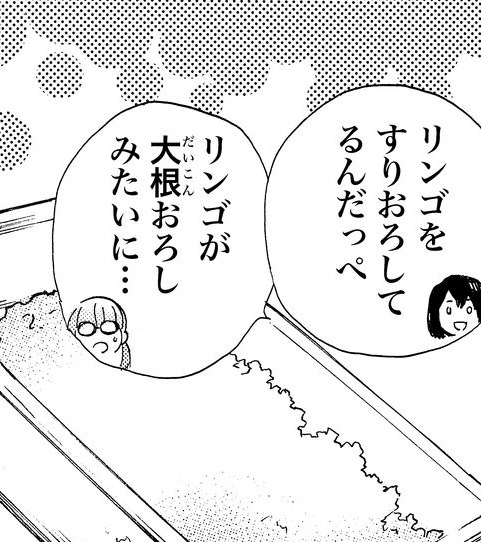
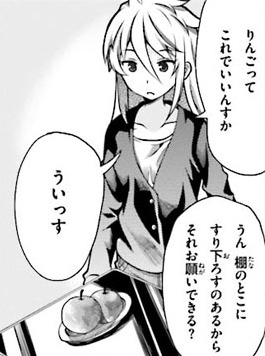
Renge is home in bed with a cold, and Kaede from the candy shop has dropped by with snacks, though she claims she only came to deliver a pillow. Renge’s older sister Kazuho heads off to make dinner and promises Renge some grated apple. Kaede offers to help, and the two go to the kitchen.
楓:
「りんごってこれでいいんすか」
“Are these the apples you want?”
一穂:
「うん 棚のとこにすり下ろすのあるから それお願いできる?」
“Yeah. There's a grater over by the shelf, so could you do that for me?”
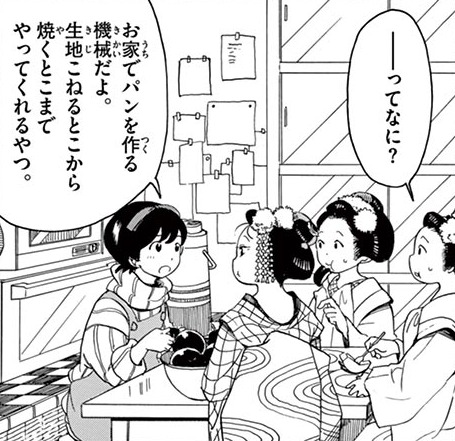
Kiyo and the maiko of the house sit around a bowl of apples in the kitchen. The talk has turned to a “home bakery”, and one of the maiko repeats the unfamiliar words.
舞妓さん:
「――ってなに?」
“...What's that?”
キヨ:
「お家でパンを作る機械だよ。生地こねるとこから焼くとこまでやってくれるやつ。」
“It's a machine for making bread at home. It does it all for you, from kneading the dough to baking the bread.”
Kiyo explains what a home bakery is. 生地こねるとこから焼くとこまで is 生地をこねるところから焼くところまで, “from kneading the dough to baking”. Here ところ names a stage of the process, and it clips to とこ both times.
Stacked Contractions
Rough speech piles several changes into one phrase. When a bubble doesn’t make sense, undo one change at a time. なきゃなんねー works like this:
なければならない, the textbook form
なければ becomes なきゃ: なきゃならない
ら becomes ん: なきゃなんない
ない becomes ねー: なきゃなんねー
Example 1 of 7: I'd have to trade side dishes with 〜なきゃなんねー
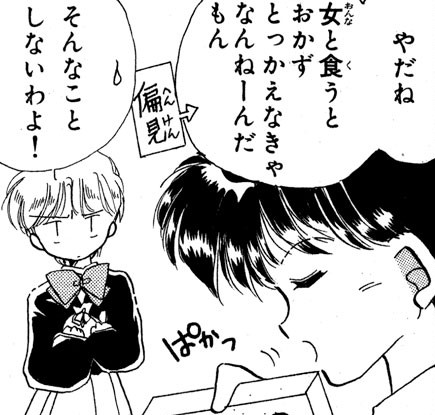
Rina asks to eat lunch with Asuka Jr., and he refuses. If he eats with a girl, he says, he’ll have to swap side dishes: おかずとっかえなきゃなんねー. That’s おかずを取り換えなければならない with every piece contracted. Even 取り換える has become とっかえる.
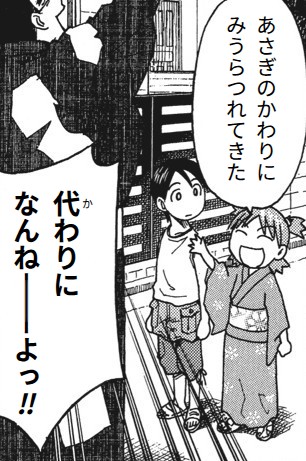
Yotsuba’s father plans to take her to see fireworks. When Jumbo hears that Yotsuba’s neighbor, Asagi, had previously invited her to use sparklers, Jumbo says Yotsuba needs to invite Asagi to see the fireworks as a thank-you. She heads next door to ask, but Asagi already has plans to see the fireworks with a friend, so Yotsuba invites Ena instead, and agrees for Ena’s friend Miura to come along. Yotsuba returns home and assures Jumbo that Asagi will go to see the fireworks. They head out the following day.
Yotsuba was supposed to invite Asagi to the fireworks as a thank-you, but she brought Miura instead. Jumbo protests: 代わりになんねーーーよっ!!, “that doesn’t count as a replacement!” なんねー is ならない, with ら → ん and ない → ねー.
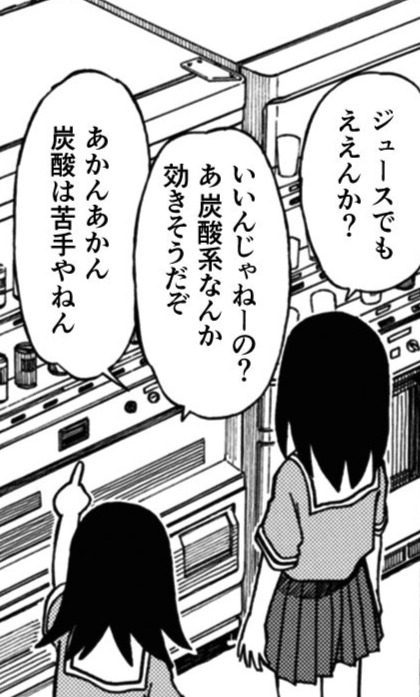
Ayumu is trying cures for her hiccups and asks if juice works as well as water. Tomo answers いいんじゃねーの?, “it should be fine, right?” Undo it in steps: いいのではないの → いいんじゃないの → いいんじゃねーの. Ayumu then answers in Kansai speech that she can’t handle carbonated drinks.
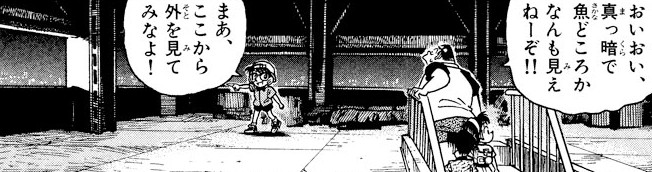
The Detective Boys follow what appears to be an encoded treasure map. They’re able to locate each symbol from the map except for what appears to be a fish. Conan figures it out, and leads the group up a fire escape to the top floor of a nearby building.
元太:
「おいおい、真っ暗で魚どころかなんも見えねーぞ!!」
“Hey, it's pitch black. Far from a fish, I can't even see anything!!”
The Detective Boys are following a treasure map, and Conan leads them to the top of a dark building to find the fish on it. Genta complains: 魚どころかなんも見えねーぞ!!, “forget a fish, I can’t see anything!” なんも is 何も, and 見えねー is 見えない.
Example 5 of 7: Experiencing danger during hide-and-seek with 〜目にあう
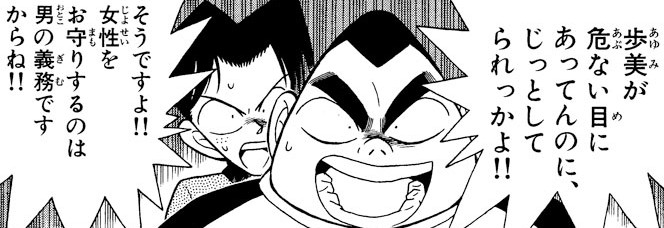
During a hide-and-seek game at the park, Ayumi hides in a car trunk and falls asleep. She wakes to find the car moving and discovers a bag of money, a slimy saw, and what seems like a severed head. Conan, tracking her via their Detective Boys badges, prepares to pursue on his electric skateboard. Genta and Mitsuhiko join him on it, but Conan urges them to stay behind due to the danger.
元太:
「歩美が危ない目にあってんのに、じっとしてられっかよ!!」
“Ayumi is in danger, so how can I just stand by and do nothing?”
光彦:
「そうですよ!! 女性をお守りするのは男の義務ですからね!!」
“That's right! It's a man's duty to protect women!”
Ayumi is trapped in a moving car, and Conan tells Genta and Mitsuhiko to stay behind. Genta refuses: 目にあってんのに、じっとしてられっかよ!! Expanded, that’s あっているのに and していられるか: “Ayumi’s in danger, so how could I just sit still?” ている loses its い, る becomes ん before の, and the る of られる becomes っ before か.
Example 6 of 7: Not doing it on purpose with 〜わけじゃない
Hase suspects Kujou knows something about Fujimiya’s past, so he decides to get closer to him and takes him to a family restaurant after school. Over dinner, Kujou mentions he moved to Hokkaido for his father’s job and later came back. Hase asks whether moving bothered him, and Kujou says not really. Hase tells him he seems somehow detached, and Kujou answers, “…I wonder.” Hase asks if he’s always been like that.
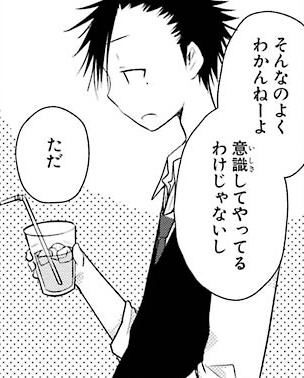
Hase asks Kujou if he’s always been so detached, and Kujou answers そんなのよくわかんねーよ, “I don’t really know about that stuff.” Undo it in steps: わからない → わかんない → わかんねー.
Example 7 of 7: Not even an air conditioner with 〜さえ
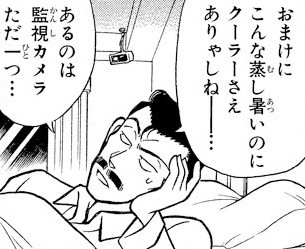
Kogoro, Ran, and Conan are guests on a Sherlock Holmes fan tour at a pension. At four in the morning, Kogoro lies awake grumbling that the room has no TV, no phone, and no newspaper.
小五郎:
「おまけにこんな蒸し暑いのにクーラーさえありゃしねー…」
“And on top of that, it's this muggy and there isn't even an air conditioner…”
Kogoro lies awake in a muggy pension room and grumbles that there isn’t even an air conditioner: クーラーさえありゃしねー. Undo it in steps: ありはしない → ありゃしない → ありゃしねー. ありは runs together into ありゃ, and ない becomes ねー.