Hypothetical condition with 〜ば Grammar: Condition » 〜ば
〜ば states the condition under which something holds: “if A, then B” . It often puts the focus on A as what it takes to get B.
It suits general statements, advice, and wishes. For example, 聞( き ) けば分( わ ) かる means “if you ask, you’ll understand”.
Usage Notes For godan verbs, shift the final sound to the え row and add ば (読( よ ) む → 読( よ ) めば). Ichidan verbs drop る and add れば (見( み ) る → 見( み ) れば). い-adjectives drop い and add ければ (高( たか ) い → 高( たか ) ければ); いい becomes よければ. する becomes すれば, and 来( く ) る becomes 来( く ) れば. Negatives replace ない with なければ. Nouns and な-adjectives use なら, the conditional form of だ (ならば in full), or であれば in more formal speech.
ば often focuses on what condition would produce a result. That makes it natural in どうすれば “what should I do”, advice with ばいい, and regrets with ばよかった.
When the ば clause describes an action, the main clause usually can’t be a request, command, invitation, or statement of intent. Say 駅( えき ) に着( つ ) いたら電話( でんわ ) してください, not 駅( えき ) に着( つ ) けば. When the ば clause describes a state (ある, いる, adjectives, potential verbs, negatives), these are fine: 分( わ ) からなければ電話( でんわ ) してください.
ば is not normally used to narrate a single past event. With a past-tense main clause, it describes something that didn’t happen (もっと早( はや ) く来( く ) れば間( ま ) に合( あ ) ったのに, “if I’d come earlier, I’d have made it”) or something that always happened.
In casual speech, れば often becomes りゃ and なければ becomes なけりゃ or なきゃ. How casual contractions work covers these. Set phrases built on ば, such as によれば “according to” and ば〜ほど “the more… the more”, have their own pages.
Formation View formation details Godan verb (え-row) + ば 先生( せんせい ) に聞( き ) けば 、分( わ ) かるよ"If you ask the teacher, you'll understand." Ichidan verb (drop る) + れば 毎日( まいにち ) 続( つづ ) ければ 、上手( じょうず ) になる"If you keep at it every day, you'll get good." い-adjective (drop い) + ければ 高( たか ) ければ 、買( か ) わない"If it's expensive , I won't buy it." Verb (ない-form, drop ない) + なければ 今( いま ) 行( い ) かなければ 、間( ま ) に合( あ ) わない"If we don't go now, we won't make it." Noun / な-adjective + なら・であれば 学生( がくせい ) であれば 、無料( むりょう ) です"If you're a student , it's free." 〜ばいい (advice) 困( こま ) ったら、私( わたし ) に言( い ) えばいい "If you're in trouble, you can just tell me." 〜ばよかった (regret) もっと早( はや ) く来( く ) ればよかった "I should have come earlier." What It Takes ば names a condition and what follows from it. Often the speaker wants the result, and the ば clause says what it would take to get there.
Example 1 of 2: Might appear bigger with 〜かもしれない Example 1 of 2
ご注文はうさぎですか? » Volume 1 » Page 81Due to Chino’s concerns about her height, Rize suggests a solution.
リゼ: 「声( こえ ) が大( おお ) きければ存在( そんざい ) も大( おお ) きく見( み ) えるかもしれない」 “If your voice is loud, your presence might seem bigger too.” チノ: 「錯覚( さっかく ) ですか」 “An optical illusion?” Challenge Yourself Show translation
Challenge
What does リゼ mean in the highlighted line?
リゼ: 「声( こえ ) が大( おお ) きければ存在( そんざい ) も大( おお ) きく見( み ) えるかもしれない 」 チノ: 「錯覚( さっかく ) ですか」 Clues かもしれない かもしれない keeps Rize's proposal uncertain What does the speaker mean? If your voice is loud, your presence might seem bigger too. Rize suggests that a louder voice might make Chino's presence seem bigger, but she does not promise that it will work. Rize promises that a loud voice will make Chino physically taller. The highlighted form is かもしれない. Here かもしれない keeps Rize's proposal uncertain, so this choice does not match the Japanese. Rize says a quieter voice might make Chino seem bigger. The highlighted form is かもしれない. Here かもしれない keeps Rize's proposal uncertain, so this choice does not match the Japanese. Rize says Chino already has a loud and commanding presence. The highlighted form is かもしれない. Here かもしれない keeps Rize's proposal uncertain, so this choice does not match the Japanese.
かもしれない keeps Rize’s proposal uncertain. Rize suggests that a louder voice might make Chino’s presence seem bigger, but she does not promise that it will work.
View Full Example Chino worries about being small. Rize names a condition that might help: if her voice is loud, her presence might seem bigger. かもしれない keeps the result uncertain.
Example 2 of 2: Keeping still while her ribbon dries with 〜間 Example 2 of 2
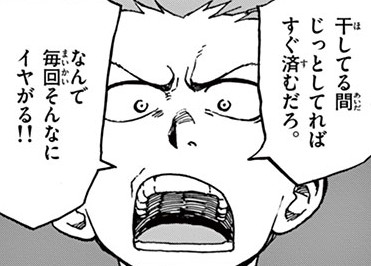
ふだつきのキョーコちゃん » Volume 5 » Page 80Kyouko’s ribbon needs to be washed. Since she is a jiāngshī (vampire), she will uncontrollably attack people to drink their blood when her ribbon is removed. For this reason, her brother tries to tie her up with a rope. Kyouko hides in the bathroom, then sneaks out the window only to find Kenji waiting outside.
ケンジ: 「干( ほ ) してる間( あいだ ) じっとしてれば すぐ済( す ) むだろ。」 “While it's drying, if you'd just keep still it'd be over soon.” ケンジ: 「なんで毎回( まいかい ) そんなにイヤがる!!」 “Why do you seem to hate it so much every time?!” Challenge Yourself Show translation
Challenge
What does Kenji say Kyouko should do while the ribbon dries?
ケンジ: 「干( ほ ) してる間( あいだ ) 済( す ) むだろ。」 ケンジ: 「なんで毎回( まいかい ) そんなにイヤがる!!」 Clues 干( ほ ) してる間( あいだ ) during the time the ribbon is drying じっとしてればすぐ済( す ) む if she keeps still, the problem will be over soon What does the speaker mean? Keep still until it finishes drying. 間( あいだ ) sets the drying period, and じっとしてれば makes staying still the condition for getting through it quickly. Leave through the window while it is wet. Kenji tells Kyouko to remain still during the drying period, not use it as a chance to escape. Hold the ribbon in place with her hands. The condition is じっとしてれば, simply keeping still. The line does not ask her to hold the ribbon. Wash the ribbon again before it dries. The ribbon is already drying. Kenji says the situation will soon be finished if Kyouko waits. Tie Kenji up so he cannot interfere. Kenji wants Kyouko restrained while the ribbon is off. He does not tell her to restrain him. Check the ribbon every few minutes. Kenji's instruction is to stay still while it dries, not repeatedly inspect it.
Kenji says Kyouko only needs to keep still while the ribbon dries. The time span is marked by 間( あいだ ) , and してれば makes her cooperation the condition for the ordeal ending quickly.
View Full Example Kenji tells Kyouko that all she has to do is keep still while the ribbon dries. してれば is casual for していれば.
If Not with 〜なければ なければ means “if not”. It often warns what will happen unless something is done. じゃなきゃ, from じゃなければ (ではなければ), works like “otherwise”.
Example 1 of 2: Deactivating a bomb with 解除 Example 1 of 2
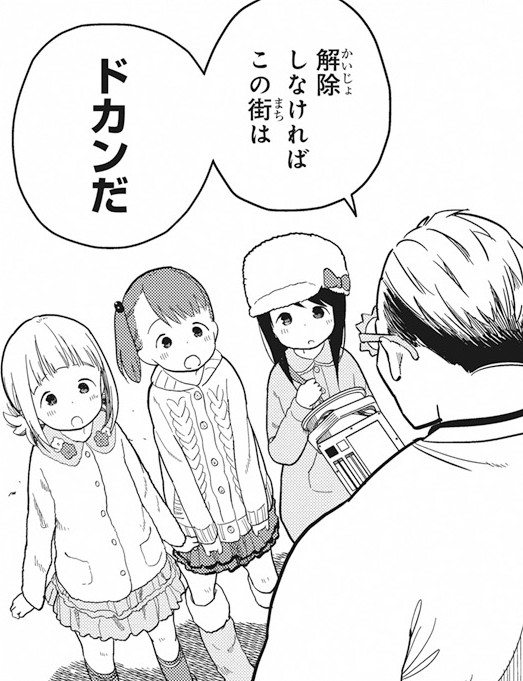
三ツ星カラーズ » Volume 1 » Page 125A shop owner tells the Colors trio that he’s crafted a bomb.
おやじ: 「解除( かいじょ ) しなければ この街( まち ) はドカンだ」 “If you don't deactivate it, this district will go kaboom!” Challenge Yourself Show translation
Challenge
What does Oyaji say will happen if the Colors fail to deactivate the bomb?
おやじ: 「解除( かいじょ ) 街( まち ) はドカンだ」 Clues 解除( かいじょ ) しなければif they do not deactivate it この街( まち ) はドカンだ this district will go kaboom What does the speaker mean? The district will be blown up. しなければ sets failure to deactivate as the condition, and ドカン supplies the explosive result. The district will be safely evacuated. ドカン imitates an explosion. The line says nothing about evacuation. The bomb will deactivate itself. The consequence follows if the Colors do not perform 解除( かいじょ ) , so no automatic deactivation is promised. Oyaji will move the bomb to another district. The threatened result affects この街( まち ) , and no movement is mentioned. The Colors will lose access to their clubhouse. The stated consequence is an explosion in the district, not a clubhouse penalty. Saitou will arrest Oyaji before anything happens. No arrest appears in the condition or result. Oyaji presents the explosion as what follows failure.
Oyaji says that unless the Colors deactivate the bomb, the district will go kaboom. しなければ supplies the negative condition, and ドカン gives the mock-dramatic consequence.
View Full Example The shop owner claims he’s built a bomb. If the girls don’t defuse it, the town goes boom.
Example 2 of 2: Singing one song after another with 連続 Example 2 of 2
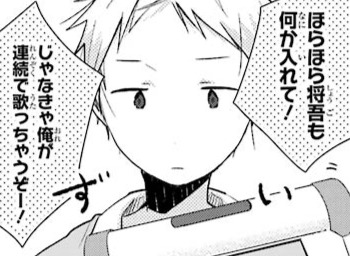
一週間フレンズ。 » Volume 6 » Page 5To distract himself from things going on with Fujimiya, Hase goes to karaoke, bringing Shougo with him.
長谷( はせ ) :「ほらほら将吾( しょうご ) も何( なに ) か入( い ) れて!」 “Come on, come on, Shougo! Put something in, too!” 「じゃなきゃ 俺( おれ ) が連続( れんぞく ) で歌( うた ) っちゃうぞー!」 “Otherwise, I'll just keep singing one after another!” Challenge Yourself Show translation
Challenge
What will Hase do if Shougo does not choose a song?
長谷( はせ ) :「ほらほら将吾( しょうご ) も何( なに ) か入( い ) れて!」 「じゃなきゃ俺( おれ ) が連続( れんぞく ) 歌( うた ) っちゃうぞー!」 Clues じゃなきゃ if not, a casual shortening of じゃなければ 俺( おれ ) が連続( れんぞく ) で歌( うた ) っちゃうぞーI will end up singing continuously, delivered as a teasing warning What does the speaker mean? He will keep choosing and singing songs himself. 俺( おれ ) が makes Hase the singer, and 連続( れんぞく ) で says he will sing songs without a break. He will stop the karaoke session immediately. 歌( うた ) っちゃう predicts that Hase will sing, not that he will end the session. He will choose a song and make Shougo sing it. 俺( おれ ) が identifies Hase as the person who will sing. He will wait silently until Shougo makes a choice. Hase warns that he will fill the gap by singing continuously, not wait in silence. He will ask Shougo to sing a duet with him. The line says 俺( おれ ) が, and there is no word that includes both of them as singers. He will leave because he cannot think of another song. Hase sounds ready to keep singing. The line does not mention leaving or running out of songs.
Hase tells Shougo to put in a song. Otherwise, Hase will keep singing one after another himself. ぞー turns the prediction into a playful warning.
View Full Example Hase wants Shougo to pick a karaoke song. じゃなきゃ means “otherwise” (literally “if not”), so the threat is that Hase will sing song after song himself.
Asking What to Do with どうすれば どうすれば is a common way to ask what’s needed: “what should I do?” It often continues with いい. どうしたら works too.
Just Do This with 〜ばいい ばいい presents the needed action as simple and enough on its own: “you can just…” or “all I have to do is…”.
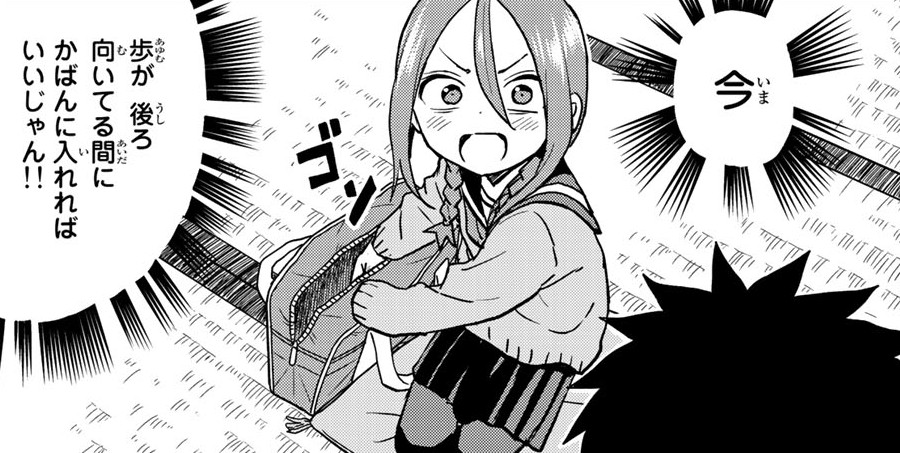
それでも歩は寄せてくる » Volume 4 » Page 91Urushi prepared chocolate to give Ayumu for Valentine’s Day but is too nervous to give it to him. After the two play shogi during their club, Ayumu turns away from Urushi as he puts the shogi table away.
うるし: 「今( いま ) 。歩( あゆむ ) が 後( うし ) ろ向( む ) いてる間( あいだ ) にかばんに入( い ) れればいいじゃん “Now! While Ayumu's back is turned, I can just put it into his satchel!” Challenge Yourself Show translation
Challenge
What plan does Urushi form for giving Ayumu the chocolate?
うるし: 「今( いま ) 。歩( あゆむ ) が 後( うし ) ろ向( む ) いてる間( あいだ ) に入( い ) れればいいじゃん!!」 Clues 歩( あゆむ ) が後( うし ) ろ向( む ) いてる間( あいだ ) に"while Ayumu is facing away," marking the brief opportunity かばんに入( い ) れればいいじゃん "I can just put it in his bag," presenting the plan as an easy solution. What does the speaker mean? Slip the chocolate into Ayumu's bag while his back is turned. The 〜間( あいだ ) に clause gives the window while Ayumu faces away, and かばんに入( い ) れる names Urushi's planned action. Hand him the chocolate after he finishes putting away the table. Urushi plans to avoid handing it to him directly by using the moment when he cannot see her. Hide the chocolate in her own bag until the next day. The bag belongs to Ayumu in context, and she wants to put the chocolate into it now. Ask Ayumu to turn around so she can confess. She takes advantage of his back already being turned. She does not ask him to face her. Place the chocolate on the shogi table before he moves it. The location in her plan is かばんに, in his bag, not on the table. Wait until Ayumu leaves the clubroom completely. The opportunity is the shorter interval while he is facing away, not after he leaves.
Urushi sees an opening while Ayumu is facing away. During that 間( あいだ ) , she plans to put the chocolate into his bag without having to give it to him face to face.
View Full Example Urushi is too nervous to hand Ayumu her Valentine’s chocolate. She hits on an easy way out: she can just slip it into his bag while his back is turned.
Requests and Wishes After a State When the ば clause describes a state, such as できる “can”, ある, or an adjective, the main clause can be a request or wish. できれば, “if possible”, softens a request this way.
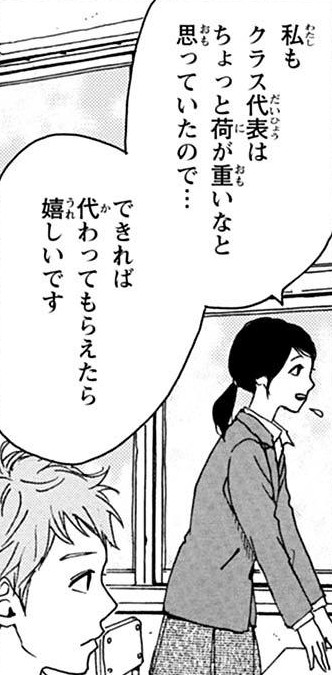
orange » Volume 3 » Page 121Takako and Azu tell their teacher they want to participate in the sports day relay race. The teacher points out that participants have already been decided, then one of the decided participants chimes in.
生徒( せいと ) :「私( わたし ) もクラス代表( だいひょう ) はちょっと荷( に ) が重( おも ) いなと思( おも ) っていたので…」 “I was also thinking I have too much on my plate as class representative.” 「できれば 代( か ) わってもらえたら嬉( うれ ) しいです」 “If possible, I'd be happy if someone could take my place.” Challenge Yourself Show translation
Challenge
Why would the student be happy to switch out?
生徒( せいと ) :「私( わたし ) もクラス代表( だいひょう ) はちょっと荷( に ) が重( おも ) い思( おも ) っていたので…」 「できれば代( か ) わってもらえたら嬉( うれ ) しいです」 Clues クラス代表( だいひょう ) は as for being class representative ちょっと荷( に ) が重( おも ) い a little too much to handle 〜と思( おも ) っていたので because she had been thinking that 代( か ) わってもらえたらif she could have someone replace her What does the speaker mean? The class representative role already feels like more responsibility than she can handle. 荷( に ) が重( おも ) い describes a burden that feels too great. ので connects that concern to her wish for someone to replace her. The relay equipment is physically too heavy for her to carry. 荷( に ) が重( おも ) い is figurative here. Its topic is the class representative role, not sports equipment. She wants to keep her role and add the relay duties as well. 代( か ) わってもらえたら asks for someone to take her place. She is not asking to keep both responsibilities. She thinks another student is too unreliable to represent the class. The speaker describes the role as too burdensome for herself. She does not criticize anyone else's ability. She has already been removed from the representative role. She speaks conditionally about how happy she would be if someone replaced her. The switch has not happened yet. She wants a partner to help her without changing who represents the class. 代( か ) わる means to take someone's place. Her request is for a replacement, not an assistant.
The student uses 荷( に ) が重( おも ) い figuratively for a responsibility she finds too demanding. Because the class representative role already feels like too much, she would welcome someone taking her place.
View Full Example One of the students already picked for the relay speaks up. できれば, a set phrase for “if possible”, uses the potential できる, a state, so it can come before a request. The request itself is softened with たら and 嬉( うれ ) しいです.
Regrets and Complaints With よかった, ば looks back at something that didn’t happen: “should have”. Aimed at someone else, it says what they should have done, which can sound critical. ばいいのに and ばいいものを complain that things aren’t the way the speaker wants. In a complaint, a ば clause left trailing can mean “if only”.
Example 1 of 3: Because her teaching method is unreliable with 〜ので Example 1 of 3
ご注文はうさぎですか? » Volume 1 » Page 87At a library study session, Syaro is astonished to learn Cocoa’s the one tutoring Chiya.
シャロ: 「それならココアがチノちゃんに教( おし ) えてあげればよかった “Then shouldn't you have taught Chino yourself, Cocoa?” チノ: 「ココアさんは教( おし ) え方( かた ) がアレなので頼( たよ ) りになりません」 “Cocoa is unreliable because of her method of teaching.” Challenge Yourself Show translation
Challenge
What does チノ mean in the highlighted line?
シャロ: 「それならココアがチノちゃんに教( おし ) えてあげればよかったんじゃない?」 チノ: 「ココアさんは教( おし ) え方( かた ) がアレなので 頼( たよ ) りになりません」 Clues なので アレなので gives the reason Cocoa is unreliable What does the speaker mean? Cocoa is unreliable because of her method of teaching. Chino avoids a blunt criticism with アレ, so アレなので means "because her teaching method is, well, like that". Chino says Cocoa is unreliable because she lacks knowledge of the subject. The highlighted form is なので. Here アレなので gives the reason Cocoa is unreliable, so this choice does not match the Japanese. Chino says Cocoa's teaching method makes her especially dependable. The highlighted form is なので. Here アレなので gives the reason Cocoa is unreliable, so this choice does not match the Japanese. Chino criticizes Syaro's teaching method rather than Cocoa's. The highlighted form is なので. Here アレなので gives the reason Cocoa is unreliable, so this choice does not match the Japanese.
アレなので gives the reason Cocoa is unreliable. Chino avoids a blunt criticism with アレ, so アレなので means “because her teaching method is, well, like that”.
View Full Example At a study session, Syaro asks whether Cocoa should have been the one to teach Chino. あげればよかったんじゃない? is “wouldn’t it have been better if you’d taught her?” It’s about Cocoa’s choice, not Syaro’s own regret: a hindsight suggestion, framed as a question with んじゃない?.
Example 2 of 3: Demolishing the movie theater with 解体 Example 2 of 3
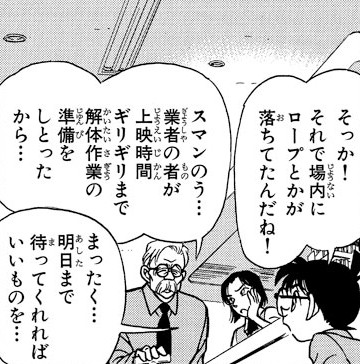
名探偵コナン » Volume 23 » Page 12Conan and his friends go to the theater to see a movie. There, they discover this is the last day before the theater closes.
コナン: 「そっか!それで場内( じょうない ) にロープとかが落( お ) ちてたんだね!」 “Oh, I see! That's why there were ropes and stuff lying around the venue!” オーナー: 「スマンのう… 業者( ぎょうしゃ ) の者( もの ) が上映( じょうえい ) 時間( じかん ) ギリギリまで解体( かいたい ) 作業( さぎょう ) の準備( じゅんび ) をしとったから…」 “Sorry about that... The contractor's crew was rushing to get the dismantling ready right up until showtime...” スタッフ: 「まったく… 明日( あした ) まで待( ま ) ってくれればいいものを …」 “Honestly... They could've at least waited until tomorrow...” Challenge Yourself Show translation
Challenge
Why were ropes and other materials lying around the theater?
コナン: 「そっか!それで場内( じょうない ) にロープとかが落( お ) ちてたんだね!」 オーナー: 「スマンのう… 業者( ぎょうしゃ ) の者( もの ) が上映( じょうえい ) 時間( じかん ) ギリギリまで解体( かいたい ) 作業( さぎょう ) の準備( じゅんび ) をしとったから…」 スタッフ: 「まったく… 明日( あした ) まで待( ま ) ってくれればいいものを…」 Clues 解体( かいたい ) 作業( さぎょう ) の準備( じゅんび ) preparations for demolition work 上映( じょうえい ) 時間( じかん ) ギリギリまでright up until showtime What does the speaker mean? Contractors had been preparing to demolish the theater until showtime. The owner connects the materials to last-minute preparations for 解体( かいたい ) 作業( さぎょう ) . The staff had decorated the theater for a festival. The materials belonged to demolition preparations, not decorations. The audience brought ropes for the final screening. The owner says the contractor's crew left them during its work. Workers had finished rebuilding the theater. 解体( かいたい ) means dismantling or demolition, not reconstruction. The ropes were clues deliberately planted by Conan. Conan notices them and then learns their practical source from the owner. The staff planned to move the screening outside. The issue is demolition work being prepared too close to the screening time.
The contractor’s crew had been preparing the theater for demolition right up until showtime. That work explains the ropes and other materials left inside.
View Full Example On the theater’s last day, the contractors were preparing the demolition right up until showtime. The staff member grumbles that they could have waited until tomorrow. ものを adds the complaint: they didn’t.
Example 3 of 3: Bus pickup and drop off with 送迎 Example 3 of 3
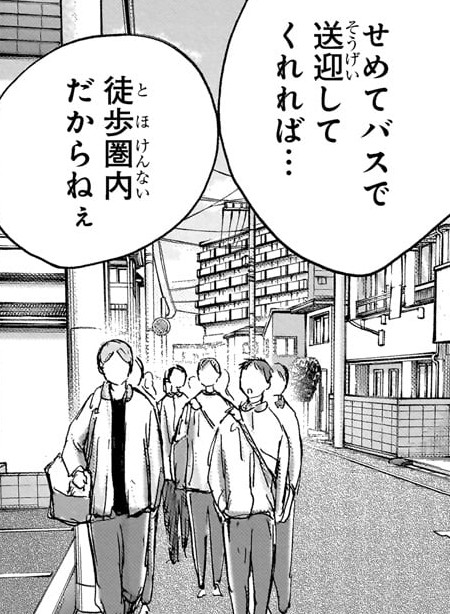
アオのハコ » Volume 10 » Page 182After school, the girls’ basketball team walks to the location where they’re practicing for an upcoming match.
生徒: 「せめてバスで送迎( そうげい ) してくれれば …」 “If only they'd at least provide a bus to pick us up and drop us off” 生徒: 「徒歩( とほ ) 圏内( けんない ) だからねぇ」 “It's within walking distance, after all.” Challenge Yourself Show translation
Challenge
What does the first student wish someone would provide?
生徒: 「せめてバスで送迎( そうげい ) 生徒: 「徒歩( とほ ) 圏内( けんない ) だからねぇ」 Clues せめて at least, presenting this as a minimum request 〜で送迎( そうげい ) してくれれば… if only they would provide pickup and drop-off transportation by that means What does the speaker mean? A bus to pick the team up and drop them off. 〜で marks the bus as the means of travel, and 送迎( そうげい ) する covers taking the team there and bringing them back. Permission for the team to walk to practice. Walking distance appears in the reply as the reason no shuttle is provided. It is not the first student's request. A bus that the team members can drive themselves. 〜てくれれば asks for someone else to provide the transportation. The students are not offering to drive. Someone to escort the team on foot. The requested 送迎( そうげい ) is explicitly by bus, not an escort for the walk. A shorter route within walking distance. The second student says the destination is already within walking distance. The wish is for transportation anyway. A different place where the team can practice. The line asks for pickup and drop-off service. It does not propose changing the practice location.
The first student wishes the team had a bus shuttle. せめて frames that as the least the school could do, while 送迎( そうげい ) includes both pickup and drop-off.
View Full Example The team has to walk to practice. The ば clause trails off, leaving out something like いいのに: “if only they’d at least send a bus”.