If that's the case with なら
Grammar: Condition » なら
なら expresses a hypothetical condition or introduces a topic.
Usage Notes
なら follows a noun directly, or the plain form of a clause, often as のなら (casual んなら).
Unlike たら, the なら clause doesn’t need to happen first: 「行( い ) くなら車( くるま ) で行( い ) け」 “if you’re going (at some point), go by car”; even though going is mentioned first, the advice applies before the going occurs.
After a bare noun, なら simply sets that noun up as the topic under discussion: 「寿司( すし ) なら、あの店( みせ ) がいい」 “if it’s sushi (you want), that shop is good”.
Formation
View formation details
Noun + なら
温泉( おんせん ) なら 、北海道( ほっかいどう ) がいい"If it's hot springs you're after, Hokkaido is good."
Verb (plain form) + なら
そんなに眠( ねむ ) いなら 、寝( ね ) なさい
"If you're that sleepy , go to bed."
Clause + の + なら
行( い ) くなら 、早( はや ) く行( い ) こう"If we're going , let's go soon."
Note: In casual speech, のなら contracts to んなら.
それなら (picking up the conversation)
それ なら 心配( しんぱい ) いらないよ"In that case , there's no need to worry."
Responding to What Someone Said
三ツ星カラーズ »
Volume 1 » Page 6
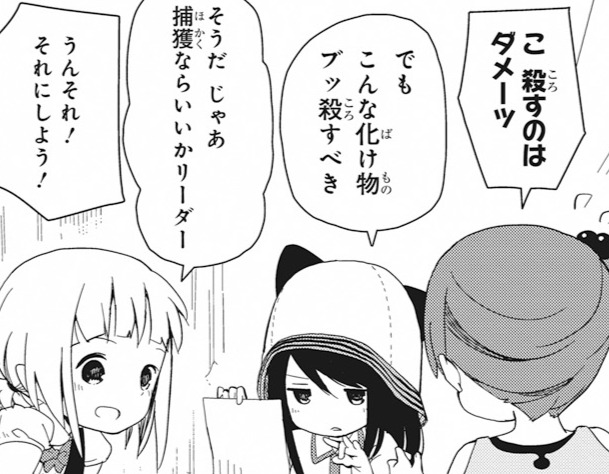
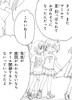
Yui, Sacchan, and Kotoha are friends who’ve formed a group called Colors to protect their neighborhood. Yui is the group’s leader.
Yui hurries to the Colors clubhouse with news of a cat she saw. She draws it on paper, but Sacchan sees it as the sketch of a monster. Kotoha looks over the drawing and asks if they’re going to kill it.
結衣( ゆい ) :「こ 殺( ころ ) すのはダメーッ」
“K-killing it is not okay!”
琴葉( ことは ) :「でも こんな化( ば ) け物( もの ) ブッ殺( ころ ) すべき」
“But a monster like this should be killed.”
さっちゃん:
「そうだ じゃあ捕獲( ほかく ) なら いいかリーダー」
“Right. Then is capturing it okay, Leader?”
結衣( ゆい ) :「うんそれ!それにしよう!」
“Yeah, that! Let's do that!”
Challenge Yourself
Show translation
Challenge
What does Kotoha think they should do with the supposed monster?
Clues
こんな化( ば ) け物( もの )
a monster like this
ブッ殺( ころ ) すべき
should kill it, stated as a blunt judgment
What does the speaker mean?
Kill it.
ブッ殺( ころ ) す names the violent action, and べき says Kotoha judges it to be the right course.
Capture it without harming it.
Capture is Sacchan's later compromise. Kotoha's original proposal uses 殺( ころ ) す.
Ask Officer Saitou to identify it.
Kotoha states what should be done to the monster. She does not ask for identification.
Leave it alone because it may be harmless.
こんな化( ば ) け物( もの ) frames it as threatening, and べき presses for action.
Let Yui decide after drawing it again.
Kotoha gives her own direct judgment. She does not defer the decision or request another drawing.
Turn it into the Colors' new leader.
The line calls it a monster and says it should be killed, not given a role.
Kotoha bluntly says that a monster like the one in Yui’s drawing should be killed. Sacchan then proposes capture instead, which Yui accepts.
View Full Example
Sacchan responds to Yui’s ban on killing by using 捕獲( ほかく ) なら to propose capturing the creature instead.
ご注文はうさぎですか? »
Volume 1 » Page 85
When Syaro is invited to study at the library with the others, she considers Rize may praise her for helping the others.
シャロ:
「そ そんなに言( い ) うなら 教( おし ) えてあげてもいいかなー」
“I-if you insist that much, maybe I could teach you if that's okay.”
ココア:
「そこまでは言( い ) ってないよ!」
“I didn't say all that!”
Challenge Yourself
Show translation
Challenge
What does シャロ mean in the highlighted line?
Clues
教( おし ) えてあげてもいいてもいい softens the offer
What does the speaker mean?
I-if you insist that much, maybe I could teach you if that's okay.
教えてあげる by itself can sound very direct or self-important.
Syaro demands that the others let her teach them.
The highlighted form is 教( おし ) えてあげてもいい. Here てもいい softens the offer, so this choice does not match the Japanese.
Syaro refuses to teach no matter how much they ask.
The highlighted form is 教( おし ) えてあげてもいい. Here てもいい softens the offer, so this choice does not match the Japanese.
Syaro asks Cocoa to teach the group instead.
The highlighted form is 教( おし ) えてあげてもいい. Here てもいい softens the offer, so this choice does not match the Japanese.
てもいい softens the offer. 教えてあげる by itself can sound very direct or self-important.
View Full Example
Syaro’s そんなに言( い ) うなら turns the others’ urging into the condition for her offer, giving the line the coy sense “if you insist.”
Narrowing the Topic or Scope
ご注文はうさぎですか? »
Volume 1 » Page 8
Seeing Syaro handing out advertisement fliers. When Syaro says she can’t go home until she’s done with them, Cocoa likens her to the fabled little match girl.
ココア:
「そんなにチラシ燃( も ) やしたかった?」
“Did you really want to burn the fliers that badly?”
「マッチなら あるよ」
“I've got some matches.”
シャロ:
「そういう意味( いみ ) じゃない」
“That's not what I meant.”
Challenge Yourself
Show translation
Challenge
What does ココア mean in the highlighted line?
Clues
燃( も ) やしたかった燃( も ) やしたかった = "wanted to burn"
What does the speaker mean?
Did you really want to burn the fliers that badly?
燃( も ) やしたかった is the past form of 燃( も ) やしたい: "wanted to burn".
Cocoa understands that Syaro wants to finish distributing the fliers.
The highlighted form is 燃( も ) やしたかった. Here 燃( も ) やしたかった = "wanted to burn", so this choice does not match the Japanese.
Cocoa offers matches because Syaro wants to light the street.
The highlighted form is 燃( も ) やしたかった. Here 燃( も ) やしたかった = "wanted to burn", so this choice does not match the Japanese.
Cocoa's interpretation is correct, and Syaro agrees that she wants to burn them.
The highlighted form is 燃( も ) やしたかった. Here 燃( も ) やしたかった = "wanted to burn", so this choice does not match the Japanese.
燃( も ) やしたかった = “wanted to burn”. 燃( も ) やしたかった is the past form of 燃( も ) やしたい: “wanted to burn”.
View Full Example
Cocoa uses マッチなら to limit her offer to the topic of matches: “if matches are what you need, I have some.”
それでも歩は寄せてくる »
Volume 4 » Page 46
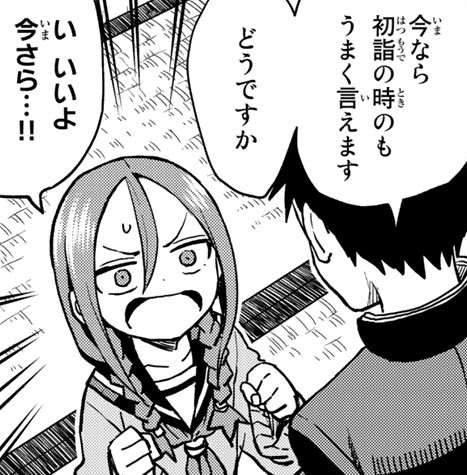
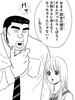
Ayumu heavily compliments Urushi on her looks wearing a sweater that’s a little too big. He quietly congratulates himself, and when Urushi questions him on it, Ayumu explains that he’s regretted his inability to find the words to compliment her outfit during their New Year’s shrine visit.
歩( あゆむ ) :「今( いま ) なら 初詣( はつもうで ) の時( とき ) のもうまく言( い ) えます。どうですか」
“I can properly say it now for the New Year's shrine visit. How about it?”
うるし:
「い いいよ。 今( いま ) さら…!!」
“It's okay. It's too late!”
Challenge Yourself
Show translation
Challenge
Why does Urushi reject Ayumu's compliment with 今( いま ) さら?
Clues
今( いま ) なら初詣( はつもうで ) の時( とき ) のもうまく言( い ) えますAyumu says he can now properly express the compliment from the shrine visit
いいよ。今( いま ) さら…!!
"It is fine. It is too late now," refusing because the proper moment has passed.
What does the speaker mean?
The shrine-visit moment for that compliment has already passed.
Ayumu contrasts 今( いま ) with 初詣( はつもうで ) の時( とき ) , and Urushi's 今( いま ) さら says the delayed compliment comes too late.
She thinks the compliment is false because her current outfit is different.
Her objection is the late timing, not a claim that Ayumu is lying.
She wants him to repeat the compliment at the next shrine visit.
いいよ and 今( いま ) さら stop the delayed compliment rather than reschedule it.
She has forgotten what she wore at the shrine.
Urushi recognizes exactly which missed moment Ayumu means.
She is upset that he complimented the sweater too early.
今( いま ) さら means the opposite. The relevant timing is already too far in the past.
She believes compliments should never be said directly.
Her response is tied to this compliment's delay, not a general rule against compliments.
Ayumu says he can finally express what he failed to say during the New Year’s shrine visit. Urushi answers 今( いま ) さら because that was the moment when the compliment belonged, and it has long since passed.
View Full Example
Ayumu’s 今( いま ) なら limits his claim to the present, when he can give the compliment he failed to express during the shrine visit.
Reasoning with それなら
名探偵コナン »
Volume 1 » Page 139
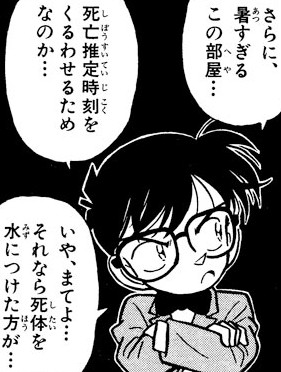
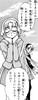
Upon walking in on a murder scene, Conan goes right to work making observations about the blood-covered body and its surroundings. He notes how the room is torn apart save for one upright chair beside the deceased.
コナン:
「さらに、暑( あつ ) すぎるこの部屋( へや ) …」
“Furthermore, this room is too warm...”
「死亡推定時刻( しぼうすいていじこく ) をくるわせるためなのか…」
“Is it to confuse the estimated time of death...?”
「いや、まてよ… それなら 死体( したい ) を水( みず ) につけた方( ほう ) が…」
“No, wait... If that's the case, it would be better to put the corpse in water...”
Challenge Yourself
Show translation
Challenge
What possible purpose does Conan consider for the overheated room?
Clues
暑( あつ ) すぎるこの部屋( へや ) this room that is too hot
死亡推定時刻( しぼうすいていじこく ) をくるわせるためなのかperhaps to throw off the estimated time of death
What does the speaker mean?
To distort the estimated time of death.
Conan explicitly considers whether the heat was meant to confuse the death-time estimate.
To make the victim leave the room voluntarily.
Conan connects the temperature to forensic timing, not to driving someone outside.
To melt the murder weapon.
No melting weapon is mentioned. The possible target is the estimated time of death.
To dry water from the floor.
Water appears only in Conan's alternative thought about the body.
To conceal the smell of poison.
The line considers heat as a way to alter the apparent death time.
To keep the investigators comfortable.
The room is 暑( あつ ) すぎる, excessively hot, and Conan treats that as suspicious.
Conan briefly suspects that someone overheated the room to disrupt the estimated time of death. He then questions the theory and considers another method.
View Full Example
Conan uses それなら to treat the heated-room theory as a premise, then reasons that putting the body in water would work better.
Advice That Precedes the Condition
ご注文はうさぎですか? »
Volume 1 » Page 105
Before Cocoa teaches Rize how to swim, Syaro stops her with a suggestion.
シャロ:
「泳( およ ) ぐなら 念( ねん ) のため軽( かる ) くストレッチした方( ほう ) がいいと思( おも ) うの」
“If you're going to swim, I think you had better do some light stretching just in case.”
ココア:
「さすがシャロちゃん」
“That's Syaro for you.”
Challenge Yourself
Show translation
Challenge
What does シャロ mean in the highlighted line?
Clues
軽( かる ) くストレッチした方( ほう ) がいいストレッチした方( ほう ) がいい gives advice
What does the speaker mean?
If you're going to swim, I think you had better do some light stretching just in case.
Syaro recommends stretching before swimming; she does not compare two literal directions.
Syaro says everyone has already finished stretching.
The highlighted form is 軽( かる ) くストレッチした方( ほう ) がいい. Here ストレッチした方( ほう ) がいい gives advice, so this choice does not match the Japanese.
Syaro advises the group not to swim at all.
The highlighted form is 軽( かる ) くストレッチした方( ほう ) がいい. Here ストレッチした方( ほう ) がいい gives advice, so this choice does not match the Japanese.
Syaro asks Cocoa to teach her how to stretch.
The highlighted form is 軽( かる ) くストレッチした方( ほう ) がいい. Here ストレッチした方( ほう ) がいい gives advice, so this choice does not match the Japanese.
ストレッチした方( ほう ) がいい gives advice. Syaro recommends stretching before swimming; she does not compare two literal directions.
View Full Example
Syaro uses 泳( およ ) ぐなら to make swimming the condition for her advice, even though the stretching needs to happen before anyone swims.
Casual んなら
よつばと! »
Volume 10 » Page 76
During Jumbo’s visit, Yotsuba tells him she made pancakes earlier.
よつば:
「まだちょっとのこってる!チンしてたべるか!?」
“There's some left over! Shall I heat it up to up to eat?”
ジャンボ:
「おう。よつばが作( つく ) ったんなら 食( た ) べなきゃな」
“Sure. If you made them, I have to eat some.”
Challenge Yourself
Show translation
Challenge
What does Yotsuba offer Jumbo?
Clues
まだちょっとのこってる
a little of the pancakes remains
チンしてたべるか!?
asks whether to microwave the leftovers and eat them
What does the speaker mean?
Microwave the leftover pancakes for him to eat.
のこってる establishes the leftovers, and チンして means heating them in the microwave before eating.
Cook a fresh batch of pancakes from scratch.
Yotsuba says some remain and offers to reheat them, not make new pancakes.
Let Jumbo take the cold leftovers home.
The offer includes チンして, heating the food now, rather than packing it up cold.
Eat the pancakes herself before Jumbo can try them.
Yotsuba directs the offer to Jumbo, and his reply says he will eat them because she made them.
Throw away the small amount that remains.
The remaining pancakes make the offer possible. Yotsuba proposes eating them, not discarding them.
Teach Jumbo how to use the microwave.
チンして describes what Yotsuba will do with the food. It is not a lesson about the appliance.
Yotsuba has a small amount of pancake left and offers to heat it in the microwave for Jumbo. チンする is casual slang for microwaving food.
View Full Example
Jumbo’s よつばが作( つく ) ったんなら reacts to Yotsuba’s news that she made the pancakes. んなら is the conversational contraction of のなら.
アオハライド »
Volume 8 » Page 123
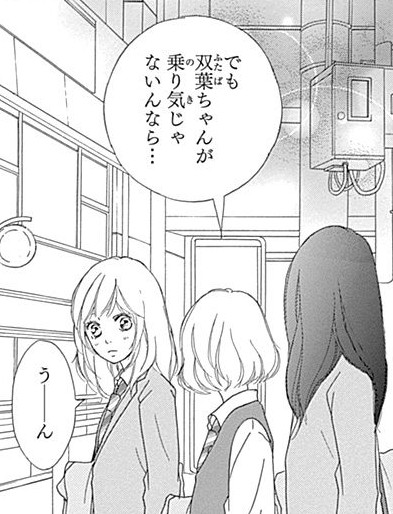
Kikuchi asks Futaba out. He says if she prefers, they can invite their friends along as well.
After school, Futaba brings it up with her friends. Yuuri says she’ll go if Kikuchi’s friend Uramiya is there.
悠里( ゆうり ) :「でも双葉( ふたば ) ちゃんが乗( の ) り気( き ) じゃないんなら …」
“But if you're not interested...”
双葉( ふたば ) :「うーーーん」
“Mm...”
Challenge Yourself
Show translation
Challenge
What is Yuuri uncertain about?
Clues
双葉( ふたば ) ちゃんが乗( の ) り気( き ) じゃないFutaba is not interested or eager to take part
〜んなら…
if that is the case, trailing off before stating the consequence
What does the speaker mean?
Whether Futaba actually wants to join the outing.
乗( の ) り気( き ) じゃない means not being interested in taking part, and んなら makes Futaba's interest the condition Yuuri is considering.
Whether Kikuchi has already canceled the outing.
Yuuri's condition concerns Futaba's 乗( の ) り気( き ) , not a decision made by Kikuchi.
Whether Futaba wants Yuuri to go without her.
Yuuri has not reached that conclusion. She first checks whether Futaba herself is interested.
Whether Uramiya knows that Futaba invited everyone.
The line does not discuss what Uramiya knows. It focuses on Futaba's willingness to go.
Whether the group has chosen a place to meet.
No place or meeting time appears in the line. 乗( の ) り気( き ) concerns enthusiasm for the plan.
Whether Futaba dislikes Yuuri's choice of friends.
じゃない negates Futaba's interest in the outing. It does not express dislike of anyone in the group.
Yuuri senses that Futaba may not be eager to go and leaves her thought unfinished. 乗( の ) り気( き ) describes willingness to take part, while んなら frames that willingness as the condition for what Yuuri might say next.
View Full Example
Yuuri attaches んなら to 乗( の ) り気( き ) じゃない, “not interested.” She leaves the result unstated, trusting Futaba to understand what her reluctance would mean for the outing.
Supplemental Examples
Try finding this grammar in the following examples: